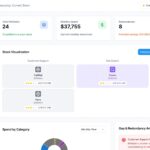










Marketing teams have access to more data than ever before. Every campaign, website visit, email, advertisement, customer interaction, and conversion can generate valuable information. Yet having more data does not automatically make marketing decisions easier.
The real challenge is knowing what the numbers mean.
This is where Martech reporting becomes important. A well-designed reporting process can turn scattered marketing data into information that teams can actually use. Instead of spending hours collecting numbers from different platforms, marketers can focus on understanding performance, identifying opportunities, and improving future campaigns.
Modern Martech reporting is not about creating the biggest dashboard. It is about creating reports that answer useful business questions.
Here are five strategies that can make marketing reporting more meaningful and effective.
1. Connect Reporting With Business Goals
One of the most common reporting problems is focusing too heavily on individual marketing metrics.
Clicks, impressions, website sessions, email opens, and social engagement can all provide useful context. However, these numbers do not always explain whether marketing activity is contributing to business growth.
A better approach is to start reporting with the company’s actual objectives.
For example, if the business wants to increase qualified leads, the reporting process should show more than the number of visitors generated by a campaign. It should also help marketers understand how many visitors became leads, how many leads became opportunities, and how those opportunities contributed to revenue.
This creates a clearer connection between marketing activity and business outcomes.
What to include
A goal-focused Martech report might track:
- Qualified leads
- Conversion rates
- Pipeline contribution
- Customer acquisition cost
- Revenue influenced by marketing
- Campaign-generated opportunities
- Customer retention or expansion
The exact metrics will depend on the business. The important point is that every major metric should have a reason for being in the report.
2. Bring Data From Different Marketing Platforms Together
Marketing technology rarely exists in one place.
A company may use a CRM for customer information, an analytics platform for website activity, an email platform for campaigns, advertising platforms for paid media, and marketing automation software for lead nurturing.
Looking at each platform separately can create an incomplete picture.
For example, an advertising platform might show that a campaign generated hundreds of clicks. The CRM may tell a different part of the story by showing that only a portion of those visitors became qualified leads.
Bringing these data points together allows marketers to see the complete journey instead of isolated channel results.
A unified Martech reporting approach can help teams compare:
Campaign → Visitor → Lead → Opportunity → Customer
This makes it easier to identify where performance is strong and where potential customers are dropping out.
It also reduces the need to manually collect the same information from multiple systems every reporting cycle.
3. Use Attribution to Understand the Customer Journey
Customers rarely make a purchase after interacting with just one marketing channel.
Someone might discover a company through search, read a blog article, see a social media post later, click a retargeting advertisement, and finally submit a form after receiving an email.
So which channel deserves credit?
This is where attribution becomes useful.
Different attribution models can provide different perspectives on the customer journey. First-touch models emphasize the interaction that introduced the customer, while last-touch models focus on the interaction closest to conversion. Multi-touch approaches attempt to distribute credit across several interactions.
No single model can perfectly explain every customer journey.
Instead of treating attribution as an absolute answer, marketers can use it as a way to investigate how different channels and touchpoints contribute to conversion.
Good Martech reporting should therefore show both the conversion outcome and the journey behind it.
This can help marketers ask better questions, such as:
- Which channels introduce new prospects?
- Which interactions help prospects move forward?
- Which campaigns appear repeatedly in successful journeys?
- Where are customers losing interest?
- Which touchpoints need additional testing?
4. Replace Vanity Metrics With Actionable Insights
A report can contain dozens of numbers and still provide very little guidance.
For example, saying that website traffic increased by 25% sounds positive. But marketers still need to know what caused the increase and whether the additional traffic produced meaningful results.
This is why actionable reporting is more valuable than simply reporting activity.
Instead of writing:
“Website traffic increased by 25%.”
A stronger report could investigate:
“Website traffic increased by 25%, primarily from organic search, while the lead conversion rate remained stable. The next step is to identify which new landing pages are attracting qualified visitors.”
The second statement gives the reader something to investigate.
This approach turns Martech reporting from a collection of statistics into a decision-support tool.
Ask three questions
When preparing a marketing report, ask:
- What changed?
- Why did it change?
- What should we investigate or improve next?
These questions encourage teams to look beyond surface-level performance.
5. Automate Reporting Without Losing the Human Perspective
Manual reporting can consume a surprising amount of marketing time.
Teams may spend hours exporting spreadsheets, checking numbers, copying information between documents, and preparing recurring presentations.
Automation can reduce much of this repetitive work.
Marketing teams can use connected platforms and automated dashboards to collect data regularly and present important KPIs in a consistent format.
Automation can also help identify unusual changes. For example, a sudden drop in conversions or unexpected increase in acquisition costs can trigger an alert so the marketing team can investigate sooner.
However, automation should not completely replace human analysis.
A dashboard can show that conversion rates changed. It may not explain whether the reason was a campaign change, landing-page problem, audience shift, tracking issue, seasonality, or something else.
The technology should handle repetitive data collection and organization. Marketers should provide the context.
What Makes Martech Reporting Truly Useful?
Effective reporting is not necessarily about having more charts or adding more metrics.
It is about making information easier to understand.
A useful Martech report should be:
Relevant: It focuses on metrics connected to specific goals.
Consistent: Definitions and measurement methods remain stable over time.
Connected: Data from important marketing systems can be viewed together.
Actionable: The report helps teams identify what deserves attention.
Accessible: Different stakeholders can quickly understand the information they need.
For example, an executive may want a concise view of revenue, pipeline, and marketing efficiency, while a campaign manager may need detailed information about traffic, conversions, audience segments, and channel performance.
The same underlying data can support both audiences when reporting is structured properly.
Common Martech Reporting Mistakes to Avoid
Even sophisticated marketing teams can run into reporting problems.
Some common issues include:
- Tracking too many metrics
- Using inconsistent KPI definitions
- Reporting channel performance without business context
- Relying entirely on one attribution model
- Combining data without checking its quality
- Creating dashboards that are difficult to interpret
- Spending more time preparing reports than analyzing them
Avoiding these problems can make reporting considerably more useful.
The goal is not to create a dashboard that looks impressive. The goal is to create a reporting system that helps people understand marketing performance.
The Future of Martech Reporting
Marketing reporting is moving toward a more connected and intelligent approach.
As marketing platforms become increasingly integrated, teams can combine customer, campaign, behavioral, and revenue data to develop a more complete understanding of performance.
AI can also assist with identifying patterns, summarizing large datasets, detecting unusual changes, and helping marketers explore questions faster. But human judgment remains important because numbers need business context before they can become useful decisions.
The strongest reporting strategy will therefore combine technology, reliable data, and human interpretation.
Final Thoughts
Martech reporting should be more than a monthly collection of charts and numbers.
When reporting connects marketing activity with business goals, combines data from multiple platforms, examines customer journeys, focuses on actionable insights, and uses automation intelligently, it becomes much more valuable to the entire organization.
The biggest transformation is not simply having access to more data.
It is learning how to turn that data into a clearer understanding of what is happening across marketing—and where the team should look next.
For modern marketers, that is the real value of Martech reporting.
Frequently Asked Questions
1. What is Martech reporting?
Martech reporting is the process of collecting and analyzing marketing technology data to understand campaign performance, customer journeys, conversions, and business results.
2. Why is Martech reporting important for marketers?
Martech reporting helps marketers connect campaign activity with business goals, identify performance changes, understand customer behavior, and make more informed marketing decisions.
3. What metrics should a Martech report include?
A Martech report can include conversion rates, qualified leads, customer acquisition cost, pipeline contribution, revenue, campaign performance, and other metrics that support specific marketing goals.
4. How can marketers improve their Martech reporting?
Marketers can improve Martech reporting by connecting data sources, using consistent KPIs, focusing on actionable insights, automating repetitive reporting tasks, and adding business context to performance data.