









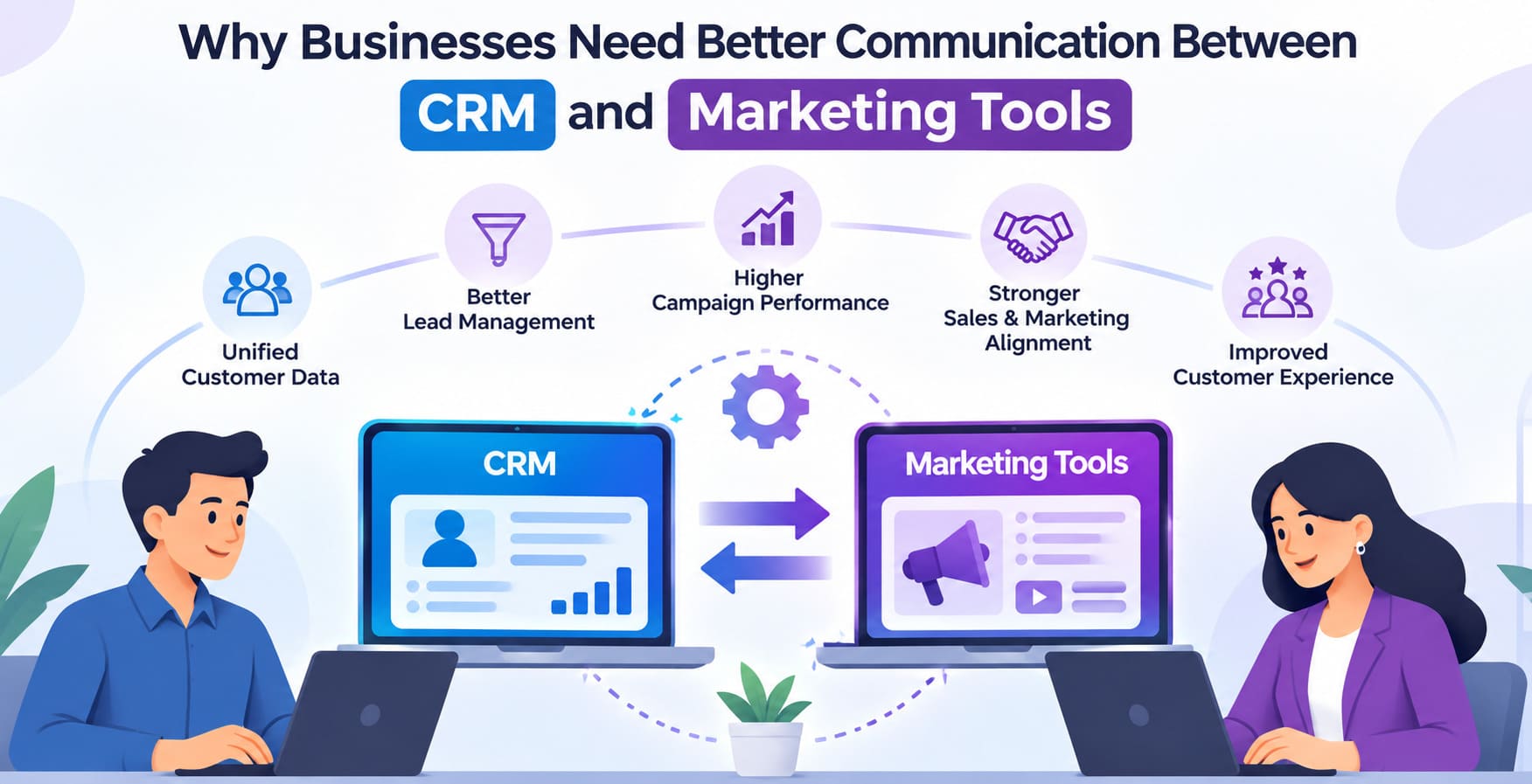
Businesses today use multiple digital platforms to understand customers, manage leads, run marketing campaigns, and improve sales activities. A CRM system helps companies organize customer details, track conversations, and manage sales opportunities. Marketing tools help teams reach audiences through email campaigns, marketing automation, website forms, analytics, and other digital channels.
Both systems play an important role in business growth. However, using them separately can create problems that are not always immediately visible.
Imagine a person visits a company’s website, downloads a service brochure, and later submits an enquiry form. The marketing platform may record these activities, but the sales team might only see the person’s basic contact information in the CRM. When a representative makes the first call, they have little understanding of what the person was interested in or what information they already explored.
This creates an unnecessary gap between customer interest and business communication.
The problem becomes even more complicated when businesses manage hundreds or thousands of customer records across different platforms. Information gets updated in one system but remains unchanged in another. Marketing teams may continue using old contact details, while sales representatives work with incomplete records.
These challenges explain why communication between CRM and marketing tools is becoming increasingly important.
Businesses need more than separate software platforms. They need connected systems that allow customer information to move between teams, support better decisions, and create a consistent experience throughout the customer journey.
1. Disconnected Systems Make Customer Information Difficult to Manage
One of the most common problems businesses experience is scattered customer information.
Marketing departments may use separate platforms for email marketing, campaign management, website analytics, and lead generation. Meanwhile, sales representatives depend on CRM software to maintain contact records, track conversations, and manage opportunities.
When these systems do not communicate properly, employees may have different versions of the same customer information.
For example, a marketing team may update a prospect’s email address after receiving a new enquiry. However, the CRM system may still contain the previous address. If the sales team uses that outdated information, important communication could be delayed or missed.
This situation becomes more difficult when several employees handle the same customer account.
Connecting CRM and marketing platforms helps businesses maintain more consistent records. Relevant customer updates can be shared between systems, reducing the need to search through multiple platforms before taking action.
The benefit is not limited to convenience. Accurate information also helps teams communicate with greater confidence.
2. Marketing Teams Need to Understand What Happens After Lead Generation
Generating leads is an important part of marketing, but it does not explain the complete customer journey.
A person may click an advertisement, visit a website, download a resource, or register for a webinar. These activities show interest, but businesses still need to understand what happens afterwards.
Does the person respond to sales communication? Do they request a product demonstration? Are they interested in the service, or are they simply researching available options?
Marketing platforms can record engagement activities, while CRM systems can provide information about sales conversations and opportunity progress.
When these systems operate separately, marketing teams may not receive enough information about the quality and progress of the leads they generate.
For instance, a campaign might produce 200 enquiries, but only a small percentage may become genuine sales opportunities. Without CRM information, marketers may continue investing in campaigns that generate activity without delivering meaningful business outcomes.
When CRM and marketing tools communicate, marketing teams can better understand which campaigns are attracting relevant prospects.
This allows businesses to move beyond counting enquiries and focus on the quality of the opportunities being generated.
3. Poor Data Synchronization Can Create Duplicate Customer Records
Duplicate records are another challenge that often appears when businesses use multiple marketing and CRM platforms.
A customer might submit an enquiry through a website, register for an event, and later respond to an email campaign. If these interactions are not connected properly, the same person could appear as multiple contacts.
This creates confusion for employees who are trying to understand the customer’s complete history.
For example, one sales representative might contact a prospect using information from the first record, while another employee follows up using a separate record created through a later campaign.
The customer may receive repeated messages or calls without the business realizing that both records belong to the same person.
Duplicate records can also affect campaign reporting, lead assignment, and customer segmentation.
Businesses should establish clear rules for identifying existing contacts, matching customer records, and updating information across platforms.
Using consistent email addresses, contact identifiers, and data validation processes can help reduce duplication.
A well-maintained CRM system should provide a reliable view of customer information rather than becoming another place where incomplete records accumulate.
4. Customers May Receive Messages That No Longer Match Their Situation
Customers expect businesses to understand their previous interactions. They do not want to repeatedly explain what they have already discussed or receive messages that are unrelated to their current needs.
However, disconnected systems can make this difficult.
Consider a customer who has already purchased a subscription. If the marketing platform does not receive the updated customer status from the CRM, that person might continue receiving promotional messages designed for new customers.
Similarly, someone who has already booked a consultation may receive another email asking them to schedule their first appointment.
These experiences can make communication feel repetitive and poorly coordinated.
The issue is not necessarily the quality of the marketing message. The real problem is that the system delivering the message does not have the latest customer information.
When CRM and marketing tools share relevant updates, businesses can adjust their communication based on customer status, previous interactions, and current interests.
This makes it easier to send appropriate messages at different stages of the customer relationship.
5. Manual Data Entry Reduces Team Productivity
Employees should spend their time understanding customers, improving campaigns, and supporting business growth. However, disconnected systems often force teams to spend unnecessary hours managing information manually.
For example, a marketing employee may download leads from an advertising platform, organize them in a spreadsheet, and upload them into the CRM. Later, the sales team may update the same information after speaking with prospects.
If the marketing platform does not receive these updates, the process may need to be repeated.
This creates additional work and increases the possibility of human error.
A missing field, incorrect email address, or outdated contact status can affect future communication.
Automation and system integration can help reduce these repetitive activities. New leads can be transferred automatically, relevant contact information can be updated, and selected customer activities can be shared between platforms.
However, businesses should not automate every process without reviewing it first. They need to identify which updates are important and ensure that information is transferred accurately.
The goal should be to make everyday work easier without creating unnecessary complexity.
6. Sales Teams Need Marketing Context Before Contacting Leads
A lead’s contact details do not always explain why that person is interested in a business.
A sales representative may know a prospect’s name, email address, company, and phone number. But these details alone may not provide enough context for a meaningful conversation.
Marketing information can help fill this gap.
For example, a prospect may have:
- Downloaded a product guide.
- Visited a particular service page.
- Responded to a marketing email.
- Registered for an online event.
- Submitted a form requesting additional information.
When relevant engagement details are available in the CRM, sales representatives can better understand what attracted the prospect.
This helps them prepare more relevant conversations instead of beginning every interaction with general questions.
It also reduces the communication gap between marketing activities and sales follow-ups.
However, businesses should share only appropriate and relevant engagement information, with suitable access controls and respect for customer privacy.
7. Marketing Reports Cannot Always Show the Complete Business Picture
Marketing teams regularly review campaign performance through reports containing impressions, clicks, email opens, website visits, and form submissions.
These metrics help explain how people interact with marketing campaigns. However, they do not always show whether those interactions contribute to meaningful business opportunities.
A campaign might receive thousands of clicks but generate very few qualified enquiries. Another campaign may attract fewer visitors but bring prospects who are genuinely interested in the company’s services.
Without connecting marketing data with CRM information, businesses may struggle to understand this difference.
A connected reporting process can help teams examine the relationship between campaign sources, lead quality, sales opportunities, and customer outcomes.
For example, marketing managers can compare which campaigns generate enquiries and which ones contribute to opportunities that progress through the sales pipeline.
This information supports more informed budget allocation and campaign planning.
It also encourages marketing teams to evaluate performance based on business outcomes rather than focusing only on engagement numbers.
8. Disconnected Platforms Can Affect Lead Nurturing
Not every potential customer is ready to make a purchase immediately.
Some people need additional information, time to compare solutions, or internal approval before making a decision. This is particularly common in businesses with longer sales cycles.
Marketing automation helps companies maintain communication with these prospects through educational emails, helpful resources, and relevant updates.
However, lead nurturing becomes less effective when the marketing platform does not receive updated information from the CRM.
For example, a prospect who has already entered an active sales discussion may continue receiving introductory emails intended for people who are just discovering the brand.
This can make communication feel disconnected.
When CRM and marketing tools work together, businesses can adjust nurturing activities based on changes in lead status and sales progress.
A prospect who is still researching may receive educational content, while someone already discussing a proposal may receive more relevant information.
This creates a more organized communication process without requiring employees to manage every interaction manually.
9. Better Integration Improves Coordination Between Marketing and Sales
Marketing and sales teams often work towards the same business objective, but their daily responsibilities are different.
Marketing focuses on attracting audiences, creating awareness, generating enquiries, and nurturing potential customers. Sales teams concentrate on conversations, understanding requirements, presenting solutions, and closing opportunities.
When both departments use separate information sources, misunderstandings can develop.
Marketing may believe that it has generated enough qualified leads, while sales representatives may feel that the enquiries do not match their requirements.
Sometimes the issue is not lead generation itself. It is the lack of shared information about what makes a lead valuable.
Connecting CRM and marketing tools can help teams work with common customer records, lead statuses, campaign details, and qualification information.
Businesses should also establish clear agreements about lead qualification, assignment, follow-up responsibilities, and feedback.
Technology supports the process, but communication between employees remains equally important.
10. Customer Journey Tracking Becomes More Difficult Without Connected Tools
Customers rarely make decisions after interacting with a business only once.
They may discover a company through a search engine, visit its website, read a blog, download a resource, attend a webinar, and eventually contact the sales team.
Each interaction provides a different piece of information about the customer’s interests.
When marketing and CRM platforms operate independently, these interactions may remain scattered across different systems.
As a result, businesses can struggle to understand how customers move from their first interaction to an actual sales conversation.
Connected systems help bring relevant information together and provide a clearer picture of customer engagement.
This makes it easier for teams to identify common interaction patterns, understand customer requirements, and improve communication at different stages of the buying process.
It also helps businesses identify areas where potential customers may lose interest or need additional support.
11. Choosing More Marketing Tools Is Not Always the Solution
When businesses experience communication problems between platforms, their first reaction may be to purchase another software solution.
However, adding more tools does not automatically solve existing problems.
In some cases, additional platforms create more data sources, more subscriptions, and more integration requirements.
Before investing in new software, businesses should review their current technology environment.
They should understand which platforms are already being used, what information each platform stores, and where communication breaks down.
Some systems may already offer native integrations. Others may support APIs or third-party automation connectors.
The right approach depends on the company’s size, existing technology, data requirements, and business processes.
Businesses should prioritize reliable integration, clear data ownership, security, and ease of maintenance rather than selecting tools simply because they offer more features.
12. Data Security and Access Control Should Remain a Priority
Connecting CRM and marketing platforms involves sharing customer information between systems. While this improves coordination, businesses must also consider how that information is protected.
Not every employee needs access to every customer record or marketing activity.
For example, marketing employees may need access to campaign engagement information, while sales representatives may require contact details and relevant conversation history.
Businesses should define access permissions based on employee responsibilities.
They should also review integration permissions, data retention practices, authentication methods, and the security standards of connected platforms.
Customer consent and applicable privacy requirements must be considered when collecting, sharing, and using personal information.
A successful integration should make customer information more useful without making it less secure.
13. How Businesses Can Build Better Communication Between CRM and Marketing Tools
Improving communication between platforms requires planning. Simply connecting two systems does not guarantee that customer information will be accurate or useful.
Businesses should take a structured approach.
Understand existing workflows: Identify how customer information currently moves between marketing, sales, and CRM platforms. Look for delays, repeated tasks, and missing information.
Decide which information needs to be shared: Not every data field needs to move between systems. Prioritize useful details such as contact information, lead source, campaign activity, lead status, and relevant customer updates.
Select suitable integration methods: Review native integrations, APIs, and trusted third-party connectors based on compatibility and business requirements.
Maintain consistent data standards: Use common field names, formatting rules, and contact identification methods to reduce duplicate and inconsistent records.
Create clear automation rules: Define what should happen when a new lead arrives, a contact changes status, or a sales opportunity progresses.
Test synchronization regularly: Check whether updates are reaching the correct platforms and whether errors are being reported properly.
Train employees: Make sure marketing and sales teams understand how connected systems work and how to maintain accurate information.
Measure the results: Review improvements in lead response, data accuracy, campaign reporting, and manual workload.
These steps help businesses build a connected technology environment that supports actual business needs rather than simply increasing the number of available tools.
14. The Future of CRM and Marketing Technology Depends on Better Connectivity
Marketing technology continues to evolve. Businesses are adopting artificial intelligence, predictive analytics, advanced automation, and customer data platforms to understand their audiences more effectively.
However, these technologies depend on the quality and availability of information.
An AI-powered marketing platform cannot provide useful recommendations if customer records are incomplete or important interactions are missing. Similarly, an automation workflow cannot deliver the right message if it does not receive updated information about a customer’s status.
This makes system connectivity an important part of modern marketing operations.
Businesses that establish reliable communication between their CRM and marketing platforms can create a stronger foundation for future improvements.
They can use more complete information to understand customer behaviour, improve campaign planning, and coordinate activities across departments.
As marketing environments become more complex, the ability to connect information across platforms will become increasingly valuable.
Conclusion
CRM and marketing tools should work together because customer relationships do not exist in separate software platforms.
Every website visit, email interaction, enquiry, sales conversation, and purchase contributes to a customer’s experience with a business. When these interactions remain scattered across different systems, teams struggle to understand the complete picture.
Better communication between CRM and marketing platforms helps businesses reduce repetitive work, maintain more accurate customer information, improve lead follow-ups, and evaluate campaign performance with greater clarity.
However, successful integration is not only about technology. It also requires clear processes, consistent data management, proper security, and cooperation between marketing and sales teams.
Businesses do not necessarily need more software to improve their marketing operations. Sometimes, they simply need the tools they already use to communicate more effectively.
When customer information reaches the right people at the right time, marketing becomes more coordinated, sales conversations become more informed, and customer experiences become easier to manage.
Frequently Asked Questions
1. Why is communication between CRM and marketing tools important?
Communication between CRM and marketing tools helps businesses share customer information, manage leads efficiently, reduce manual work, and improve coordination between marketing and sales teams.
2. What problems can disconnected CRM and marketing tools create?
Disconnected platforms can lead to duplicate customer records, missing information, delayed follow-ups, and irrelevant marketing messages. These issues can affect team productivity and customer relationships.
3. How does CRM integration improve marketing campaign performance?
CRM integration helps marketing teams understand customer interactions, lead quality, and sales progress. Businesses can use these insights to improve audience targeting and make better marketing decisions.
4. How can businesses connect CRM and marketing tools?
Businesses can connect CRM and marketing tools through native integrations, APIs, or third-party automation platforms. Maintaining accurate customer records and regularly checking data synchronization also helps keep both systems reliable.