








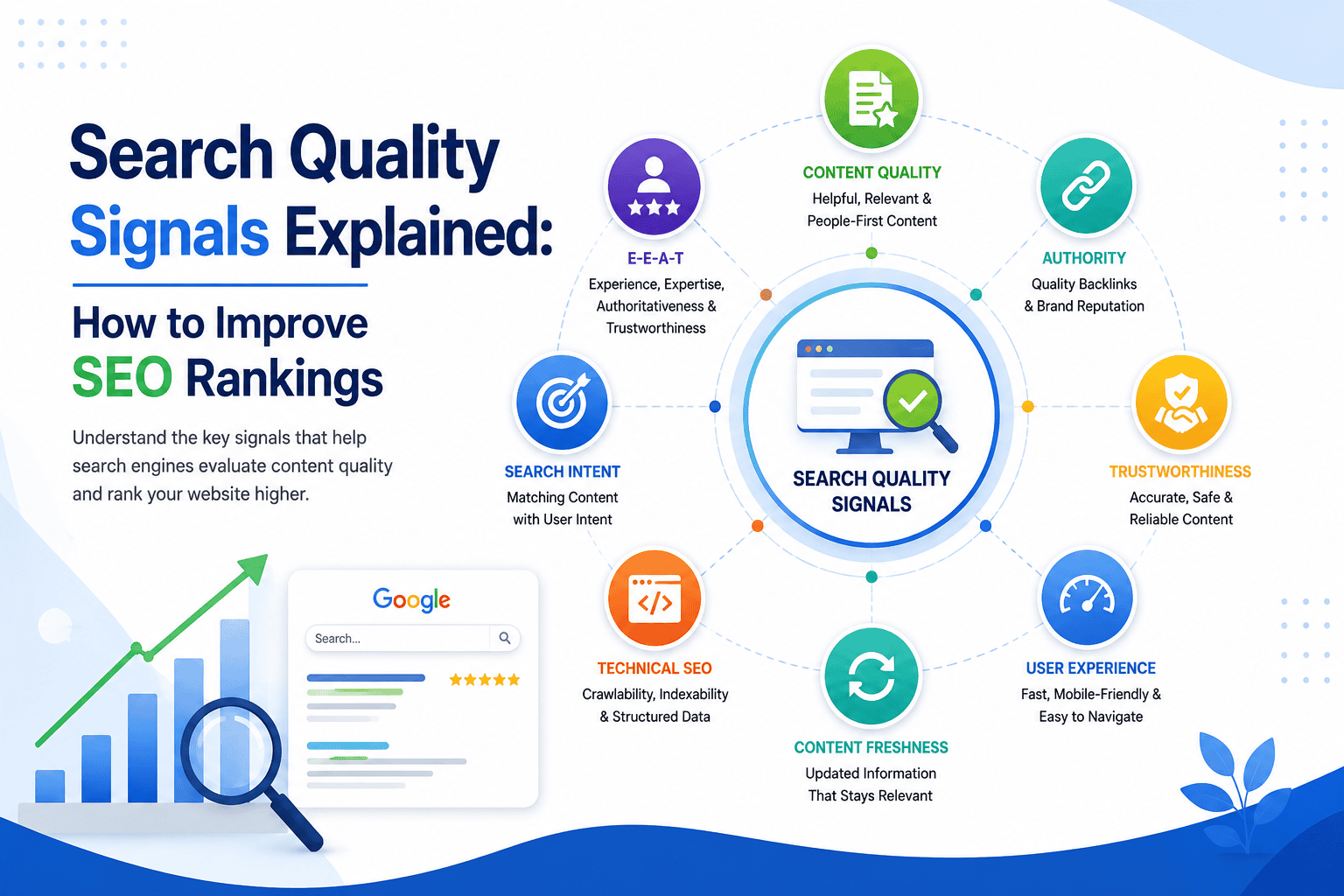
Have you ever wondered why some websites consistently rank at the top of Google Search while others struggle to gain visibility? The answer often lies in Search Quality Signals.
Search quality signals are the indicators search engines use to evaluate whether a webpage is useful, trustworthy, relevant, and capable of satisfying a user’s search intent. Instead of relying on a single ranking factor, modern search engines analyze hundreds of signals to determine which pages deserve higher rankings. Google emphasizes helpful, reliable, people-first content supported by expertise, authority, and trust.
Understanding these signals is essential for businesses, marketers, and content creators who want to improve their SEO performance and attract more organic traffic.
What Are Search Quality Signals?
Search quality signals are measurable factors that help search engines determine the overall quality of a webpage.
These signals help answer questions such as:
- Is the content relevant to the user’s query?
- Is the information accurate and trustworthy?
- Does the page provide a great user experience?
- Is the website recognized as an authority?
- Will visitors find the answer they need?
Google combines numerous quality signals rather than relying on any single factor to rank content.
Why Search Quality Signals Matter
Strong search quality signals help websites:
- Improve organic search rankings
- Increase website traffic
- Build credibility and trust
- Improve user engagement
- Generate higher-quality leads
- Support long-term SEO growth
High-quality content also has a better chance of appearing in AI-powered search experiences, featured snippets, and other enhanced search results.
Key Search Quality Signals
1. Content Relevance
Search engines first determine whether your content matches what users are searching for.
Improve relevance by:
- Understanding search intent
- Answering the user’s questions clearly
- Using descriptive headings
- Covering the topic comprehensively
- Including related concepts naturally
Content should solve the user’s problem instead of simply repeating keywords.
2. Helpful, People-First Content
Google prioritizes content created for people—not content written solely to manipulate rankings.
Helpful content should:
- Provide original insights
- Explain concepts clearly
- Offer practical solutions
- Include examples
- Demonstrate real expertise
Thin, duplicate, or AI-generated content without added value is less likely to perform well.
3. E-E-A-T (Experience, Expertise, Authoritativeness, Trustworthiness)
One of the strongest quality concepts is E-E-A-T.
Experience
Show firsthand knowledge through case studies, practical examples, or real-world insights.
Expertise
Publish content written or reviewed by knowledgeable professionals.
Authoritativeness
Earn recognition through high-quality backlinks, industry mentions, and a strong reputation.
Trustworthiness
Provide accurate information, secure browsing (HTTPS), transparent author details, and reliable references.
Google uses these quality concepts to evaluate how useful and trustworthy content appears.
4. Content Freshness
Some topics require updated information.
Keep content fresh by:
- Updating statistics
- Adding new research
- Refreshing screenshots
- Revising outdated recommendations
- Expanding existing sections
Regular updates signal that your content remains relevant.
5. Website Authority
Authority develops over time through:
- Quality backlinks
- Brand recognition
- Positive mentions
- Expert content
- Consistent publishing
Links from respected websites remain an important quality signal because they indicate that others consider your content valuable.
6. User Experience (UX)
Search engines also evaluate how users interact with your website.
Important UX factors include:
- Fast loading speed
- Mobile-friendly design
- Easy navigation
- Clear page structure
- Readable typography
- Secure HTTPS connection
A positive user experience encourages visitors to stay longer and engage with your content.
7. Search Intent Satisfaction
Your page should completely answer the user’s query.
For example:
Informational Intent
- Guides
- Tutorials
- Educational articles
Commercial Intent
- Product comparisons
- Reviews
- Buying guides
Transactional Intent
- Product pages
- Service pages
Understanding intent helps improve both rankings and user satisfaction.
8. Structured Data
Schema markup helps search engines better understand your content.
Common schema types include:
- Article
- FAQ
- Organization
- Breadcrumb
- Review
- Product
Structured data can improve eligibility for rich search results.
9. Internal Linking
A strong internal linking strategy helps search engines discover content while improving user navigation.
Benefits include:
- Better crawling
- Stronger topical authority
- Improved page relationships
- Increased time on site
Link related articles wherever appropriate.
10. Technical SEO
Even excellent content can struggle without solid technical SEO.
Focus on:
- XML sitemap
- Robots.txt
- Clean URLs
- Proper heading structure
- Canonical tags
- Core Web Vitals
- Crawlability
- Indexability
Technical optimization supports stronger search visibility.
Common Mistakes That Hurt Search Quality
Avoid these issues:
- Thin content
- Keyword stuffing
- Duplicate pages
- Outdated information
- Slow loading speed
- Poor mobile experience
- Broken links
- Missing author information
- Weak internal linking
- Publishing content without real value
Best Practices to Improve Search Quality Signals
Create content that genuinely helps your audience.
Publish original research, expert insights, and practical examples.
Maintain consistent branding and website structure.
Update older content regularly.
Improve page speed and mobile usability.
Use descriptive headings and logical formatting.
Earn backlinks naturally through valuable content.
Implement structured data where appropriate.
Monitor SEO performance using analytics and search console tools.
Future of Search Quality Signals
Search engines continue to become more intelligent through AI and machine learning.
Instead of rewarding pages with the highest keyword density, modern algorithms increasingly evaluate:
- User satisfaction
- Helpful information
- Content depth
- Experience
- Trust
- Authority
Businesses that focus on creating genuinely useful, accurate, and user-focused content are more likely to succeed as search continues to evolve.
Conclusion
Understanding search quality signals is essential for building a successful SEO strategy.
Rather than trying to optimize for a single ranking factor, focus on delivering exceptional value through trustworthy, relevant, and well-structured content. Combine high-quality writing with strong technical SEO, excellent user experience, and continuous updates to improve your visibility in search results.
As search engines evolve, websites that consistently prioritize users over algorithms will be best positioned for long-term organic growth.
Frequently Asked Questions (FAQs)
1. What are search quality signals?
Search quality signals are factors search engines use to evaluate the relevance, trustworthiness, authority, and overall quality of a webpage before determining its ranking.
2. Is E-E-A-T a ranking factor?
E-E-A-T is not a single ranking factor but a framework Google uses to evaluate content quality and trustworthiness through multiple signals.
3. Does content freshness improve SEO?
Yes. Updating content with current information, statistics, and examples can improve its relevance for topics where freshness matters.
4. Why is user experience important for SEO?
A fast, mobile-friendly, and easy-to-navigate website helps users find information quickly, supporting stronger search performance.