

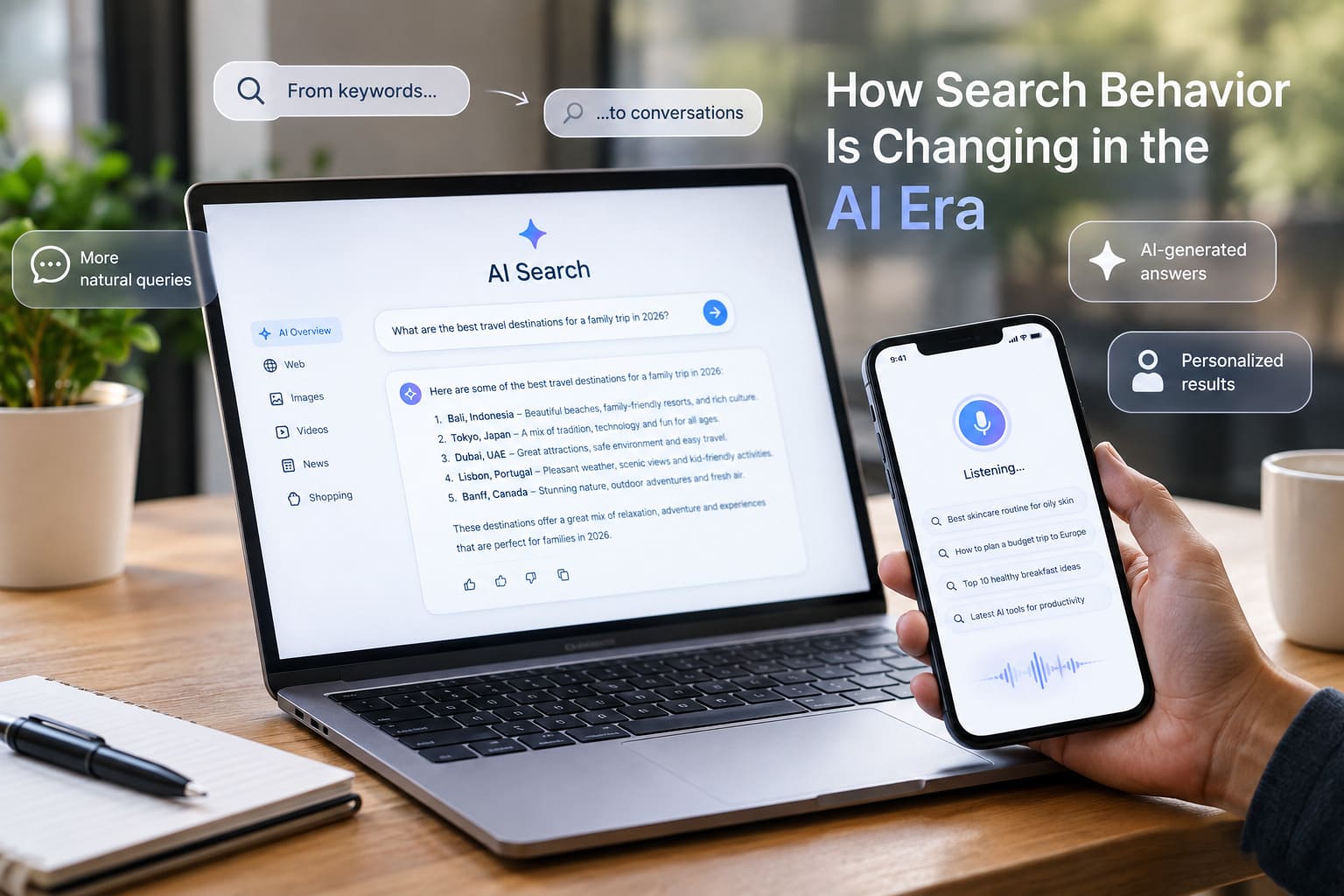
The way people search for information has changed dramatically over the past few years. Traditional search engines once relied heavily on matching keywords, but today, artificial intelligence (AI) is transforming search into a more intelligent, conversational, and personalised experience. Instead of simply displaying a list of web pages, AI-powered search engines understand user intent, analyse context, and provide direct, comprehensive answers.
The rise of AI platforms such as ChatGPT, Google AI Search, Gemini, Microsoft Copilot, and Perplexity AI is changing how people discover information, compare products, and make purchasing decisions. Users are now asking complete questions instead of entering a few keywords, expecting instant and accurate responses.
For businesses, marketers, and SEO professionals, this shift presents both challenges and opportunities. Understanding how search behaviour is evolving can help organisations create content that performs well in both traditional search engines and AI-powered search experiences.
What Is AI-Powered Search?
AI-powered search combines search engine technology with large language models (LLMs) to understand natural language, user intent, and context. Instead of relying only on keyword matching, AI analyses entire questions and generates relevant, conversational responses.
Popular AI-powered search platforms include:
- Google AI Search
- ChatGPT Search
- Microsoft Copilot
- Gemini
- Perplexity AI
These platforms help users find answers faster while reducing the need to browse multiple websites.
Why Search Behaviour Is Changing
Several technological advancements are driving this transformation:
- Artificial Intelligence and Machine Learning
- Natural Language Processing (NLP)
- Voice Search
- Mobile-First Browsing
- AI Assistants
- Personalised Search Results
- Visual Search Technologies
These innovations allow search engines to better understand what users actually mean rather than simply matching keywords.
Key Changes in Search Behaviour
1. Users Search with Complete Questions
Previously, users searched using short phrases like:
- SEO tools
- CRM software
- AI chatbot
Today, users search naturally:
- Which CRM software is best for a small business?
- How can AI improve digital marketing?
- What are the best SEO tools for beginners?
This shift allows AI systems to understand the full context of the query.
2. Conversational Search Is Becoming the New Standard
People now interact with AI search engines as they would with another person.
Instead of starting a new search every time, users ask follow-up questions such as:
- What is marketing automation?
- Which platform is the best?
- Is it suitable for B2B businesses?
- What is the pricing?
AI remembers previous questions and delivers more relevant responses.
3. Search Intent Is More Important Than Keywords
Modern search engines focus on understanding why a user is searching rather than simply identifying matching keywords.
The four primary search intents include:
- Informational
- Navigational
- Commercial
- Transactional
Content that directly answers user questions is more likely to rank well in both traditional and AI-powered search.
4. Long-Tail Keywords Are Growing
AI understands detailed and highly specific search queries.
For example:
Instead of:
Marketing Analytics
Users now search:
Which marketing analytics software is best for eCommerce businesses?
Long-tail keywords often have stronger user intent and higher conversion potential.
5. Zero-Click Searches Are Increasing
AI-generated summaries often provide immediate answers without requiring users to visit multiple websites.
This means businesses must create unique, trustworthy, and in-depth content that encourages users to explore further.
6. Voice Search Continues to Expand
Voice assistants encourage conversational searches.
Examples include:
- What is the future of AI in marketing?
- Which SEO strategy works best in 2026?
- How does customer journey mapping improve conversions?
Optimising for conversational language improves visibility across both voice and AI search.
7. Visual Search Is Becoming More Popular
Users increasingly search using:
- Images
- Videos
- Screenshots
- PDFs
Optimising images with descriptive file names, alt text, captions, and structured data helps improve discoverability.
8. Users Expect Faster Answers
Modern users expect:
- Quick summaries
- Bullet points
- Step-by-step guides
- Comparison tables
- Visual explanations
Content that is easy to scan improves user experience and AI visibility.
How AI Is Impacting SEO
Artificial intelligence is changing the way SEO works.
Businesses should focus on:
- High-quality content
- Search intent optimisation
- User experience
- Topic clusters
- Internal linking
- E-E-A-T (Experience, Expertise, Authoritativeness, Trustworthiness)
- Structured data
- Regular content updates
Traditional keyword optimisation alone is no longer enough.
How Businesses Can Optimise for AI Search
Create Comprehensive Content
Write complete guides that answer every important question users may have.
Include:
- Definitions
- Examples
- Statistics
- Case studies
- FAQs
- Expert insights
Understand User Intent
Before writing, ask:
- What problem is the user trying to solve?
- What information are they expecting?
- What questions might they ask next?
Answering these questions helps create valuable content.
Build Topical Authority
Publish multiple articles around a single subject.
Example:
Digital Marketing
↓
- AI Marketing
- Marketing Automation
- Customer Journey
- CRM
- Marketing Analytics
- SEO
- Content Marketing
This helps search engines recognise your expertise.
Use Clear Structure
Organise content using:
- H2 and H3 headings
- Bullet points
- Numbered lists
- Tables
- FAQs
Well-structured content is easier for both users and AI systems to understand.
Optimise Technical SEO
Don’t overlook technical optimisation:
- Improve page speed
- Ensure mobile responsiveness
- Add schema markup
- Optimise Core Web Vitals
- Use descriptive URLs
- Secure your site with HTTPS
Technical SEO supports better crawling, indexing, and user experience.
The Future of Search
Search will continue evolving with AI.
Future trends include:
- AI-generated answers
- Conversational search
- Personalised search experiences
- Multimodal search (text, voice, image, and video)
- AI agents that complete tasks
- Predictive search recommendations
Businesses that adapt early will gain a competitive advantage.
Final Thoughts
Artificial intelligence is reshaping how people search, discover information, and make decisions online. Success in the AI era requires more than keyword optimisation – it demands a deep understanding of user intent, high-quality content, topical authority, and a seamless user experience.
Businesses that consistently publish valuable, trustworthy, and well-structured content will be better positioned to succeed in both traditional search engines and AI-powered search platforms. By embracing these changes today, organisations can build stronger online visibility, attract qualified audiences, and stay ahead in the rapidly evolving digital landscape.
Frequently Asked Questions
1. How is AI changing the way people search online?
AI is making search more conversational and context-driven. Users can ask detailed questions and receive summarized answers instead of relying only on traditional lists of search results.
2. Are people still using traditional search engines in the AI era?
Yes. Traditional search engines remain widely used, while AI-powered search tools are becoming another way for users to discover information, compare options, and find answers.
3. What does changing search behavior mean for marketers?
Marketers need to create useful, trustworthy, and well-structured content that directly answers user questions. Content should also be easy for search engines and AI systems to understand.
4. How can businesses optimize content for AI-driven search?
Businesses can focus on clear answers, natural language, relevant entities, strong topical coverage, structured content, and credible sources while continuing to follow sound SEO practices.