









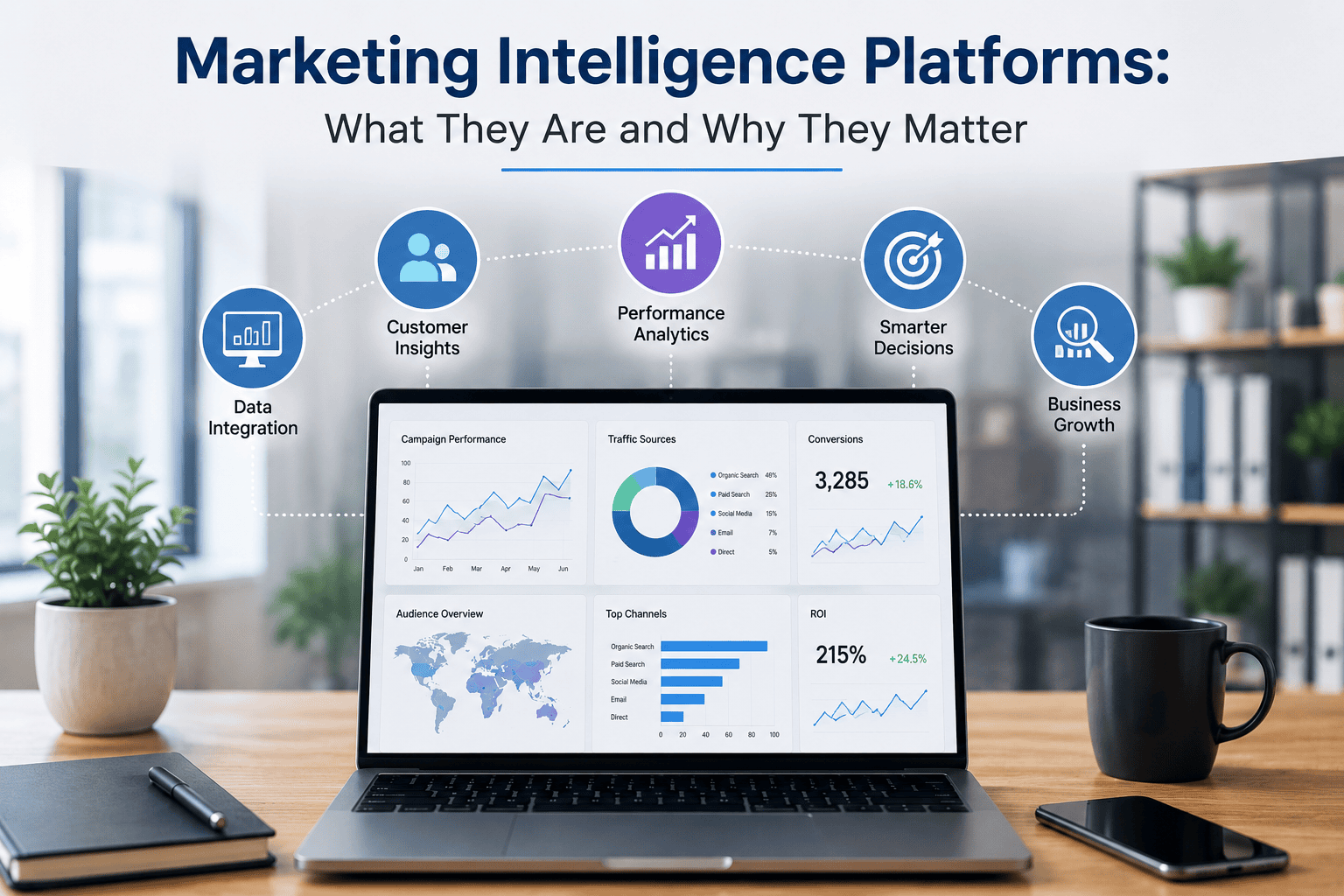
Today’s marketers have access to more data than ever before. Website traffic, social media engagement, email campaigns, customer behavior, paid advertising, CRM records, and sales performance all generate valuable insights. However, collecting data alone isn’t enough. The real challenge is turning that information into smarter business decisions.
This is where Marketing Intelligence Platforms become essential.
These platforms bring together data from multiple marketing channels, analyze customer behavior, identify trends, and help businesses make informed decisions faster. Instead of relying on assumptions, organizations can use real-time insights to improve campaigns, increase conversions, and maximize marketing ROI.
Whether you’re a startup, a growing business, or a large enterprise, marketing intelligence helps you understand what’s working, what isn’t, and where your next opportunities lie.
What Is a Marketing Intelligence Platform?
A Marketing Intelligence Platform is a software solution that collects, organizes, analyzes, and visualizes marketing data from various sources.
Instead of checking multiple dashboards separately, marketers can access all important metrics from one centralized platform.
A marketing intelligence platform typically combines data from:
- Website analytics
- Search engine optimization (SEO)
- Social media platforms
- Email marketing tools
- CRM systems
- Advertising platforms
- Marketing automation software
- Sales data
- Customer behavior analytics
The goal is simple: transform scattered marketing data into actionable business intelligence.
Why Marketing Intelligence Matters
Modern customers interact with businesses through multiple digital touchpoints before making a purchase.
Without marketing intelligence, businesses often face challenges such as:
- Data scattered across different platforms
- Difficulty measuring campaign performance
- Slow reporting processes
- Limited understanding of customer behavior
- Inefficient marketing spending
- Missed growth opportunities
Marketing intelligence platforms solve these problems by providing a complete picture of marketing performance.
Key Features of Marketing Intelligence Platforms
1. Centralized Data Integration
One of the biggest advantages is the ability to connect multiple marketing tools into one dashboard.
Instead of manually collecting reports, marketers can view all campaign data in one place.
2. Real-Time Analytics
Marketing conditions change quickly.
Real-time reporting allows businesses to monitor campaign performance instantly and make immediate improvements when necessary.
3. Customer Insights
Marketing intelligence platforms help businesses understand:
- Customer interests
- Buying behavior
- Engagement patterns
- Purchase history
- Audience demographics
- Customer journey
These insights improve personalization and customer experience.
4. Campaign Performance Tracking
Businesses can measure:
- Traffic sources
- Conversion rates
- Cost per acquisition (CPA)
- Return on investment (ROI)
- Click-through rates (CTR)
- Customer engagement
This makes campaign optimization much easier.
5. Predictive Analytics
Many modern platforms use artificial intelligence and machine learning to forecast future trends.
Predictive analytics helps marketers:
- Identify future customer demand
- Estimate campaign performance
- Predict customer churn
- Improve budget planning
6. Competitive Intelligence
Some marketing intelligence platforms also monitor competitor activity.
Businesses can track:
- Market trends
- Competitor keywords
- Advertising strategies
- Industry benchmarks
- Share of voice
This helps companies stay competitive.
Benefits of Marketing Intelligence Platforms
Better Decision Making
Marketing decisions become data-driven instead of based on assumptions.
Improved ROI
Businesses can invest more in high-performing campaigns while reducing wasteful spending.
Faster Reporting
Automated dashboards eliminate hours of manual reporting.
Teams can access updated reports instantly.
Better Customer Experience
Understanding customer preferences allows businesses to create personalized marketing campaigns.
This increases engagement and customer satisfaction.
Higher Marketing Efficiency
Marketing teams spend less time gathering data and more time optimizing campaigns.
Stronger Collaboration
Sales, marketing, and management teams work from the same data, improving communication across departments.
Common Use Cases
Marketing intelligence platforms support various business functions, including:
Digital Marketing
Monitor SEO, PPC, email marketing, and social media performance.
Lead Generation
Identify high-quality leads and measure conversion performance.
Content Marketing
Analyze which content drives the most traffic and engagement.
Customer Journey Analysis
Understand how customers move through different marketing channels before purchasing.
Budget Optimization
Allocate marketing budgets based on actual campaign performance.
Executive Reporting
Provide leadership teams with clear dashboards and performance summaries.
Industries That Benefit Most
Marketing intelligence platforms are valuable across many industries, including:
- B2B technology
- SaaS companies
- E-commerce
- Healthcare
- Financial services
- Manufacturing
- Education
- Retail
- Professional services
- Marketing agencies
Any business that relies on digital marketing can benefit from marketing intelligence.
How to Choose the Right Marketing Intelligence Platform
When evaluating platforms, consider the following factors:
Integration Capabilities
Ensure the platform connects with your existing CRM, analytics, advertising, and marketing tools.
Ease of Use
Choose a platform with an intuitive interface and customizable dashboards.
AI and Automation
Look for AI-powered insights, predictive analytics, and automated reporting features.
Scalability
Select a solution that can grow alongside your business.
Data Security
Verify that the platform follows strong security standards and protects customer information.
Reporting Flexibility
Custom reports and dashboards should meet the needs of different teams within your organization.
Best Practices for Using Marketing Intelligence Platforms
To maximize value:
- Define clear marketing goals.
- Track meaningful KPIs.
- Integrate all major data sources.
- Review dashboards regularly.
- Use insights to optimize campaigns.
- Share reports across teams.
- Continuously test and improve marketing strategies.
Consistency is key to turning data into measurable business growth.
Future Trends in Marketing Intelligence
Marketing intelligence continues to evolve with advancements in AI and automation.
Emerging trends include:
- AI-powered decision intelligence
- Predictive customer analytics
- Privacy-first data strategies
- Cookieless marketing measurement
- Real-time personalization
- Automated campaign optimization
- Generative AI for marketing insights
- Cross-channel attribution modeling
Businesses that adopt these innovations will be better positioned to adapt to changing customer expectations and market conditions.
Conclusion
Marketing Intelligence Platforms have become an essential part of modern marketing strategies. They help businesses collect data from multiple sources, uncover meaningful insights, improve customer understanding, and make informed decisions backed by real-time analytics.
Rather than relying on disconnected reports or assumptions, organizations can use marketing intelligence to optimize campaigns, increase efficiency, and achieve stronger business outcomes. As marketing grows more data-driven and competitive, investing in the right intelligence platform can provide a significant advantage for businesses of all sizes.
Frequently Asked Questions (FAQs)
1. What is a Marketing Intelligence Platform?
A Marketing Intelligence Platform is software that collects, analyzes, and visualizes marketing data from multiple sources to help businesses make better marketing decisions.
2. How does a Marketing Intelligence Platform improve marketing performance?
It provides real-time insights into campaign performance, customer behavior, and marketing ROI, enabling teams to optimize strategies more effectively.
3. Who should use Marketing Intelligence Platforms?
Businesses of all sizes, including startups, enterprises, marketing agencies, SaaS companies, retailers, and B2B organizations, can benefit from these platforms.
4. What is the difference between Marketing Intelligence and Business Intelligence?
Marketing Intelligence focuses specifically on marketing performance, customer behavior, and campaign analytics, while Business Intelligence covers data across the entire organization.