









Marketing has never been a static discipline. Customer expectations change, new channels appear, and technology continuously reshapes the way brands attract and retain customers. What feels innovative today can quickly become a standard part of tomorrow’s marketing strategy.
In 2026, that change is happening particularly quickly. Artificial intelligence, automation, answer engines, connected experiences, advanced analytics, and flexible marketing technology are influencing how businesses plan campaigns and interact with customers.
Gartner’s research provides useful insight into these shifts, but the real challenge for marketers is understanding what these changes mean in practice. Simply adopting the latest technology does not guarantee better marketing results. Businesses need to identify where technology can solve genuine problems, improve customer experiences, and contribute to measurable growth.
This guide explores the major disruptive technology trends in marketing strategy and how businesses can prepare for a rapidly changing digital environment.
What Makes a Technology Disruptive in Marketing?
A technology becomes disruptive when it changes the way a business approaches an established process, customer interaction, or competitive strategy.
In marketing, disruption can affect almost everything from content creation to advertising and customer data management.
For example, AI is not disruptive simply because it can generate text or images. Its larger impact comes from changing how marketing teams research audiences, make decisions, personalize experiences, automate workflows, and measure campaigns.
A useful way to look at disruptive technology is to ask three questions:
- Does it change how customers behave?
- Does it change how marketers work?
- Does it create a new source of competitive advantage?
If the answer is yes, the technology deserves strategic attention.
1. Generative AI Is Moving Beyond Content Creation
Generative AI was initially adopted by many marketing teams for relatively simple tasks such as writing drafts, creating ideas, summarizing information, and producing variations of marketing copy.
That is only one part of its potential.
AI is increasingly becoming part of broader marketing workflows. It can help marketers analyze customer information, identify patterns, create campaign variations, support research, and assist with decision-making.
This changes the role of the marketer. Instead of spending most of the day completing repetitive tasks, marketers can spend more time reviewing ideas, developing strategy, understanding customers, and improving campaigns.
However, human oversight remains important. AI-generated information can be inaccurate, repetitive, or disconnected from a brand’s actual audience. The strongest approach is usually a combination of machine efficiency and human judgment.
2. Agentic AI Could Change Marketing Workflows
One of the more significant developments in AI is the move toward systems that can perform multiple tasks instead of responding to one instruction at a time.
Agentic AI can potentially coordinate a sequence of actions based on a defined objective.
Imagine a marketer setting a goal to improve engagement within a specific customer segment. An AI-powered workflow could assist with audience analysis, identify relevant content, recommend campaign variations, monitor results, and suggest adjustments.
The important change is not simply automation. It is the movement from individual automated tasks toward connected workflows.
For marketing teams, this could reduce operational workload while allowing employees to focus on strategy and creative decisions.
Businesses should still introduce these systems carefully. Clear permissions, approval processes, data controls, and performance monitoring are necessary before allowing AI to influence important customer-facing activities.
3. Search Is Expanding Into Answer Engines
Traditional search has been an important source of website traffic for years. However, customers are increasingly using AI-powered search and conversational tools to find answers and compare information.
This creates a new challenge for marketers.
Instead of optimizing content only for a list of search results, brands need to create information that can be understood, trusted, and referenced within answer-driven experiences.
This means marketers should pay greater attention to:
- Clear and useful explanations
- Strong topical coverage
- Original insights
- Structured content
- Accurate information
- Author expertise
- Consistent brand information
SEO is therefore not disappearing. It is becoming broader.
The future of search visibility will involve understanding both traditional search behavior and AI-assisted discovery.
4. AI Is Changing Digital Advertising
Digital advertising has already become highly automated, but AI is taking that automation further.
Advertising platforms can use machine learning to identify audiences, predict responses, optimize bidding, and distribute campaigns across different placements.
For marketers, this can improve efficiency. At the same time, it creates a new problem: marketers may have less visibility into exactly how automated systems make certain decisions.
That makes measurement even more important.
Marketing teams should not evaluate AI-powered advertising only by impressions or clicks. They should connect campaigns with meaningful business outcomes such as qualified leads, conversions, revenue, retention, or customer lifetime value.
Automation can improve campaign execution, but marketers still need to understand whether the campaign is actually producing business value.
5. Martech Stacks Are Becoming More Flexible
Marketing technology stacks can quickly become complicated.
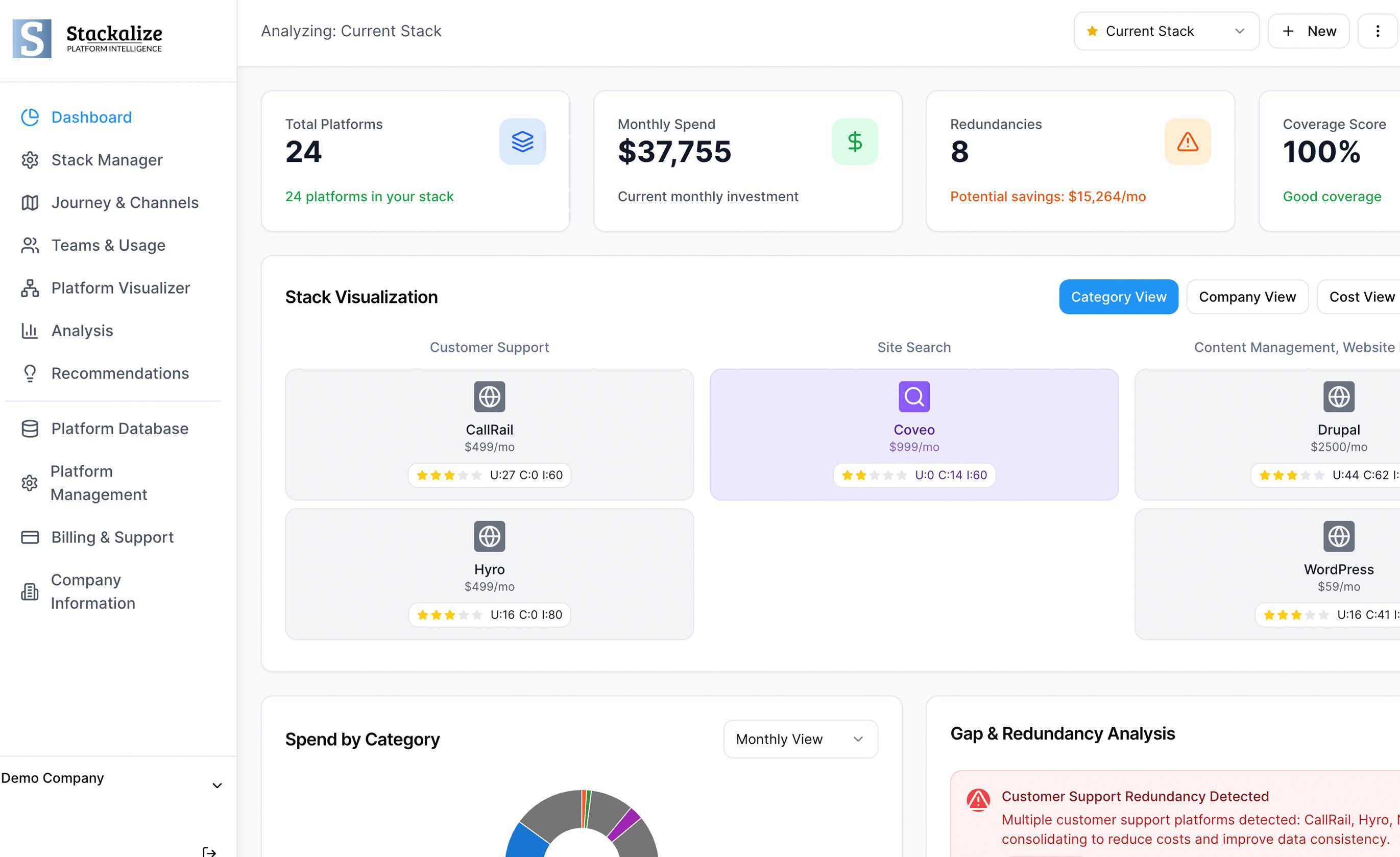
A company may use a CRM, customer data platform, email platform, analytics system, advertising tools, content management system, automation software, and several AI applications.
The problem is not the number of tools alone. The real problem occurs when these systems do not communicate effectively.
This is where flexible and composable marketing technology becomes valuable.
Instead of relying on one large platform for every marketing requirement, organizations can connect specialized technologies according to their needs.
A flexible martech environment can make it easier to:
- Introduce new capabilities
- Replace outdated tools
- Connect customer data
- Experiment with AI
- Improve personalization
- Adapt to changing business requirements
The goal should not be to build the largest martech stack. A smaller, well-connected technology ecosystem can often be more useful than dozens of disconnected platforms.
6. Customer Data Is Becoming a Strategic Asset
As marketing becomes more dependent on AI, customer data becomes even more important.
AI systems need reliable information to produce useful recommendations. If customer records contain duplicates, outdated information, missing fields, or inconsistent identifiers, the resulting analysis can also become unreliable.
Marketers should therefore treat data quality as part of marketing strategy rather than simply an IT responsibility.
Important areas include:
- Data accuracy
- Customer identity management
- Consent and privacy
- Data integration
- First-party data
- Data governance
- Measurement consistency
Good data can support better segmentation, personalization, forecasting, and customer journey analysis.
Poor data can undermine even the most advanced AI system.
7. Personalization Is Becoming More Contextual
Personalization used to mean inserting a customer’s name into an email or showing products based on previous purchases.
Modern personalization is moving toward context.
Customers expect businesses to understand where they are in the buying journey and provide information that makes sense at that particular moment.
For example, a first-time visitor may need educational content, while an existing customer may need product support or an upgrade recommendation.
AI can help identify these differences at scale.
However, personalization should not become intrusive. Customers need transparency and control over how their information is used.
The best personalization feels helpful rather than invasive.
8. Connected Devices Are Creating New Marketing Experiences
Smart devices, wearables, connected products, and voice-enabled technologies are creating additional opportunities for customer interaction.
Marketing is no longer limited to websites, apps, email inboxes, and social media.
A connected product could provide useful information at the right moment. A voice assistant could help a customer find an answer. A wearable device could support context-based interactions.
These experiences are still developing, but they demonstrate an important shift: customers can interact with brands through increasingly diverse environments.
Businesses entering this area need to think carefully about privacy, consent, usefulness, and customer expectations.
Technology should make an experience better—not simply create another channel for advertising.
9. Authenticity Matters More in an AI-Generated World
AI makes content production faster, but speed can create another problem: content overload.
When businesses can produce hundreds of articles, images, videos, and social posts quickly, customers may find it harder to identify what is genuinely useful.
This makes originality and authenticity more valuable.
Brands can differentiate themselves through:
- Original research
- Expert opinions
- Customer experiences
- Case studies
- First-hand insights
- Distinctive brand perspectives
- Human storytelling
AI can help marketers produce and organize content, but it should not eliminate the human perspective that makes a brand recognizable.
10. Marketing Teams Need to Adapt Their Skills
Technology changes marketing jobs as much as it changes marketing tools.
Marketers increasingly need to understand how to work with AI, interpret data, evaluate technology, and collaborate with technical teams.
Some of the most valuable skills for modern marketing teams include:
AI Literacy
Marketers should understand what AI can do, where it performs well, and where human review is required.
Data Interpretation
Being able to understand customer and campaign data is becoming essential.
Strategic Thinking
Automation can handle repetitive activities, but deciding what the business should do next still requires judgment.
Experimentation
Marketing teams need to test new technologies rather than adopting them based purely on industry hype.
Customer Understanding
Technology should support customer needs rather than becoming the objective itself.
How to Adopt Disruptive Technology Without Creating Chaos
Adopting every new technology is not a smart strategy.
A better approach is to connect technology decisions with clear business priorities.
Start With a Problem
Identify something that needs improvement before selecting a technology.
For example, your problem might be slow campaign execution, poor lead quality, fragmented customer data, or weak personalization.
Select the Right Technology
Once the problem is clear, evaluate technologies that could realistically solve it.
Run a Small Experiment
A limited pilot allows the team to understand the benefits, costs, risks, and operational requirements before making a larger investment.
Measure the Results
Use business-focused metrics rather than technology adoption numbers alone.
Ask whether the solution improved efficiency, revenue, customer experience, conversion rates, or another meaningful outcome.
Scale Carefully
If the experiment works, expand it gradually and establish clear processes for governance and monitoring.
What Gartner’s Insights Mean for Marketing Leaders
The broader lesson from Gartner’s marketing research is that emerging technology should be viewed as part of organizational strategy, not simply as a collection of new tools.
AI adoption is accelerating, but technology alone does not create competitive advantage.
Businesses need the right combination of:
- Technology
- Data
- People
- Processes
- Customer insight
- Measurement
- Governance
Marketing leaders should therefore focus less on asking, “Which new tool should we buy?” and more on asking, “Which business problem can this technology help us solve better?”
That shift in thinking can prevent unnecessary technology investments and create a more sustainable approach to digital transformation.
Preparing for the Next Phase of Marketing
The marketing environment of the next few years will likely be more automated, more personalized, and more dependent on intelligent systems.
But successful marketing will still require human creativity, empathy, judgment, and strategic thinking.
Organizations preparing for this future should focus on building a strong foundation:
- Improve customer data quality.
- Build practical AI skills within marketing teams.
- Experiment with emerging technologies.
- Strengthen measurement and attribution.
- Review privacy and governance processes.
- Create genuinely useful content.
- Keep customer experience at the center of technology decisions.
These fundamentals make it easier to adopt new technologies without constantly rebuilding the entire marketing operation.
Conclusion
The biggest disruptive technology trends in marketing strategy are changing more than individual marketing activities. They are influencing how businesses discover customers, create experiences, manage data, run advertising, and organize marketing teams.
AI and agentic systems are increasing automation. Answer engines are changing how people discover information. Flexible martech architectures are helping businesses adapt faster, while connected technologies are creating new customer touchpoints.
Yet technology should never become the strategy itself.
The strongest marketing organizations will be those that combine emerging technology with reliable data, strong customer understanding, creative thinking, and clear business objectives.
For marketing leaders in 2026, the opportunity is not simply to adopt disruptive technology early. It is to use the right technology at the right time to create better experiences and measurable business growth.
Frequently Asked Questions
What are disruptive technology trends in marketing?
Disruptive technology trends in marketing are innovations that change how businesses attract customers, manage campaigns, analyze data, and improve customer experiences. AI, automation, answer engines, and connected technologies are examples of these developments.
How is AI changing marketing strategy?
AI helps marketers automate repetitive tasks, analyze customer data, personalize campaigns, create content, and support strategic decisions. Human oversight remains important to ensure that AI-driven marketing remains accurate, relevant, and aligned with business goals.
Why are answer engines important for marketers?
Answer engines are changing how people discover information by providing direct and conversational responses. Marketers can adapt by creating useful, accurate, well-structured, and trustworthy content that clearly addresses customer questions.
How can businesses adopt disruptive marketing technologies?
Businesses should start with a clear business problem instead of adopting technology simply because it is trending. Testing a technology through a small pilot and measuring its impact can help determine whether it should be adopted more widely.