







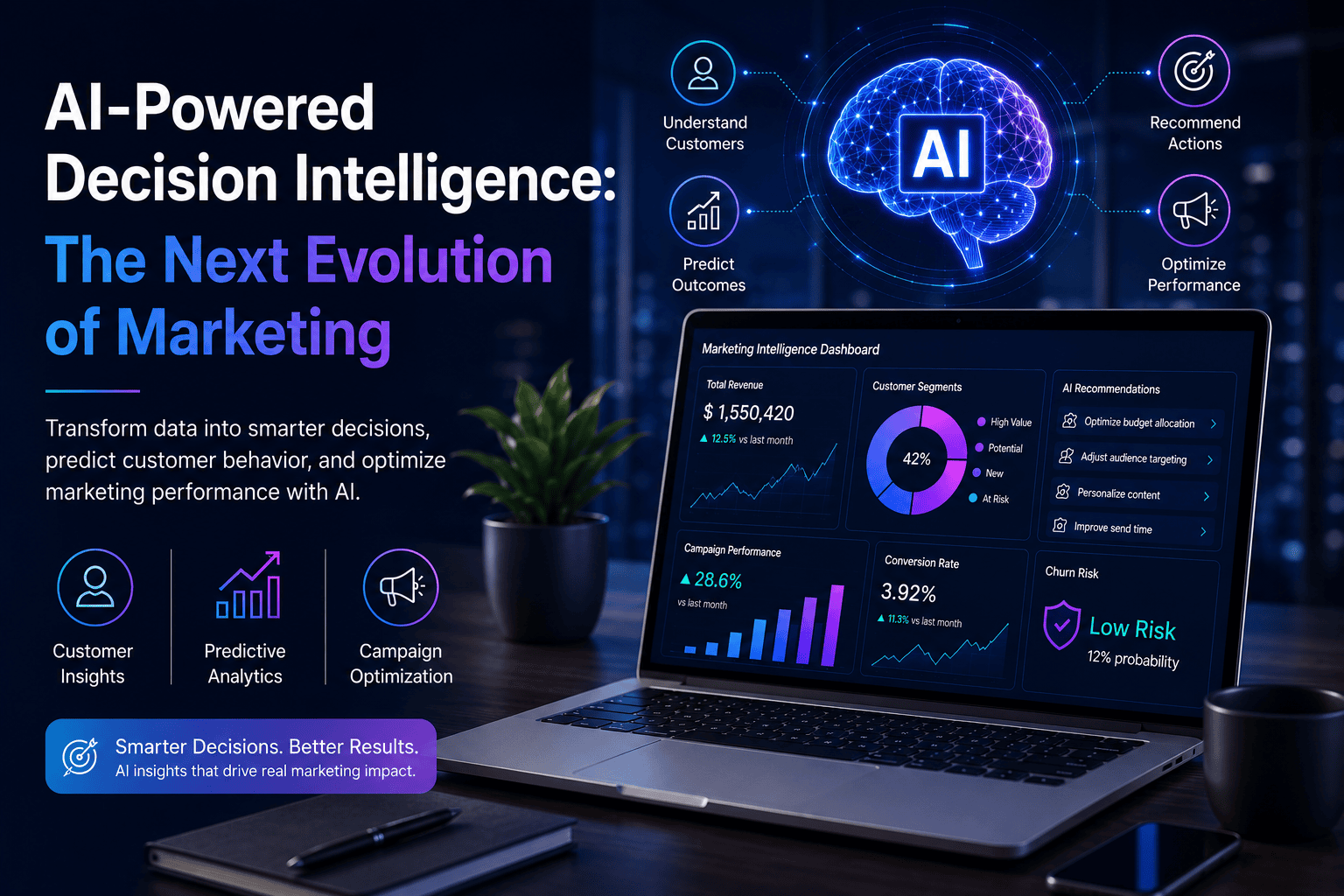
Modern marketing is no longer driven by intuition alone. Every customer interaction generates valuable information, from website visits and email clicks to purchase history and social media engagement. The challenge for businesses is not the lack of data—it is knowing how to transform that data into meaningful decisions.
This is where AI-Powered Decision Intelligence is changing the future of marketing.
Decision Intelligence combines artificial intelligence, machine learning, predictive analytics, and business intelligence to help marketers make faster, smarter, and more informed decisions. Instead of simply reporting what happened in the past, it provides actionable recommendations about what businesses should do next.
Whether it is identifying the right audience, optimizing campaign budgets, predicting customer behavior, or improving marketing performance, AI-powered decision intelligence enables organizations to move from reactive marketing to proactive strategy.
As digital competition grows, businesses that rely on intelligent decision-making are better positioned to deliver personalized customer experiences, improve marketing efficiency, and achieve sustainable growth.
What Is AI-Powered Decision Intelligence?
AI-Powered Decision Intelligence is an advanced approach that combines data analysis, artificial intelligence, machine learning, and predictive models to support better business and marketing decisions.
Unlike traditional reporting tools that only display historical performance, decision intelligence analyzes patterns, predicts future outcomes, and recommends the best course of action.
Think of it as an intelligent advisor that continuously evaluates data from multiple marketing channels and helps marketers make decisions backed by evidence rather than assumptions.
For example, instead of simply showing that an email campaign had a 22% open rate, a decision intelligence platform can recommend:
- The best time to send future emails.
- The audience segment most likely to engage.
- The type of content that drives higher conversions.
- Budget adjustments for better campaign performance.
This ability to turn insights into actions is what makes decision intelligence a powerful evolution in modern marketing.
Why Traditional Marketing Decisions Are No Longer Enough
Marketing teams often manage data from multiple platforms, including CRM systems, email marketing tools, website analytics, advertising platforms, and social media dashboards. While these tools provide valuable insights, they also create challenges.
Some common issues include:
- Data scattered across multiple platforms.
- Time-consuming manual analysis.
- Delayed decision-making.
- Difficulty identifying customer intent.
- Inconsistent campaign optimization.
Traditional reporting tells marketers what happened. Decision intelligence goes further by helping them understand why it happened, what is likely to happen next, and what action should be taken.
This shift allows businesses to become more agile and responsive in an increasingly competitive digital environment.
Key Components of AI-Powered Decision Intelligence
Artificial Intelligence
Artificial intelligence processes vast amounts of customer and marketing data far more quickly than manual analysis. AI identifies patterns, detects anomalies, and uncovers opportunities that might otherwise go unnoticed.
Machine Learning
Machine learning enables systems to improve continuously as they process more information. Over time, recommendations become more accurate because the models learn from customer behavior and campaign performance.
Predictive Analytics
Predictive analytics uses historical and real-time data to forecast future outcomes.
Examples include:
- Predicting customer churn.
- Estimating campaign performance.
- Identifying high-value leads.
- Forecasting product demand.
These predictions help businesses make proactive marketing decisions rather than reacting after opportunities have passed.
Business Intelligence
Business intelligence brings together information from multiple sources into dashboards and reports. Decision intelligence builds on this foundation by recommending specific actions based on the available insights.
Automation
AI-powered automation executes repetitive marketing tasks, such as audience segmentation, campaign scheduling, and performance monitoring. This allows marketing teams to focus on strategy, creativity, and innovation.
How AI-Powered Decision Intelligence Works
The process begins with collecting data from various sources, including websites, CRM systems, marketing automation platforms, analytics tools, social media, and customer support channels.
Once the data is collected, AI analyzes customer behavior, engagement patterns, and campaign performance. Machine learning models identify trends and generate predictions about future outcomes.
Finally, the platform recommends actions that can improve marketing performance, such as refining audience targeting, adjusting campaign budgets, or personalizing customer experiences.
This continuous cycle of collecting, analyzing, predicting, and optimizing enables businesses to make better decisions every day.
Benefits of AI-Powered Decision Intelligence
Smarter Decision-Making
Marketers gain access to recommendations based on real-time data instead of relying solely on assumptions or historical reports. This leads to faster and more confident decisions.
Improved Customer Personalization
By understanding customer preferences and behaviors, businesses can deliver more relevant content, product recommendations, and offers that increase engagement and conversions.
Better Campaign Performance
Decision intelligence continuously monitors marketing campaigns and identifies opportunities to improve targeting, messaging, timing, and budget allocation.
Increased Marketing Efficiency
Routine analysis and reporting are automated, allowing teams to spend more time on strategic planning, creative development, and customer engagement.
Stronger Return on Investment
With more accurate targeting and optimized campaigns, businesses can reduce wasted marketing spend and maximize returns on their investments.
Conclusion
AI-Powered Decision Intelligence is transforming how businesses approach modern marketing. By combining artificial intelligence, machine learning, predictive analytics, and business intelligence, organizations can move beyond traditional reporting and make proactive, data-driven decisions with greater confidence.
Rather than relying on intuition alone, marketers can leverage intelligent insights to optimize campaigns, personalize customer experiences, allocate budgets more effectively, and respond quickly to changing market conditions. This not only improves marketing efficiency but also drives stronger customer engagement and higher return on investment.
As the volume of marketing data continues to grow, businesses that embrace AI-Powered Decision Intelligence will be better equipped to identify opportunities, reduce uncertainty, and stay ahead of the competition. In the evolving digital landscape, intelligent decision-making is no longer just an advantage it is becoming an essential part of successful marketing.
Frequently Asked Questions (FAQs)
1. What is AI-Powered Decision Intelligence in marketing?
AI-Powered Decision Intelligence is the use of artificial intelligence, machine learning, predictive analytics, and business intelligence to help marketers analyze data, predict future outcomes, and make smarter, data-driven decisions that improve marketing performance.
2. How does AI-Powered Decision Intelligence improve marketing campaigns?
It analyzes customer behavior, identifies trends, recommends the best audience segments, optimizes campaign budgets, personalizes content, and predicts future campaign performance, helping businesses increase engagement and maximize return on investment (ROI).
3. Can small and medium-sized businesses benefit from AI-Powered Decision Intelligence?
Yes. AI-powered marketing solutions are suitable for businesses of all sizes. Small and medium-sized businesses can use these tools to automate repetitive tasks, gain valuable customer insights, improve targeting, and make informed marketing decisions without requiring large teams.
4. Why is AI-Powered Decision Intelligence important for the future of marketing?
As customer data continues to grow, businesses need faster and more accurate ways to make strategic decisions. AI-Powered Decision Intelligence enables organizations to deliver personalized customer experiences, optimize marketing strategies, respond quickly to market changes, and maintain a competitive advantage in the evolving digital landscape.