



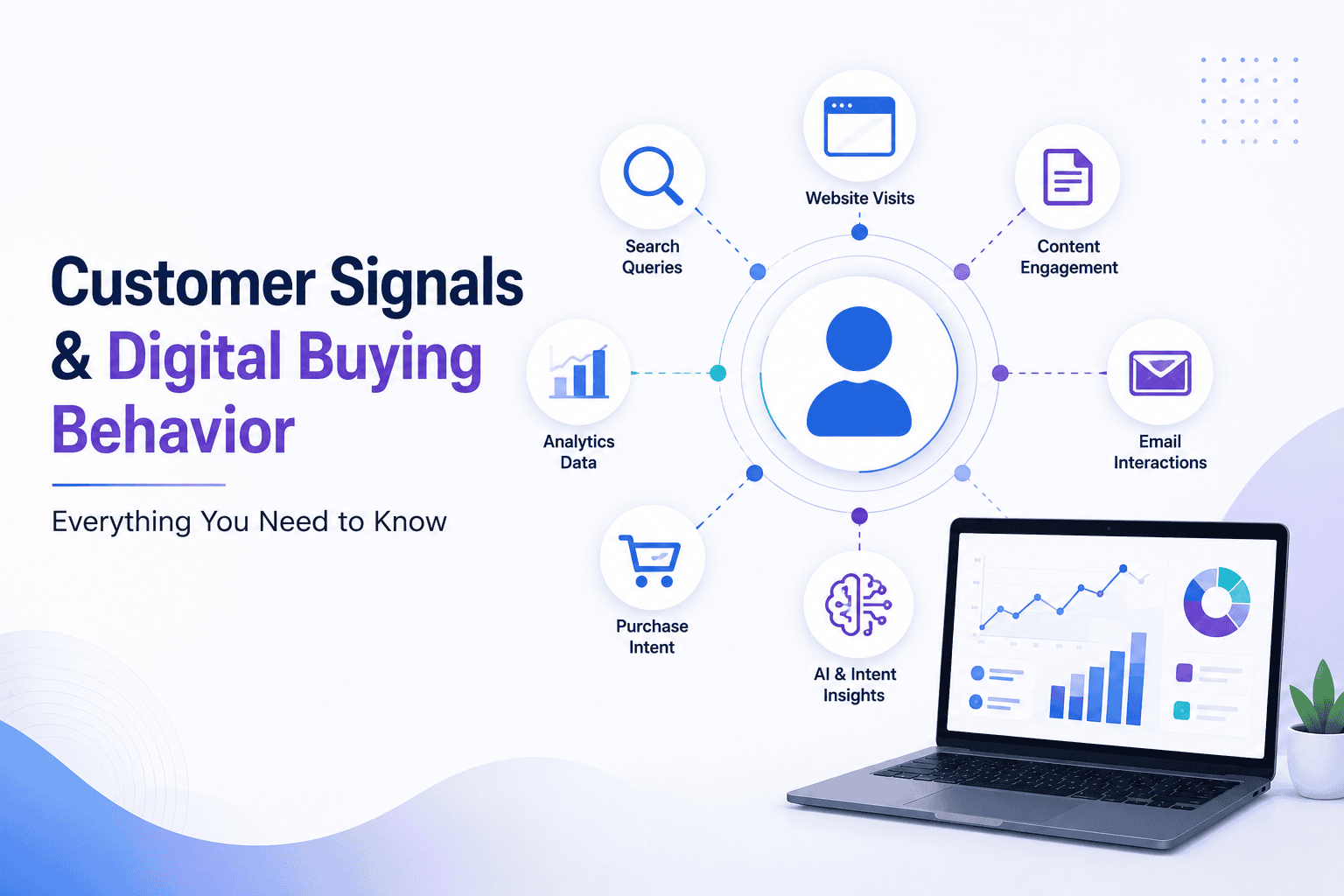
Today’s customers no longer follow a simple, linear path to making a purchase. Before choosing a product or service, they search online, compare competitors, read reviews, visit multiple websites, engage with social media, watch videos, download resources, and interact with email campaigns. Every one of these digital interactions creates valuable information known as customer signals.
Customer signals provide businesses with insights into what potential customers are interested in, where they are in the buying journey, and how likely they are to make a purchase. Instead of relying on assumptions, organisations can use customer signals to understand customer intent, personalise marketing campaigns, improve lead quality, and increase conversion rates.
As digital marketing becomes increasingly data-driven, customer signals have become one of the most valuable assets for marketers, sales teams, and business leaders. By analysing these signals, companies can create personalised customer experiences, predict buying behaviour, and make smarter business decisions.
In this comprehensive guide, we’ll explore customer signals, digital buying behaviour, different types of customer signals, how businesses collect and analyse them, and best practices for turning customer data into measurable business growth.
What Are Customer Signals?
Customer signals are digital actions, behaviours, and interactions that reveal a customer’s interests, preferences, engagement level, and purchase intent. Every time a customer interacts with a website, mobile app, email, advertisement, or social media platform, they leave behind valuable behavioural data.
These signals help businesses understand what customers are looking for and how close they are to making a purchasing decision.
Examples of customer signals include:
- Visiting a website
- Viewing product or service pages
- Reading blog articles
- Searching for keywords
- Downloading eBooks or whitepapers
- Watching videos
- Opening marketing emails
- Clicking advertisements
- Registering for webinars
- Filling out contact forms
- Booking product demonstrations
- Starting a free trial
- Adding products to a shopping cart
Each interaction contributes to a more complete understanding of customer behaviour and buying intent.
Why Customer Signals Matter
Modern buyers complete much of their research before contacting a sales representative. Because of this shift, businesses need to understand customer behaviour long before a direct conversation takes place.
Customer signals allow organisations to identify interested prospects, personalise communication, and improve customer experiences throughout the buying journey.
Key Benefits
- Understand customer intent
- Identify high-quality leads
- Improve marketing personalisation
- Increase conversion rates
- Shorten sales cycles
- Improve customer retention
- Optimise marketing budgets
- Enhance customer experiences
- Strengthen sales and marketing alignment
- Make data-driven business decisions
Businesses that effectively use customer signals can engage potential buyers with relevant information at exactly the right moment.
Types of Customer Signals
Understanding different types of customer signals helps businesses create more effective marketing strategies.
1. Behavioural Signals
Behavioural signals show how customers interact with websites, apps, and digital content.
Examples include:
- Multiple website visits
- Returning visitors
- Product page views
- Time spent on pages
- Scroll depth
- Resource downloads
- Blog reading behaviour
- Navigation paths
These behaviours indicate customer interest and engagement.
2. Engagement Signals
Engagement signals measure how customers respond to marketing efforts.
Examples include:
- Email opens
- Email clicks
- Newsletter subscriptions
- Webinar registrations
- Video views
- Social media engagement
- Survey responses
- Form submissions
Higher engagement usually indicates stronger buying intent.
3. Search Signals
Search activity reveals what customers are actively researching.
Examples include:
- Searching for products
- Comparing competitors
- Looking for pricing
- Reading reviews
- Searching implementation guides
- Exploring industry trends
Search signals often provide some of the earliest indicators of customer intent.
4. Social Signals
Customers also reveal preferences through social media.
Examples include:
- Likes
- Comments
- Shares
- Brand mentions
- Following company pages
- Watching live events
- Participating in discussions
These interactions help businesses understand audience interests.
5. Transactional Signals
Transactional signals indicate strong purchase intent.
Examples include:
- Adding products to a cart
- Requesting quotations
- Booking consultations
- Starting free trials
- Contacting sales
- Downloading pricing documents
- Completing purchases
These signals often identify customers who are ready to buy.
Understanding Digital Buying Behaviour
Digital buying behaviour describes how consumers research, evaluate, and purchase products through online channels. Unlike traditional buying journeys, modern customers interact with multiple digital touchpoints before making a decision.
A typical buying journey includes:
Awareness
Customers realise they have a problem and begin searching for information.
Common signals include:
- Google searches
- Reading educational blogs
- Watching explainer videos
- Visiting industry websites
Consideration
Customers compare different solutions.
Common signals include:
- Downloading comparison guides
- Reading case studies
- Comparing vendors
- Attending webinars
- Visiting product pages
Decision
Customers are ready to make a purchase.
Common signals include:
- Viewing pricing pages
- Booking demonstrations
- Contacting sales
- Reading testimonials
- Starting free trials
Recognising these signals helps businesses deliver relevant information at every stage.
How Businesses Collect Customer Signals
Modern organisations use multiple technologies to collect customer data.
These include:
- Website analytics platforms
- Customer Relationship Management (CRM) software
- Marketing automation tools
- Customer Data Platforms (CDPs)
- Email marketing software
- Social media analytics
- Website heatmaps
- Conversion tracking systems
- Customer surveys
- Intent data platforms
Integrating these systems creates a unified customer profile that supports better marketing and sales decisions.
Customer Signals and Personalisation
One of the biggest advantages of customer signals is the ability to personalise customer experiences.
Businesses can use behavioural insights to:
- Recommend relevant content
- Suggest products
- Personalise email campaigns
- Display targeted advertisements
- Deliver customised website experiences
- Offer timely promotions
Personalisation increases engagement because customers receive information that matches their interests and needs.
Customer Signals vs Intent Data
Although these terms are often used together, they are different.
| Customer Signals | Intent Data |
|---|---|
| Individual customer actions | Combined analysis of multiple signals |
| Website visits | Buying intent prediction |
| Email engagement | Lead prioritisation |
| Content downloads | Account-level insights |
| Social interactions | Sales opportunity identification |
Customer signals are the raw behavioural data, while intent data interprets those signals to identify likely buyers.
How Artificial Intelligence Uses Customer Signals
Artificial Intelligence has transformed customer signal analysis.
AI systems can:
- Predict customer intent
- Identify buying patterns
- Segment audiences automatically
- Recommend personalised content
- Detect churn risks
- Improve lead scoring
- Automate customer journeys
Machine learning continuously improves these predictions by analysing large volumes of behavioural data in real time.
Common Challenges
Despite their value, customer signals present several challenges.
These include:
- Poor data quality
- Data silos
- Privacy regulations
- Cookie limitations
- Disconnected marketing tools
- Large volumes of behavioural data
- Difficulty identifying meaningful patterns
Businesses should develop strong data governance practices to ensure accurate and responsible use of customer information.
Best Practices
To maximise the value of customer signals:
- Focus on collecting first-party data.
- Respect privacy laws and customer consent.
- Combine multiple signals instead of relying on one action.
- Integrate CRM and marketing platforms.
- Continuously monitor customer behaviour.
- Use AI for predictive insights.
- Align sales and marketing teams.
- Regularly optimise customer journeys.
Following these practices helps organisations create more effective and customer-centric marketing strategies.
Future Trends
Customer signal analysis continues to evolve with advances in technology.
Emerging trends include:
- AI-powered predictive analytics
- Real-time customer journey mapping
- Privacy-first data collection
- Cookieless marketing strategies
- First-party data growth
- Advanced marketing automation
- Hyper-personalisation
- Predictive lead scoring
- Intelligent customer engagement
Businesses that embrace these innovations will be better positioned to understand customer needs and deliver exceptional digital experiences.
Conclusion
Customer signals are at the heart of modern digital buying behaviour. Every website visit, search query, content download, email click, and social media interaction provides valuable insight into customer interests and purchase intent. By collecting and analysing these signals, businesses can better understand their audiences, personalise marketing efforts, improve lead quality, and build stronger customer relationships.
As artificial intelligence, analytics, and marketing automation continue to advance, customer signals will become even more valuable for predicting customer needs and delivering relevant experiences. Organisations that invest in understanding digital buying behaviour will be better equipped to make informed decisions, increase conversions, and achieve long-term business growth.
Frequently Asked Questions (FAQs)
1. What are customer signals?
Customer signals are digital interactions that indicate a person’s interests, preferences, and likelihood of making a purchase.
2. Why are customer signals important?
They help businesses understand customer behaviour, improve marketing personalisation, qualify leads, and increase conversion rates.
3. What is digital buying behaviour?
Digital buying behaviour refers to the online activities customers perform while researching and purchasing products or services.
4. What are examples of customer signals?
Examples include website visits, product page views, search queries, email engagement, content downloads, webinar registrations, and social media interactions.