






The way businesses engage with customers has changed dramatically over the last decade. Traditional marketing automation helped organizations streamline repetitive tasks such as sending emails, scheduling campaigns, and managing customer journeys. While these capabilities remain valuable, modern customers expect much more than automated communication. They expect brands to understand their preferences, anticipate their needs, and deliver personalized experiences across every interaction.
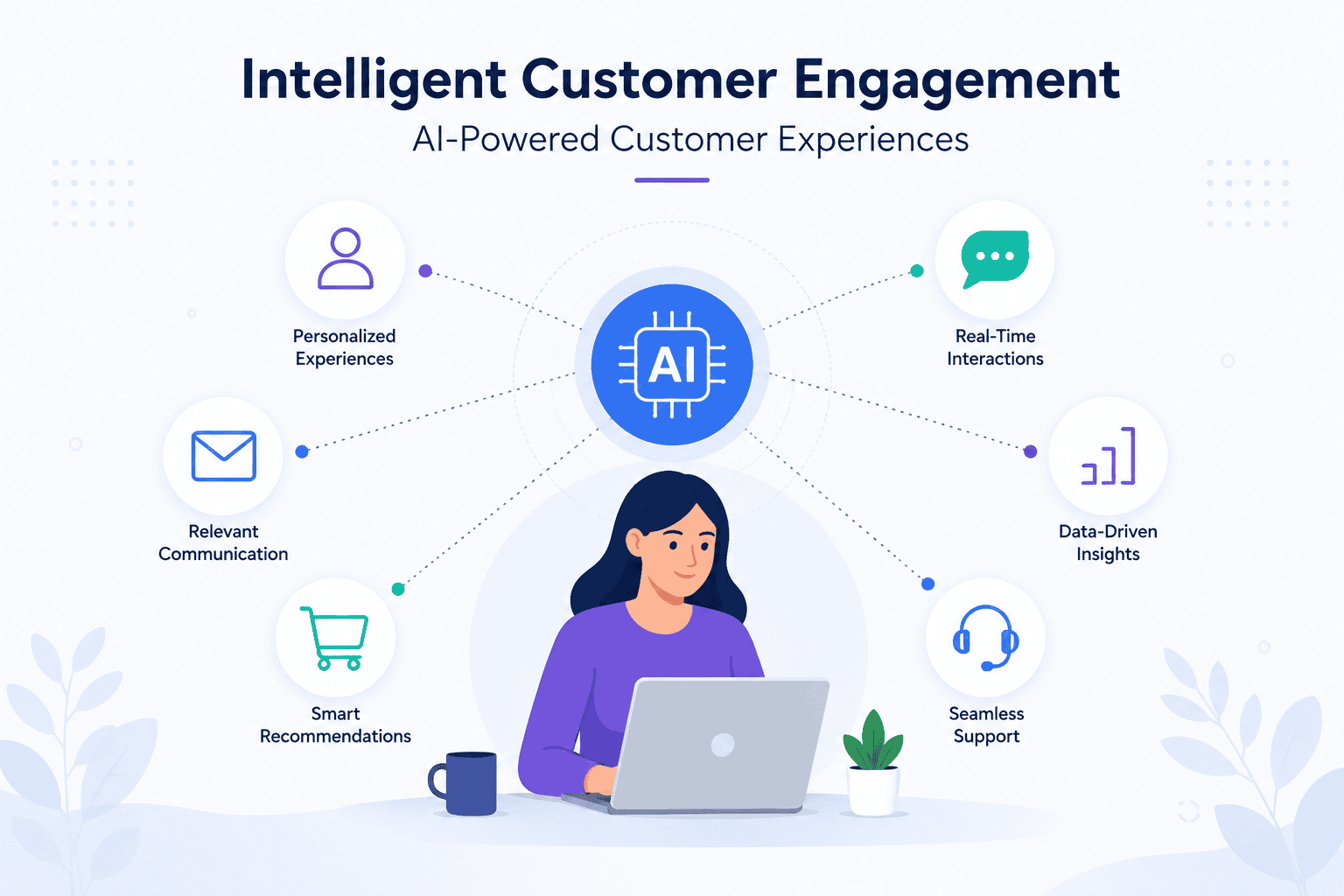
This shift has given rise to Intelligent Customer Engagement (ICE) – a strategy that combines artificial intelligence (AI), customer data, predictive analytics, and marketing automation to create meaningful, real-time interactions. Rather than relying on static workflows or generic campaigns, intelligent engagement continuously learns from customer behavior and adapts communication based on individual preferences and context.
Whether someone is visiting a website, opening an email, chatting with a support agent, or browsing products on a mobile app, intelligent customer engagement ensures that every interaction feels relevant, timely, and valuable.
In today’s competitive digital landscape, businesses that invest in intelligent engagement are better positioned to increase customer satisfaction, strengthen loyalty, improve retention, and drive sustainable business growth.
What Is Intelligent Customer Engagement?
Intelligent Customer Engagement is a customer-focused approach that uses technology to deliver personalized and context-aware experiences throughout the customer journey. It combines customer relationship management (CRM), marketing automation, AI, machine learning, predictive analytics, and unified customer data to help businesses understand and respond to customer behavior more effectively.
Unlike traditional automation, which follows predefined rules and workflows, intelligent engagement analyzes customer interactions in real time and adjusts communication accordingly. This enables businesses to provide relevant recommendations, personalized offers, and proactive support that align with each customer’s unique needs.
For example, instead of sending the same promotional email to every subscriber, an intelligent engagement platform can recommend different products, content, or services based on browsing history, purchase behavior, location, and engagement patterns.
Why Traditional Automation Is No Longer Enough
Marketing automation transformed digital marketing by helping businesses automate repetitive tasks such as email campaigns, lead nurturing, and customer segmentation. However, automation alone has limitations.
Traditional systems often rely on fixed workflows that do not adapt to changing customer behavior. As a result, customers may receive irrelevant messages, repeated promotions, or delayed responses that fail to address their current needs.
Today’s customers expect businesses to:
- Receive personalized recommendations instead of generic promotions.
- Experience consistent communication across multiple channels.
- Get immediate responses to inquiries.
- Interact with brands that understand their preferences.
- Receive relevant information at the right time.
Meeting these expectations requires more than automation. It requires intelligence, adaptability, and data-driven decision-making.
From Automation to Intelligence
The evolution of customer engagement can be viewed in four stages:
1. Manual Marketing
Businesses relied on phone calls, printed advertisements, and face-to-face interactions. Communication was personalized but difficult to scale.
2. Marketing Automation
Organizations introduced automated email campaigns, lead nurturing workflows, and scheduled communications. This improved efficiency but still depended on predefined rules.
3. Data-Driven Personalization
Customer data from websites, CRM systems, and analytics platforms enabled businesses to segment audiences and deliver more targeted campaigns.
4. Intelligent Customer Engagement
Artificial intelligence now enables businesses to analyze customer intent, predict future behavior, optimize marketing campaigns, and personalize every interaction in real time.
Core Components of Intelligent Customer Engagement
Artificial Intelligence
AI is the foundation of intelligent engagement. It processes large volumes of customer data, identifies patterns, and generates insights that help businesses make smarter decisions.
AI can:
- Recommend products
- Personalize content
- Predict customer needs
- Improve customer support
- Optimize campaigns automatically
Instead of relying on assumptions, businesses can use AI to make decisions based on actual customer behavior.
Customer Data Platforms (CDPs)
Customers interact with businesses through multiple touchpoints, including websites, email campaigns, mobile apps, social media, and customer support channels.
A Customer Data Platform combines this information into a unified customer profile.
This unified view allows businesses to understand:
- Purchase history
- Browsing behavior
- Marketing interactions
- Customer preferences
- Communication history
- Support requests
Having complete customer visibility enables more accurate personalization and better customer experiences.
Predictive Analytics
Predictive analytics uses historical and real-time data to forecast future customer actions.
Businesses can identify:
- Customers likely to make a purchase
- Customers at risk of leaving
- Products customers may be interested in
- The best time to send marketing messages
These insights help organizations take proactive actions instead of reacting after opportunities have been lost.
Machine Learning
Machine learning continuously improves customer engagement strategies by learning from new customer interactions.
As more data becomes available, recommendations become increasingly accurate, allowing businesses to improve personalization over time without manually updating workflows.
Omnichannel Communication
Customers expect consistent experiences regardless of how they interact with a business.
Intelligent engagement connects communication across:
- Websites
- Mobile applications
- SMS
- Social media
- Live chat
- Customer support
This ensures customers receive relevant information without repeating themselves or experiencing disconnected interactions.
Benefits of Intelligent Customer Engagement
Improved Personalization
Customers are more likely to engage with businesses that understand their interests and preferences.
Personalized recommendations, tailored content, and relevant offers create better customer experiences and increase engagement.
Better Customer Satisfaction
When businesses provide timely assistance, accurate recommendations, and personalized communication, customers are more satisfied with their overall experience.
Satisfied customers are also more likely to become loyal advocates for the brand.
Increased Customer Retention
Retaining existing customers is often more cost-effective than acquiring new ones.
Intelligent engagement helps businesses identify customers who may be losing interest and proactively re-engage them through personalized communication and special offers.
Higher Conversion Rates
Relevant content and personalized recommendations encourage customers to take action.
Whether purchasing a product, requesting a demo, or subscribing to a service, personalized experiences significantly improve conversion rates.
Greater Marketing Efficiency
AI reduces manual work by automating audience segmentation, campaign optimization, content recommendations, and customer insights.
Marketing teams can focus more on strategy and creativity while AI handles repetitive analysis.
Real-World Applications
E-commerce
Online retailers use intelligent engagement to recommend products, recover abandoned carts, personalize homepage content, and send targeted promotions based on browsing history.
B2B Marketing
B2B organizations use AI-powered lead scoring, account-based marketing, and predictive analytics to identify high-value prospects and deliver personalized outreach throughout the buying journey.
SaaS Companies
Software companies improve onboarding experiences, monitor product adoption, identify churn risks, and recommend additional features based on customer behavior.
Banking and Financial Services
Financial institutions use intelligent engagement to provide personalized financial recommendations, detect fraud, automate customer support, and improve digital banking experiences.
Healthcare
Healthcare providers use intelligent engagement for appointment reminders, patient education, personalized wellness recommendations, and virtual support assistants.
Best Practices for Implementation
Successfully implementing intelligent customer engagement requires more than adopting new technology.
Businesses should:
- Build a unified customer database.
- Maintain accurate and reliable customer information.
- Respect customer privacy and data security.
- Combine AI with human expertise.
- Continuously analyze customer feedback.
- Test and optimize campaigns regularly.
- Measure performance using key business metrics.
Common Challenges
Organizations may encounter several challenges during implementation:
- Disconnected customer data
- Poor data quality
- Legacy technology systems
- Privacy regulations
- Limited AI expertise
- Organizational resistance to change
Addressing these challenges requires a clear strategy, strong leadership, and ongoing investment in technology and employee training.
The Future of Intelligent Customer Engagement
Customer engagement will continue evolving as AI technologies become more sophisticated.
Future trends include:
- AI-powered marketing agents
- Hyper-personalized customer journeys
- Real-time decision engines
- Voice-enabled customer experiences
- Predictive customer service
- Emotion-aware AI interactions
- Privacy-first personalization
- Autonomous marketing optimization
Organizations that embrace these innovations while maintaining transparency and trust will be better positioned to build lasting customer relationships.
Conclusion
Intelligent Customer Engagement represents the next evolution of digital marketing and customer experience. While traditional automation improved operational efficiency, today’s competitive landscape requires businesses to go further by delivering personalized, intelligent, and meaningful interactions at every stage of the customer journey.
By combining artificial intelligence, customer data, predictive analytics, CRM systems, and marketing automation, businesses can better understand customer needs, improve satisfaction, increase retention, and drive long-term growth.
The future belongs to organizations that move beyond automation and place intelligent, customer-centric experiences at the heart of their marketing strategy.
Frequently Asked Questions
What is Intelligent Customer Engagement?
It is the use of AI, customer data, analytics, and automation to deliver personalized customer experiences across multiple channels.
How is Intelligent Customer Engagement different from marketing automation?
Marketing automation follows predefined workflows, while intelligent engagement continuously adapts using AI and real-time customer data.
Which industries benefit from Intelligent Customer Engagement?
Retail, e-commerce, healthcare, finance, SaaS, manufacturing, education, travel, and B2B organizations all benefit from intelligent engagement strategies.
What technologies are used?
Common technologies include AI, machine learning, CRM platforms, Customer Data Platforms (CDPs), predictive analytics, marketing automation, conversational AI, and business intelligence tools.