






Artificial Intelligence has become a driving force behind modern marketing, enabling businesses to automate tasks, analyze customer behavior, and deliver highly personalized experiences. While AI-powered tools have already transformed content creation, customer service, and campaign optimization, a new evolution is rapidly changing the industry — AI Agents.
Unlike traditional automation tools that execute predefined tasks, AI agents can make decisions, adapt to changing situations, and independently perform complex marketing activities. They learn from customer interactions, analyze vast amounts of data, and continuously optimize marketing strategies with minimal human intervention.
From personalized email campaigns and intelligent chatbots to predictive analytics and campaign optimization, AI agents are helping businesses improve efficiency while delivering exceptional customer experiences.
In this guide, we’ll explore what AI agents are, how they work, their benefits, practical applications, challenges, and best practices for integrating them into modern digital marketing.
What Are AI Agents?
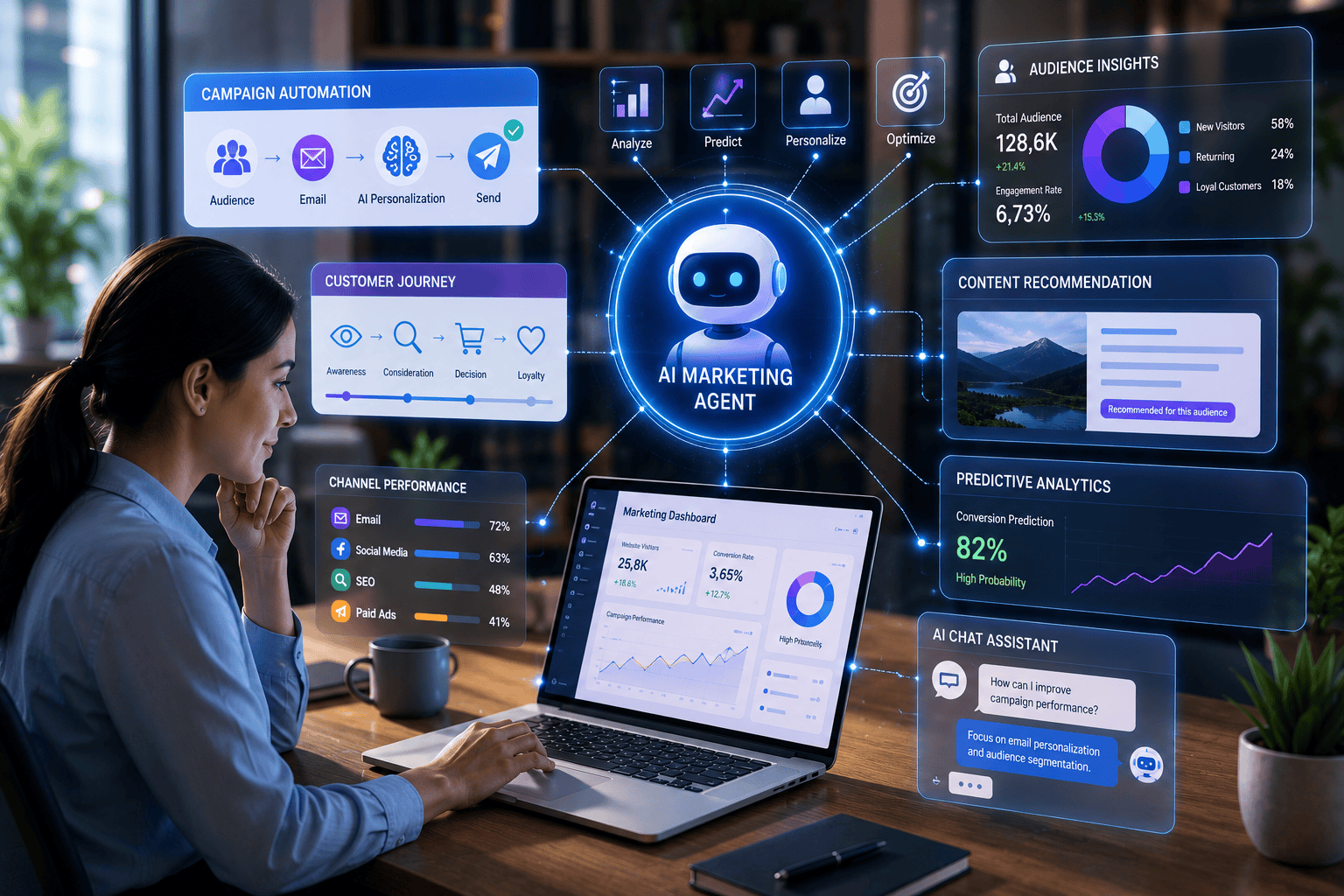
AI agents are intelligent software systems that can perceive information, analyze data, make decisions, and perform actions autonomously to achieve specific goals.
Unlike rule-based automation, AI agents continuously learn from interactions and improve their performance over time. They can process customer behavior, predict outcomes, and respond intelligently without requiring constant human supervision.
Think of an AI agent as a digital marketing assistant that never sleeps. It monitors campaigns, responds to customer inquiries, identifies trends, and recommends actions based on real-time insights.
How AI Agents Work
AI agents combine several advanced technologies, including:
- Machine Learning
- Natural Language Processing (NLP)
- Predictive Analytics
- Generative AI
- Customer Data Platforms
- Marketing Automation Systems
The process typically follows these steps:
1. Data Collection
The AI agent gathers information from websites, CRM systems, email campaigns, social media, analytics platforms, and customer interactions.
2. Data Analysis
It identifies customer behavior, buying intent, preferences, and engagement patterns.
3. Decision Making
Using predictive models, the AI agent determines the best marketing action.
4. Action Execution
The agent automatically sends emails, recommends products, personalizes website experiences, schedules campaigns, or responds to customer inquiries.
5. Continuous Learning
Every customer interaction helps improve future recommendations and marketing performance.
Why AI Agents Matter in Marketing
Today’s customers expect personalized, relevant, and timely experiences. Traditional marketing workflows often require manual analysis and execution, which can be slow and resource-intensive.
AI agents enable marketers to:
- Make faster decisions
- Improve personalization
- Automate repetitive tasks
- Increase operational efficiency
- Enhance customer satisfaction
- Optimize marketing budgets
- Improve campaign performance
This allows marketing teams to focus on creativity, strategy, and innovation rather than routine operational tasks.
Key Benefits of AI Agents in Marketing
1. Smarter Customer Personalization
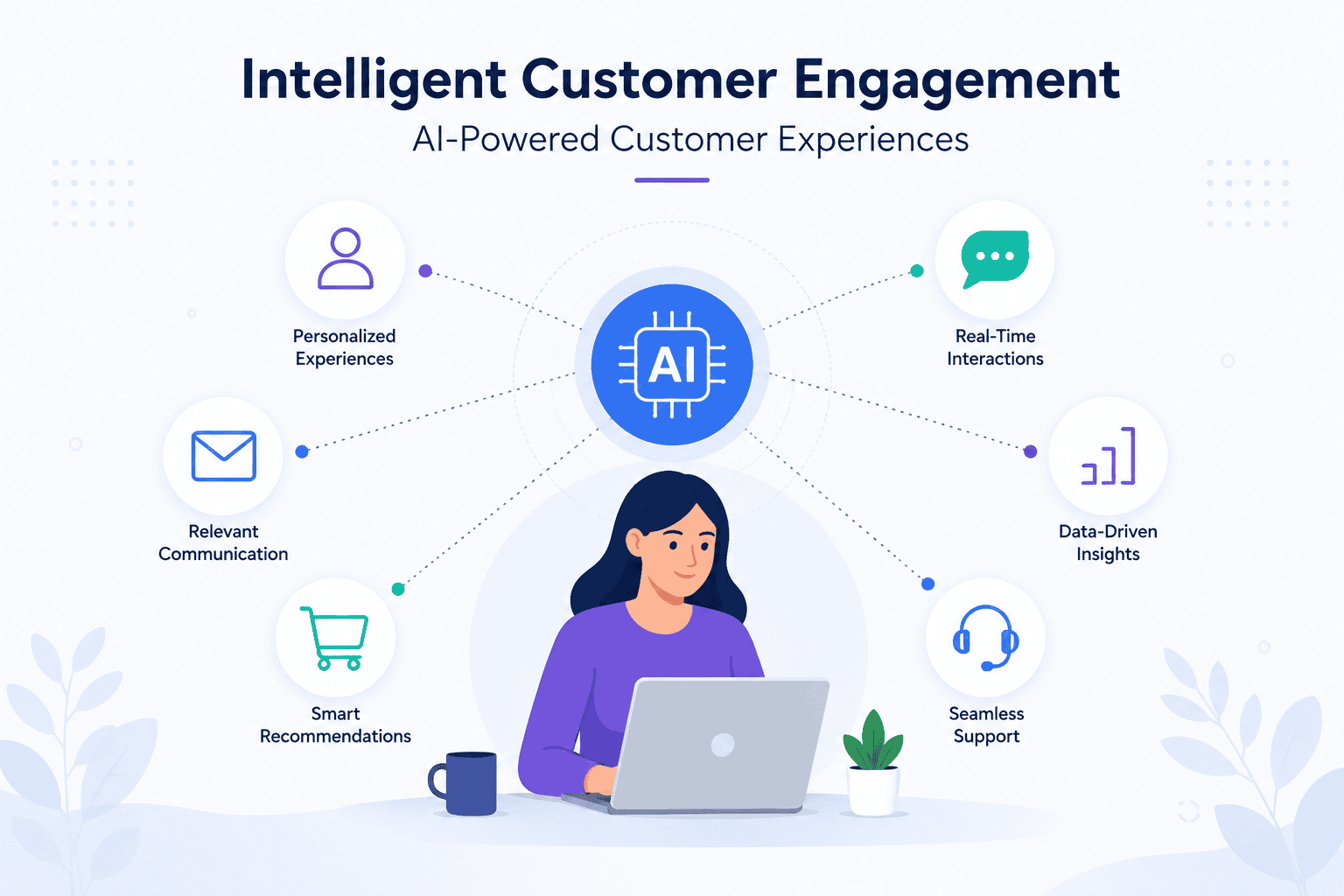
AI agents analyze customer preferences, browsing behavior, purchase history, and engagement patterns to deliver highly relevant experiences.
Examples include:
- Personalized product recommendations
- Dynamic website content
- Customized email campaigns
- Individualized offers
This level of personalization improves customer satisfaction and conversion rates.
2. Marketing Automation Beyond Workflows
Traditional automation follows predefined rules.
AI agents go a step further by making intelligent decisions based on changing customer behavior.
For example, instead of sending every subscriber the same email sequence, an AI agent can determine:
- The best email content
- The ideal send time
- The preferred communication channel
- Whether a customer should receive a discount
3. Better Customer Support
Modern AI agents power intelligent virtual assistants capable of handling customer inquiries around the clock.
They can:
- Answer FAQs
- Recommend products
- Resolve common issues
- Escalate complex conversations
- Schedule appointments
This improves response times while reducing support costs.
4. Predictive Marketing
Rather than reacting to customer behavior, AI agents anticipate future actions.
They can predict:
- Purchase intent
- Customer churn
- High-value leads
- Seasonal demand
- Product interest
Predictive insights help businesses make proactive marketing decisions.
5. Campaign Optimization
AI agents continuously monitor campaign performance across multiple channels.
They automatically adjust:
- Audience targeting
- Budget allocation
- Bid strategies
- Ad creatives
- Content recommendations
This helps maximize return on investment while minimizing manual effort.
Real-World Applications of AI Agents
Email Marketing
AI agents personalize subject lines, optimize send times, segment audiences, and recommend content that aligns with customer interests.
Social Media Management
They can:
- Schedule posts
- Analyze engagement
- Recommend trending topics
- Generate captions
- Monitor audience sentiment
Content Marketing
AI agents assist marketers by:
- Suggesting blog topics
- Identifying keyword opportunities
- Optimizing content for SEO
- Repurposing existing content
- Recommending updates for older articles
Lead Generation
AI agents evaluate visitor behavior, identify qualified leads, and prioritize prospects based on their likelihood to convert.
Customer Journey Optimization
They monitor every touchpoint throughout the customer journey and identify opportunities to improve engagement and conversions.
AI Agents vs Traditional Marketing Automation
| Feature | Traditional Automation | AI Agents |
|---|---|---|
| Rule-Based | Yes | No |
| Learns from Data | Limited | Yes |
| Decision Making | Manual | Autonomous |
| Personalization | Moderate | Advanced |
| Predictive Capabilities | Minimal | High |
| Adaptability | Low | Excellent |
| Continuous Improvement | No | Yes |
Challenges of AI Agents
While AI agents offer significant advantages, organizations should also consider potential challenges:
- Data privacy and compliance
- Integration with existing marketing systems
- Data quality issues
- Ethical use of AI
- Human oversight requirements
- Employee training and adoption
- Initial implementation costs
Addressing these challenges with proper planning ensures successful AI adoption.
Best Practices for Implementing AI Agents
- Define clear business objectives before deployment.
- Start with one or two high-impact use cases, such as email personalization or customer support.
- Ensure your CRM and customer data are accurate and up to date.
- Maintain transparency about how AI is used.
- Regularly monitor AI performance and refine its outputs.
- Keep human oversight in place for strategic decisions.
- Measure results using KPIs such as engagement, conversion rates, customer satisfaction, and ROI.
The Future of AI Agents in Marketing
AI agents are expected to become even more capable as advancements in artificial intelligence continue. Future AI agents will be able to collaborate across multiple marketing functions, coordinate campaigns across channels, and provide deeper insights into customer behavior.
Businesses that adopt AI responsibly and integrate it into their marketing strategies will be better equipped to deliver personalized experiences, improve operational efficiency, and stay competitive in an increasingly digital marketplace.
Conclusion
AI agents represent the next stage in the evolution of digital marketing. By combining automation with intelligent decision-making, they help businesses create more personalized customer experiences, improve campaign performance, and streamline marketing operations.
While successful implementation requires quality data, thoughtful planning, and human oversight, the potential benefits are substantial. Organizations that embrace AI agents can build stronger customer relationships, make faster decisions, and create more effective marketing strategies that adapt to changing customer needs.
Rather than replacing marketers, AI agents act as intelligent partners — handling repetitive tasks, uncovering valuable insights, and enabling teams to focus on creativity, strategy, and long-term growth.
Frequently Asked Questions (FAQs)
1. What are AI agents in marketing?
AI agents are intelligent software systems that can analyze data, make decisions, and perform marketing tasks autonomously to improve efficiency and customer engagement.
2. How are AI agents different from traditional marketing automation?
Traditional automation follows predefined rules, while AI agents learn from data, adapt to changing situations, and make intelligent decisions without constant human intervention.
3. Can small businesses benefit from AI agents?
Yes. AI agents can help businesses of all sizes automate customer support, personalize marketing, optimize campaigns, and improve productivity.
4. Are AI agents replacing marketers?
No. AI agents are designed to support marketers by automating repetitive tasks and providing data-driven insights, allowing professionals to focus on strategy and creativity.
5. What industries can use AI agents?
AI agents are valuable across industries, including eCommerce, SaaS, healthcare, finance, education, retail, travel, and B2B marketing.