










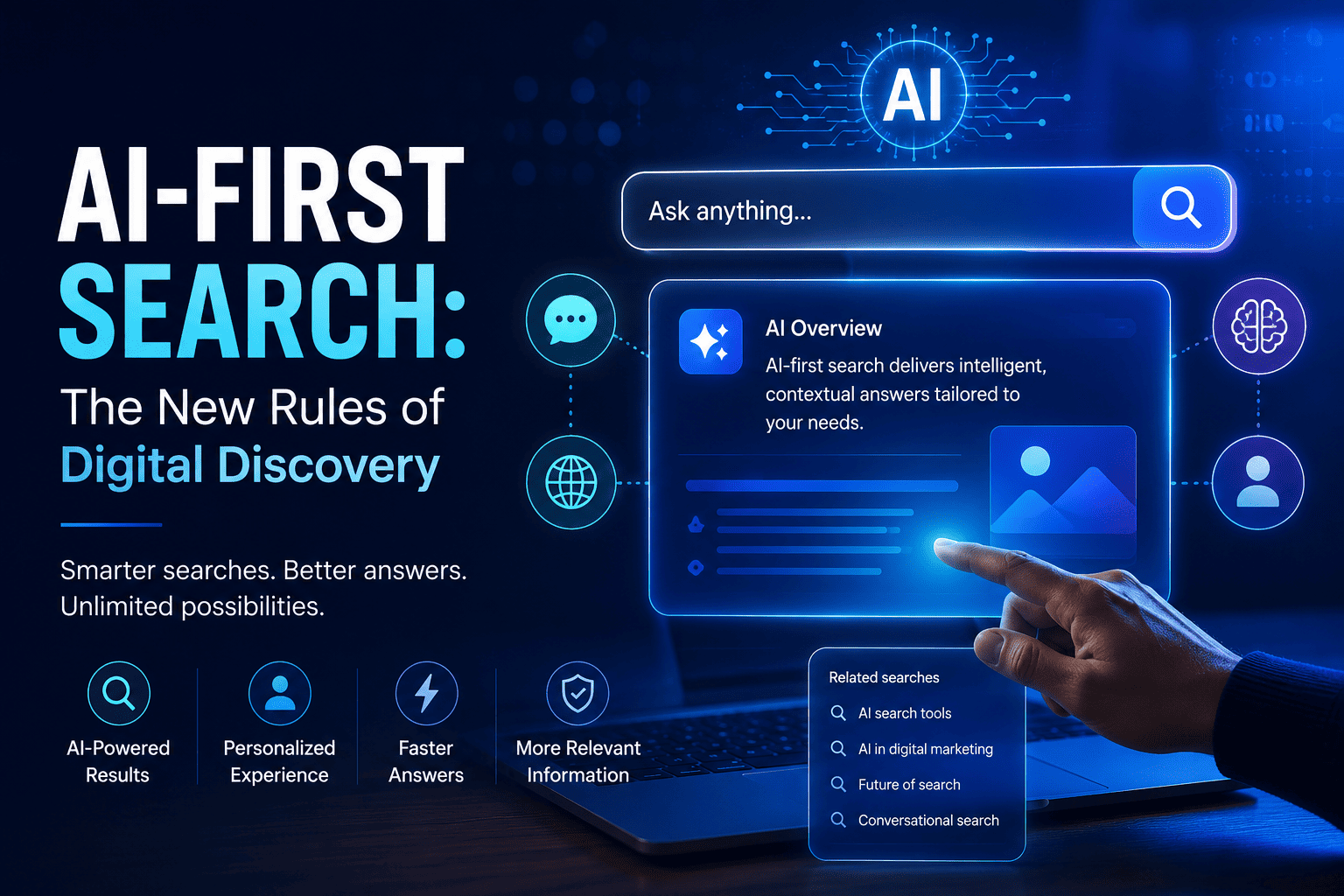
The way people search for information is evolving rapidly. Traditional search engines are no longer the only gateway to online content. Today, artificial intelligence is transforming how users discover information through AI-powered search experiences that deliver faster, more personalized, and context-aware answers.
This shift has given rise to AI-First Search, where AI models understand user intent, generate direct responses, and recommend relevant content without relying solely on keyword matching. For businesses and marketers, adapting to this new search landscape is becoming essential for maintaining visibility and reaching their target audience.
What Is AI-First Search?
AI-First Search is a modern approach to information discovery that uses artificial intelligence to understand user intent, analyze context, and provide direct answers instead of simply displaying a list of web pages.
Unlike traditional search, AI-First Search combines natural language processing (NLP), machine learning, and generative AI to deliver more accurate, conversational, and personalized search experiences.
Examples include AI assistants, AI-generated search summaries, and conversational search platforms.
How AI-First Search Works
AI-First Search follows several intelligent processes:
- Understands natural language queries
- Identifies user intent
- Analyzes trusted information sources
- Generates summarized responses
- Learns from user interactions
- Provides personalized recommendations
Instead of matching keywords alone, AI focuses on understanding what users truly want.
Why AI-First Search Matters
AI-First Search is changing the way people access information.
Key benefits include:
- Faster answers
- Better search accuracy
- Personalized search experiences
- Reduced search time
- Conversational interactions
- Improved decision-making
Users can now receive complete answers without visiting multiple websites.
AI-First Search vs Traditional Search
| Traditional Search | AI-First Search |
|---|---|
| Keyword matching | Intent understanding |
| List of links | Direct AI-generated answers |
| Multiple searches | Conversational follow-up questions |
| Limited personalization | Personalized recommendations |
| Manual information gathering | Instant summarized insights |
The Impact on SEO
SEO is evolving alongside AI.
To succeed in AI-First Search, businesses should:
- Create people-first content.
- Answer real user questions.
- Build topical authority.
- Publish original insights.
- Improve website speed and mobile performance.
- Use structured data (Schema Markup).
- Demonstrate expertise, experience, authority, and trust (E-E-A-T).
- Keep content updated.
Quality and relevance now matter more than keyword density.
Content Strategies for AI-First Search
Businesses should focus on:
1. Create Comprehensive Content
Publish in-depth articles that fully answer user questions.
2. Optimize for Conversational Queries
Use natural language instead of keyword stuffing.
3. Add FAQ Sections
Frequently Asked Questions help AI understand and extract relevant answers.
4. Use Clear Headings
Well-structured content improves readability for both users and AI systems.
5. Build Content Clusters
Cover related topics to establish authority in your niche.
Challenges of AI-First Search
Although AI offers many advantages, organizations should also consider:
- Reduced website clicks due to AI summaries
- Increased competition for AI visibility
- Greater demand for trustworthy content
- Risk of outdated or inaccurate AI responses
- Continuous algorithm updates
Businesses must consistently produce reliable and valuable content.
Best Practices
To improve visibility in AI-First Search:
- Understand user intent before creating content.
- Write for people first.
- Use descriptive headings.
- Include relevant statistics and examples.
- Add internal and external links.
- Optimize page speed.
- Improve mobile usability.
- Refresh older articles regularly.
The Future of Digital Discovery
AI-First Search will continue to reshape digital discovery through:
- Smarter AI assistants
- Voice-first search experiences
- Visual and multimodal search
- Personalized recommendations
- Predictive search results
- More conversational interactions
Businesses that embrace AI-friendly content strategies today will be better positioned for future search innovations.
Conclusion
AI-First Search represents a significant shift in how information is discovered online. Instead of relying on keywords alone, AI understands intent, context, and user needs to deliver meaningful answers.
For marketers, businesses, and content creators, success in this new era depends on producing high-quality, trustworthy, and user-focused content. By adapting SEO strategies and embracing AI-driven search experiences, organizations can remain visible and competitive in the future of digital discovery.
Frequently Asked Questions
1. What is AI-first search?
AI-first search uses artificial intelligence to understand user intent, context, and questions, providing more direct and conversational answers.
2. How is AI-first search changing digital discovery?
AI-first search is shifting digital discovery from traditional keyword-based results toward conversational answers, summaries, recommendations, and context-driven information.
3. Why is AI-first search important for marketers?
AI-first search encourages marketers to create helpful, authoritative, and well-structured content that AI systems can understand and use when answering user queries.
4. How can businesses prepare for AI-first search?
Businesses can prepare by creating high-quality content, using clear information architecture, building topical relevance, adding structured data, and answering customer questions directly.