









Marketing technology has changed dramatically. A few years ago, having a CRM, email platform, analytics tool, and advertising dashboard was enough to build a basic MarTech stack. In 2026, that approach is no longer enough.
Today, marketing teams are expected to understand customers faster, personalize experiences across channels, automate repetitive work, and prove how marketing activities contribute to revenue.
Artificial intelligence is accelerating that shift. AI assistants and agents are moving beyond content generation into areas such as customer engagement, campaign optimization, lead qualification, personalization, and workflow automation. At the same time, customer data platforms and connected systems are becoming increasingly important because AI is only as useful as the data and context behind it.
The result is a new MarTech mindset: fewer disconnected tools, better-connected systems, cleaner data, smarter automation, and clearer business outcomes.
This guide explores the most useful MarTech tools and strategies for 2026 and explains how businesses can use them to build a stronger foundation for growth.
What Is MarTech in 2026?
MarTech, short for marketing technology, refers to the software and platforms businesses use to plan, execute, automate, measure, and improve marketing activities.
The modern MarTech ecosystem can include:
- Customer relationship management (CRM)
- Marketing automation
- Customer data platforms (CDPs)
- Artificial intelligence and AI agents
- Analytics and attribution
- Content management systems
- Customer experience platforms
- Advertising technology
- Email and messaging platforms
- Personalization engines
- SEO and content optimization tools
- Social media management
- Digital asset management
The important change in 2026 is that these technologies are increasingly expected to work together.
Instead of asking, “Which tool has the most features?” marketers should ask:
“Which technology helps us achieve our business objective with the least unnecessary complexity?”
That change in thinking can make a significant difference to both marketing performance and technology costs.
Why MarTech Matters for Business Growth
Marketing teams have more customer data and more channels than ever before. But having more data does not automatically produce better marketing.
Disconnected systems can create duplicate customer records, inconsistent reporting, manual workflows, and poor visibility across the customer journey.
A well-designed MarTech environment can help businesses:
- Understand customer behavior
- Automate repetitive marketing tasks
- Improve lead management
- Personalize customer experiences
- Coordinate campaigns across channels
- Measure marketing performance
- Identify high-intent prospects
- Improve customer retention
- Connect marketing activity with revenue
This is particularly important in 2026 because marketing leaders are under increasing pressure to demonstrate measurable growth while managing budgets carefully. Gartner reports that revenue growth remains a leading priority for CMOs, while budget constraints and proving ROI from AI investments remain major challenges.
The Best MarTech Tools to Consider in 2026
There is no universal “best MarTech stack.” The right combination depends on company size, business model, customer journey, marketing channels, budget, and technical capabilities.
However, several technology categories are especially important in 2026.
1. CRM Platforms
A CRM remains one of the most important components of a MarTech stack.
CRM platforms help businesses organize customer and prospect information, track interactions, manage sales pipelines, and improve marketing-sales alignment.
A modern CRM can also become a foundation for AI-powered workflows. Instead of simply storing contact information, it can help teams identify opportunities, prioritize leads, automate follow-ups, and provide customer context.
Best for: Lead management, customer relationships, sales alignment, and lifecycle marketing.
2. Marketing Automation Platforms
Marketing automation removes repetitive work from everyday marketing operations.
Businesses can use automation to manage:
- Email sequences
- Lead nurturing
- Customer onboarding
- Re-engagement campaigns
- Lead scoring
- Campaign workflows
- Notifications
- Audience segmentation
The goal is not to automate everything.
The goal is to automate the repetitive tasks so marketers can spend more time on strategy, creativity, experimentation, and customer understanding.
3. Customer Data Platforms
Customer data platforms are becoming increasingly important as businesses attempt to create consistent customer profiles across systems.
CDPs can bring together information from different sources and make that data available for segmentation, personalization, analytics, and activation.
Research from Forrester highlights the growing importance of CDPs as marketers seek accurate, complete, and timely customer data, particularly as organizations increase their use of AI.
In 2026, however, businesses should evaluate whether they actually need a traditional CDP, a composable approach, or capabilities already available within their existing data infrastructure.
Best for: Customer data unification, segmentation, personalization, and audience activation.
4. AI Marketing Tools and AI Agents
AI is arguably the biggest change in MarTech in 2026.
AI tools can assist marketers with:
- Content creation
- Campaign planning
- Customer segmentation
- Lead qualification
- Predictive insights
- Personalization
- Customer support
- Campaign analysis
- Workflow execution
The bigger shift is the rise of agentic AI.
Instead of simply responding to a prompt, AI agents can increasingly perform defined tasks across connected systems.
For example, an AI-powered workflow could identify a high-intent lead, check customer information, recommend an appropriate next action, and trigger a personalized communication.
Gartner expects agentic AI to play a growing role in one-to-one customer interactions, while Adobe’s 2026 research emphasizes connecting data, content, and workflows before scaling agentic AI.
5. Analytics and Measurement Platforms
Marketing technology is only valuable when marketers can understand what is working.
Analytics tools help businesses monitor:
- Website traffic
- Campaign performance
- Conversion rates
- Customer journeys
- Engagement
- Lead quality
- Revenue contribution
- Customer acquisition costs
In 2026, measurement should move beyond surface-level metrics.
A campaign generating thousands of clicks is not necessarily successful if those visitors never become customers.
Instead, connect marketing metrics with meaningful business outcomes.
6. Content and CMS Platforms
Content remains a major part of digital marketing, even as search and discovery behavior changes.
A strong CMS makes it easier to create, manage, optimize, and distribute content across digital channels.
AI can accelerate content workflows, but human oversight remains important for accuracy, originality, brand voice, and trust.
The strongest approach is not “AI replaces content teams.”
It is AI helps content teams work faster while humans remain responsible for quality and strategic direction.
7. Personalization and Customer Experience Tools
Customers increasingly expect relevant experiences.
Personalization tools can help businesses tailor content, recommendations, offers, messages, and experiences based on customer behavior and context.
However, personalization depends heavily on data quality.
If customer information is incomplete or inaccurate, automation can create irrelevant experiences instead of better ones.
That is why personalization should be treated as a data-and-experience problem, not simply a software feature.
7 MarTech Strategies for Growth in 2026
Having the right tools is only half the equation.
A sophisticated MarTech stack can still underperform if the strategy behind it is unclear.
Here are seven practical strategies businesses can use in 2026.
1. Build the Stack Around Business Goals
Do not begin with software.
Begin with the problem.
For example:
Business goal: Increase qualified leads.
Your MarTech strategy may then require:
CRM → Lead scoring → Marketing automation → Personalization → Analytics
Another business may have a different priority:
Business goal: Increase customer retention.
That could require:
Customer data → Segmentation → Lifecycle automation → Personalization → Customer analytics
The technology should support the strategy, not become the strategy.
2. Connect Your Customer Data
Data fragmentation is one of the biggest obstacles to effective MarTech.
Customer information may exist across:
- CRM
- Website
- Email platform
- Advertising platforms
- Ecommerce system
- Customer support
- Mobile applications
- Analytics platforms
When these systems cannot communicate effectively, marketers struggle to understand the complete customer journey.
Unified data provides the context needed for better segmentation, personalization, measurement, and AI.
3. Use AI Where It Creates Real Value
AI should not be added simply because competitors are using it.
Start with repetitive or high-volume tasks where AI can create measurable value.
Good starting points include:
- Lead qualification
- Campaign analysis
- Customer segmentation
- Content assistance
- Email personalization
- Customer service automation
- Reporting
- Workflow recommendations
Adobe’s 2026 MarTech research recommends identifying high-value AI use cases, aligning teams, and establishing clear success metrics before scaling agentic AI.
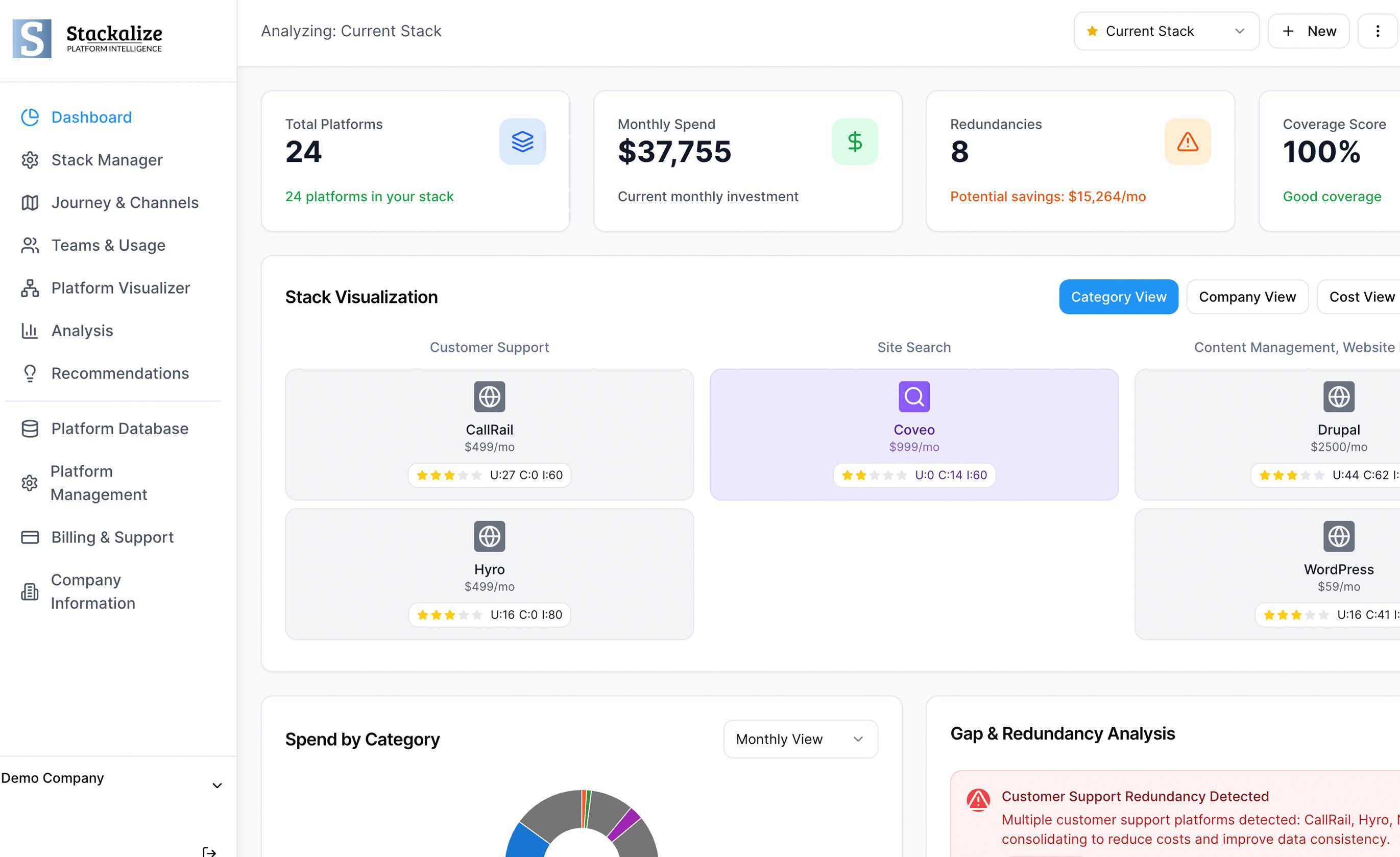
4. Reduce Unnecessary Tool Complexity
More tools do not necessarily mean better marketing.
Every additional platform can create:
- Integration requirements
- Training costs
- Data silos
- Duplicate functionality
- Security concerns
- Higher subscription costs
- Reporting complexity
Before purchasing another tool, ask:
Do we already have this capability somewhere in our stack?
A smaller, well-integrated stack can often be more effective than a large collection of disconnected applications.
5. Design Around the Customer Journey
Instead of organizing MarTech around departments, organize it around customer experiences.
Think about the journey:
Awareness → Consideration → Conversion → Onboarding → Retention → Advocacy
Then identify the technology needed at each stage.
This approach helps marketing, sales, customer success, and technology teams work toward the same customer outcome.
6. Make Measurement Part of the Strategy
Measurement should not be something added after a campaign launches.
Define success before implementation.
Useful metrics may include:
- Marketing qualified leads
- Conversion rate
- Customer acquisition cost
- Customer lifetime value
- Pipeline contribution
- Revenue influenced by marketing
- Retention rate
- Engagement rate
- Return on marketing investment
The right metrics depend on the business model, but every MarTech investment should have a clear connection to measurable outcomes.
7. Build AI Governance Into Your MarTech Stack
AI introduces opportunities, but it also introduces new risks.
Businesses should establish clear rules around:
- Data access
- Customer privacy
- AI-generated content
- Human approval
- Model outputs
- Brand safety
- Security
- Compliance
AI should operate within defined boundaries rather than becoming an uncontrolled collection of tools.
This becomes particularly important as organizations move from isolated AI experiments toward broader AI adoption.
How to Build a Future-Ready MarTech Stack
A future-ready stack does not need every new technology.
Instead, focus on five foundations.
Foundation 1: Reliable Data
Make sure customer information is accurate, accessible, and governed properly.
Foundation 2: Connected Systems
Your CRM, analytics, automation, content, and customer experience platforms should share relevant information.
Foundation 3: Intelligent Automation
Automate repetitive workflows while keeping humans involved where judgment and creativity matter.
Foundation 4: Customer-Centered Experiences
Use technology to make customer interactions more relevant rather than simply increasing the number of messages.
Foundation 5: Measurable Outcomes
Connect technology investments to KPIs that matter to the business.
This framework creates a stronger foundation for adopting new technologies without constantly rebuilding the entire stack.
Common MarTech Mistakes to Avoid in 2026
Even advanced marketing teams can make mistakes when managing technology.
Buying Tools Before Defining the Problem
A tool should solve a specific business or customer problem.
Creating Data Silos
When systems do not communicate, teams lose customer context and reporting becomes unreliable.
Automating Poor Processes
Automation does not fix a broken process. It can simply make the problem happen faster.
Treating AI as a Replacement for Strategy
AI can improve execution, but marketers still need positioning, customer understanding, creative judgment, and strategic direction.
Measuring Vanity Metrics
Traffic and impressions can be useful, but they should not replace business-focused metrics.
Ignoring Governance
As AI becomes more deeply integrated into marketing workflows, data privacy, security, transparency, and human oversight become increasingly important.
What Will Separate Successful MarTech Teams in 2026?
The strongest MarTech teams will not necessarily be the ones with the biggest technology budgets.
They will be the teams that can connect technology to business outcomes.
That means:
Better data + smarter automation + useful AI + connected systems + human judgment = stronger marketing performance.
The shift is already visible across the industry. Marketing technology is moving from collections of individual tools toward connected ecosystems where data, AI, content, and customer experiences work together.
For marketers, that creates an important opportunity.
Instead of constantly asking, “What new tool should we buy?”
Start asking:
“What customer or business problem are we trying to solve, and what is the simplest technology ecosystem that can solve it?”
That question can lead to better technology decisions, cleaner operations, stronger customer experiences, and more sustainable growth.
Final Thoughts
MarTech in 2026 is not simply about collecting the latest marketing tools.
It is about creating a connected marketing system that helps businesses understand customers, respond faster, automate intelligently, and measure what actually drives growth.
AI will continue to reshape the MarTech landscape, but technology alone will not create competitive advantage.
The real advantage comes from combining high-quality data, thoughtful strategy, useful automation, responsible AI, and human creativity.
For businesses building or modernizing their MarTech stack, the best place to start is simple: understand your goals, audit your existing technology, remove unnecessary complexity, connect your data, and invest in capabilities that produce measurable value.
That is what makes a MarTech strategy ready for 2026—and prepared for what comes next.
Frequently Asked Questions About MarTech in 2026
1. What is MarTech in 2026?
MarTech in 2026 refers to the technology businesses use to plan, automate, personalize, measure, and improve their marketing activities. It includes CRM platforms, marketing automation, AI marketing tools, customer data platforms, analytics, personalization, and content management technologies.
2. What are the most important MarTech tools in 2026?
The most important MarTech categories include CRM platforms, marketing automation, customer data platforms, AI-powered marketing tools, analytics platforms, content management systems, and personalization tools. The right combination depends on a business’s goals, customers, budget, and existing technology.
3. How can MarTech help businesses grow?
MarTech can help businesses grow by improving customer data, automating repetitive marketing tasks, personalizing customer experiences, improving lead management, connecting marketing channels, and measuring marketing performance. The key is to connect technology with clear business goals.
4. How should businesses build a MarTech stack in 2026?
Businesses should begin by defining their goals, reviewing their existing tools, improving data quality, connecting important systems, and identifying useful opportunities for AI and automation. A focused, well-integrated MarTech stack is generally more useful than a large collection of disconnected tools.