









Digital marketing teams rely on revenue data to understand whether their campaigns are delivering meaningful business results. Metrics such as clicks, conversions, and attributed revenue help marketers evaluate performance. However, these numbers do not always reveal how much additional revenue a campaign actually generates.
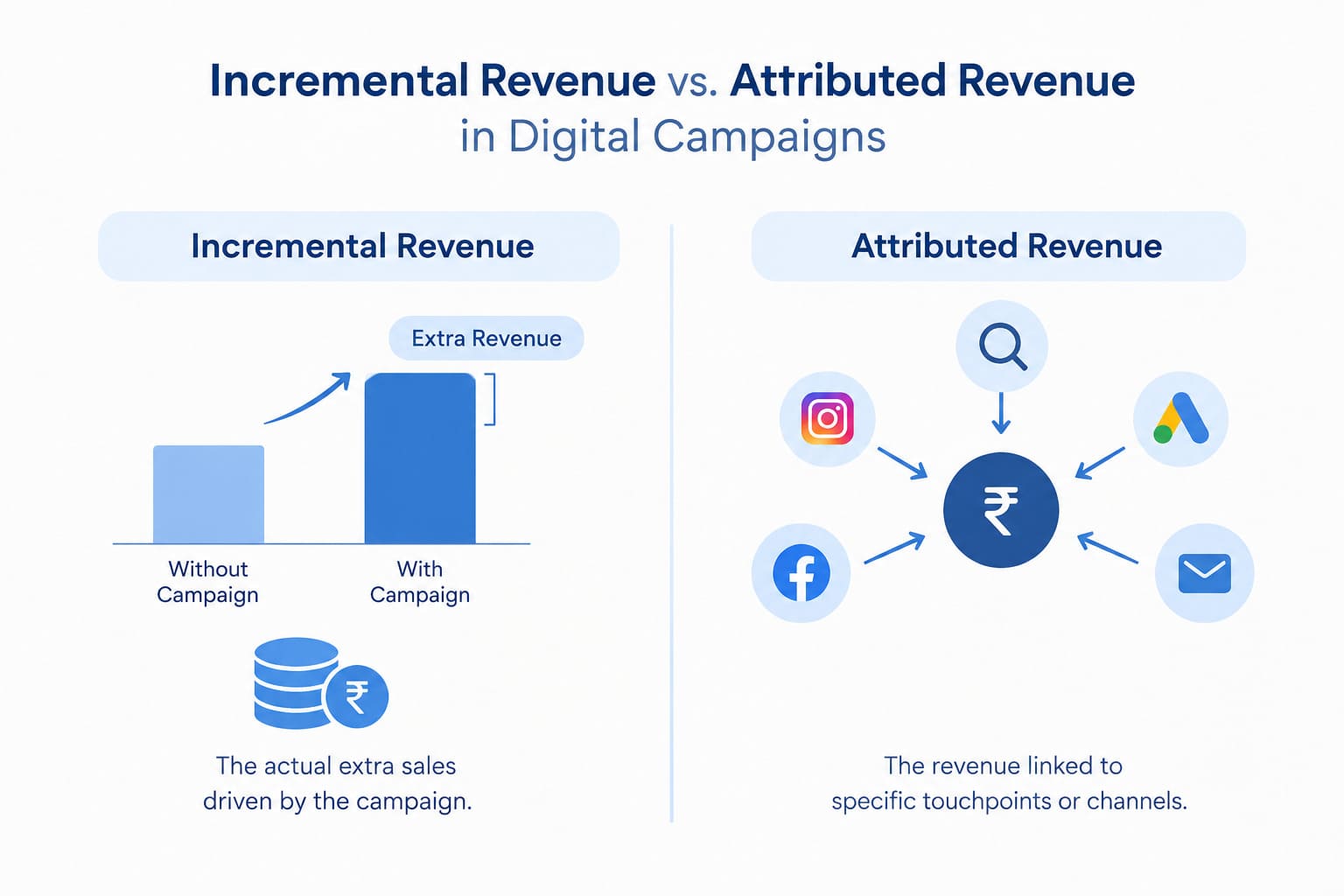
This is where the difference between incremental revenue and attributed revenue becomes important. Although both metrics help measure campaign performance, they answer different questions. Attributed revenue shows how much revenue is credited to a marketing campaign, while incremental revenue estimates how much extra revenue occurred because of that campaign.
Understanding this distinction can help businesses make smarter budget decisions, improve marketing measurement, and identify which campaigns genuinely contribute to growth.
What Is Attributed Revenue in Digital Marketing?
Attributed revenue is the revenue assigned to a marketing touchpoint or campaign according to a specific attribution model. These models determine how credit is distributed across customer interactions, such as paid advertisements, email campaigns, organic search, and social media.
For example, imagine a customer clicks a paid search advertisement, visits a website, and purchases a product worth ₹5,000. If the company’s attribution model credits the purchase to that advertisement, the campaign receives ₹5,000 in attributed revenue.
However, this does not necessarily mean the advertisement generated the entire purchase. The customer might already have intended to buy the product or discovered the brand through another channel.
Common Attribution Models
Businesses use different attribution models to understand how marketing interactions contribute to conversions.
- Last-click attribution: Gives conversion credit to the final marketing interaction before a purchase.
- First-click attribution: Credits the first recorded interaction that introduced the customer to the brand.
- Linear attribution: Distributes credit equally across eligible touchpoints.
- Data-driven attribution: Uses available conversion-path data to estimate how much credit different interactions deserve.
Each model provides a different perspective on the customer journey. As a result, attributed revenue can vary depending on the model a business selects.
What Is Incremental Revenue?
Incremental revenue is the additional revenue a business generates because of a particular marketing activity, compared with what would likely have happened without it.
Rather than simply assigning credit to a campaign, incremental measurement attempts to determine whether that campaign caused additional purchases.
Consider a company that runs a promotional email campaign. Customers who receive the email generate ₹80,000 in revenue. At first glance, the campaign may appear successful. But what if many of those customers would have purchased anyway?
To answer this question, the company can compare the results with a similar group of customers who did not receive the email.
Suppose the test group generates ₹80,000, while a comparable control group would be expected to generate ₹60,000 at the same scale. The estimated incremental revenue is ₹20,000.
This difference provides a more useful indication of the campaign’s additional contribution, assuming the comparison is well designed and other relevant factors are accounted for.
Incremental Revenue vs. Attributed Revenue: Key Differences
Although both metrics help marketers evaluate performance, they serve different purposes.
| Comparison | Attributed Revenue | Incremental Revenue |
|---|---|---|
| Main purpose | Assigns revenue credit to marketing interactions | Estimates additional revenue caused by marketing |
| Key question | Which campaign receives credit for the sale? | Would the sale have happened without the campaign? |
| Measurement approach | Attribution models and conversion tracking | Experiments, holdout groups, or causal analysis |
| Main limitation | May credit campaigns for purchases that would happen anyway | Requires reliable comparisons and careful analysis |
| Best use | Understanding customer journeys and channel performance | Evaluating campaign impact and budget allocation |
The important distinction is that attributed revenue measures how revenue is credited, while incremental revenue focuses on the additional impact of marketing.
Why Attributed Revenue Can Be Misleading
Attributed revenue is useful, but it can sometimes make a campaign look more successful than it actually is.
One common example is branded search advertising. A customer already familiar with a business searches for its name and clicks a paid advertisement before making a purchase. A last-click attribution model may assign the full sale to the advertisement, even though the customer might have purchased through the organic search result.
Retargeting campaigns can create a similar situation. Customers who have already shown strong purchase intent may see an advertisement shortly before completing an order. The campaign receives conversion credit, but that credit alone does not prove the advertisement caused the purchase.
Other factors can also influence attributed revenue, including overlapping campaigns, repeated customer interactions, tracking limitations, and differences between attribution models.
These challenges do not make attribution useless. They simply mean marketers should avoid treating attributed revenue as definitive evidence of incremental impact.
How to Measure Incremental Revenue in Digital Campaigns
Measuring incremental revenue requires a reasonable estimate of what would have happened without the campaign. Several methods can help.
1. Run Holdout Experiments
A holdout experiment separates eligible customers into a group that receives the campaign and a comparable group that does not.
For example, an e-commerce company could send a promotional email to 80% of an eligible audience while withholding it from the remaining 20%. Comparing the groups’ purchase behavior can help estimate the email’s incremental impact.
Random assignment, an adequate sample size, and consistent measurement are important for reliable results.
2. Use Conversion Lift Studies
Conversion lift studies compare outcomes between exposed and unexposed groups to estimate whether advertising generated additional conversions. These studies are commonly used to evaluate paid media campaigns.
Depending on the platform and study design, the analysis may estimate incremental conversions, revenue, or other outcomes.
3. Compare Revenue Against a Suitable Baseline
When controlled experiments are not practical, marketers may compare campaign performance with a historical baseline or a carefully selected comparison group.
However, simple before-and-after comparisons can be misleading. Seasonality, discounts, competitor activity, and broader market changes may affect revenue independently of the campaign.
4. Calculate Incremental Return on Ad Spend
Incremental return on ad spend, often called incremental ROAS, compares estimated incremental revenue with advertising expenditure.
Formula:
Incremental ROAS = Incremental Revenue ÷ Advertising Spend
For example, if a campaign generates an estimated ₹20,000 in incremental revenue and costs ₹5,000, its incremental ROAS is 4x.
This means the campaign generated an estimated ₹4 in additional revenue for every ₹1 spent on advertising. It does not mean the business earned ₹4 in profit; product costs and other expenses still matter.
A Practical Example: One Campaign, Two Revenue Figures
Imagine a retail brand launches a paid social campaign to promote a new product.
The campaign’s reporting dashboard attributes ₹1,50,000 in sales to its advertisements. A controlled experiment, however, estimates that the exposed audience generated only ₹35,000 more revenue than a comparable control group.
In this example:
- Attributed revenue: ₹1,50,000
- Estimated incremental revenue: ₹35,000
The figures are not contradictory. The attribution model assigns credit for observed sales, while the experiment estimates the additional revenue associated with the campaign.
The ₹35,000 estimate is not automatically proof of profit or a complete measure of campaign value. The business must also consider advertising costs, margins, customer retention, and the quality of the experiment.
By combining these measurements, marketers can better understand both the customer journey and the campaign’s likely business impact.
How Marketing Teams Can Use Both Metrics
Businesses do not need to choose one metric and abandon the other. In fact, using attributed revenue and incremental revenue together can provide a more balanced view of campaign performance.
Attributed revenue can help teams identify which channels and touchpoints participate in customer journeys. It is useful for campaign reporting, conversion-path analysis, and understanding how customers interact with a brand.
Incremental revenue can help determine whether additional spending is likely to generate additional sales. It is especially valuable when evaluating retargeting, promotional campaigns, paid media, and budget increases.
Marketing teams can use attribution reporting for ongoing monitoring and run incrementality experiments periodically to validate whether important campaigns are producing additional results.
They should also align revenue measurement with business goals. A campaign that generates substantial sales but little incremental profit may be less valuable than a smaller campaign that brings in genuinely new demand at a healthy margin.
The Role of Marketing Technology in Revenue Measurement
Modern marketing technology platforms make it easier to collect campaign data, connect customer interactions, and report revenue across channels. Customer relationship management systems, analytics platforms, advertising tools, and marketing automation software can all contribute to this process.
However, better tracking does not automatically establish causation. Even a well-integrated dashboard may show which campaign received credit without revealing whether the campaign created additional demand.
To improve measurement, businesses should maintain consistent conversion definitions, use reliable revenue data, document attribution settings, and integrate controlled experiments where possible. Privacy restrictions, incomplete tracking, and cross-device behavior should also be considered when interpreting results.
The goal is not simply to collect more data. It is to use the right measurement method for the question being asked.
Conclusion
Incremental revenue and attributed revenue offer two different perspectives on digital campaign performance. Attributed revenue helps marketers understand how credit is assigned across customer interactions, while incremental revenue estimates the additional sales generated because of marketing activity.
For businesses seeking more reliable marketing decisions, both metrics have a role. Attribution helps explain the customer journey, and incrementality testing helps evaluate whether campaigns create additional value.
By combining the two, marketing teams can move beyond reporting sales alone and develop a clearer understanding of which campaigns genuinely support business growth.
Frequently Asked Questions
1. What is the difference between incremental revenue and attributed revenue?
Attributed revenue assigns sales credit to marketing campaigns, while incremental revenue measures the additional sales generated because of a campaign compared with what would likely have happened without it.
2. Why can attributed revenue be higher than incremental revenue?
Attributed revenue can include purchases customers would have made anyway. Incremental revenue focuses on the additional sales caused by marketing activities, making it useful for evaluating actual campaign impact.
3. How do marketers measure incremental revenue?
Marketers can measure incremental revenue through controlled experiments, holdout groups, and conversion lift studies. These methods compare campaign results with a suitable control group or estimate of expected performance.
4. Should businesses track both incremental and attributed revenue?
Yes, tracking both metrics provides a more complete picture of campaign performance. Attributed revenue helps explain customer journeys, while incremental revenue helps businesses assess campaign impact and allocate marketing budgets more effectively.