








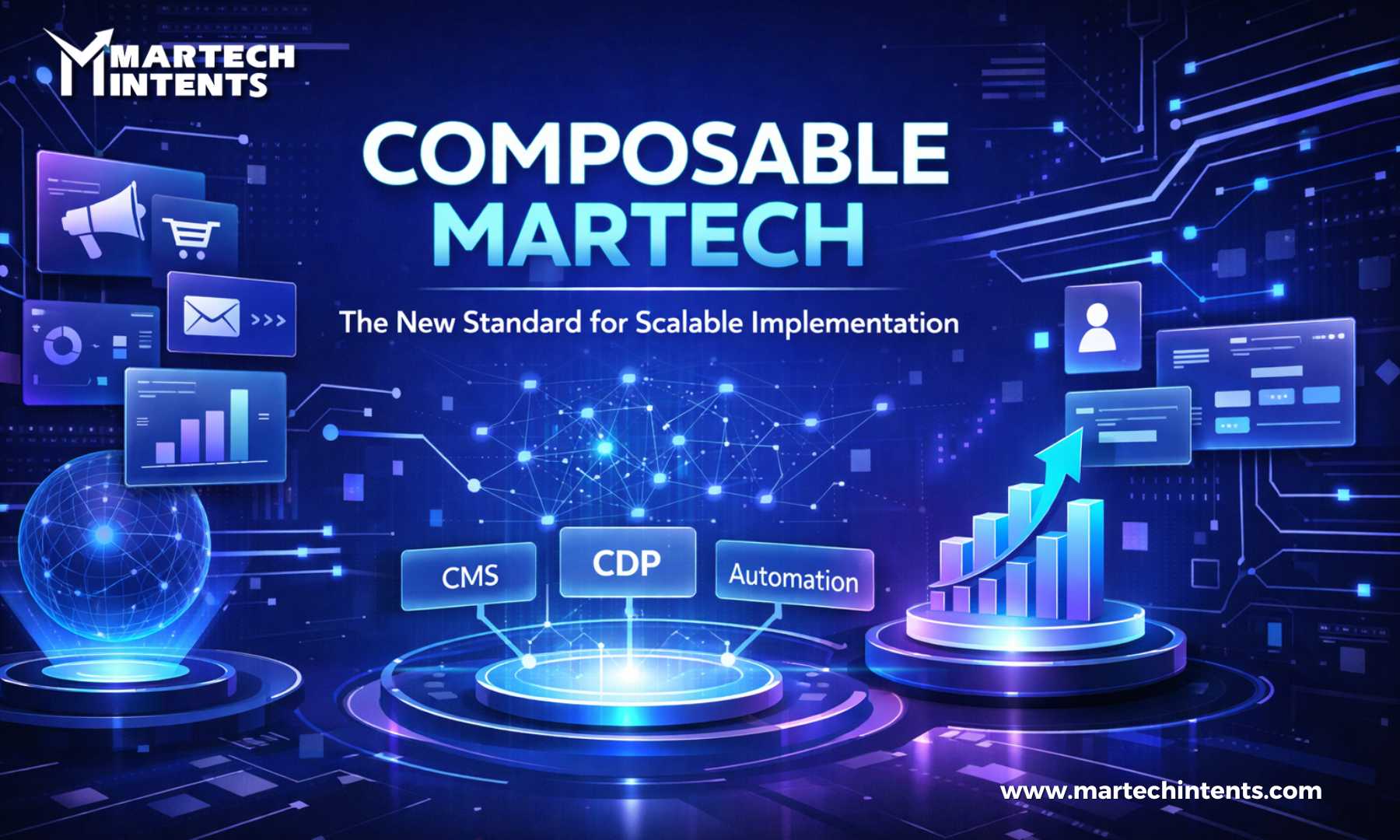
Composable Martech is reshaping how modern marketing teams design and scale their technology stacks. Instead of committing to rigid, all-in-one platforms, teams now assemble modular tools that evolve with business needs. This approach removes unnecessary friction, improves speed to market, and supports long-term flexibility. For organizations managing complex customer journeys, composable martech has become a practical foundation rather than an experimental idea.
What Composable Martech Really Means
Composable Martech refers to a modular approach to marketing technology where each capability operates independently and connects through APIs.
Rather than relying on a single vendor suite, teams select tools based on performance, fit, and adaptability.
Key characteristics of a composable approach
- API-first integrations
- Loosely coupled systems
- Best-of-breed tooling
- Independent upgrade paths
Because each component stands alone, changes do not ripple across the entire stack.
Why Composable Martech Is Gaining Adoption Fast
Marketing strategies now change faster than traditional platforms can support. As a result, rigid stacks often slow teams down.
Composable Martech solves this by prioritizing adaptability over bundled convenience.
Limitations of legacy martech platforms
- Long implementation timelines
- Forced feature dependencies
- High switching costs
- Limited experimentation
With a modular setup, teams gain freedom to adjust without rebuilding everything from scratch.
Composable Martech Architecture Without the Complexity
Composable Martech works like a layered system where each tool has a clear role.
This structure allows teams to evolve specific layers without disrupting others.
Common layers in a composable martech stack
- Data layer: Customer Data Platforms (CDPs)
- Content layer: Headless CMS solutions
- Experience layer: Frontend frameworks
- Activation layer: Email, ads, and personalization tools
Because these layers communicate via APIs, scalability becomes easier to manage.
Business Benefits of Composable Martech
Composable Martech delivers value beyond technical flexibility. It directly impacts speed, cost control, and customer experience.
Faster time to market
Teams can launch campaigns or features without waiting for platform-wide updates.
That speed often translates into competitive advantage.
Personalization that scales
When paired with Customer Data Platforms, composable systems support real-time personalization across channels.
This enables:
- Contextual messaging
- Cross-platform consistency
- Faster testing cycles
Better long-term cost efficiency
Instead of paying for bundled features, organizations invest only in what they actively use.
Over time, this reduces waste and improves ROI.
Composable Martech vs Traditional Martech Stacks
Understanding this difference helps decision-makers justify the shift.
Traditional stacks aim for simplicity through consolidation. Modular stacks aim for resilience through flexibility.
Where modular systems outperform
- Tool replacement without downtime
- Independent vendor negotiations
- Faster innovation cycles
This difference becomes more visible as organizations scale.
Comparison: Modular vs Monolithic Martech
| Capability | Modular Martech | Monolithic Martech |
|---|---|---|
| Flexibility | High | Limited |
| Vendor Dependency | Low | High |
| Scaling Speed | Incremental | Platform-bound |
| Customization | Extensive | Restricted |
| Cost Control | Granular | Bundle-based |
Tools Commonly Used in Composable Martech Stacks
Composable Martech relies on mature, specialized tools that integrate cleanly.
Headless CMS platforms
A headless CMS separates content management from presentation.
This allows:
- Omnichannel publishing
- Faster frontend changes
- Better collaboration between teams
Contentful and Sanity are popular examples.
Customer Data Platforms in composable setups
Customer Data Platforms act as the central data hub.
They unify user data and distribute it across tools like:
- Analytics platforms
- Email systems
- Personalization engines
Segment and mParticle are widely adopted for this role.
Marketing automation tools
Instead of one massive automation suite, modular stacks use focused tools for specific workflows.
This reduces operational risk and simplifies troubleshooting.
Challenges Teams Face with Composable Martech
Composable Martech is not a plug-and-play solution.
Teams must plan governance and integration carefully.
Common challenges
- Integration ownership across teams
- API version management
- Tool sprawl without clear standards
However, these issues are manageable with clear documentation and accountability.
Practical implementation guidelines
- Start with one layer, such as content or data
- Define integration standards early
- Assign owners for each tool
- Review stack performance quarterly
Most teams see faster results by avoiding large-scale rollouts.
When Composable Martech Is the Right Choice
Composable Martech works best when:
- You operate across multiple digital channels
- Personalization is business-critical
- Marketing and engineering collaborate closely
- Existing platforms limit experimentation
For teams prioritizing flexibility, modular architecture is a natural fit.
FAQs
1. What makes composable martech different from traditional platforms?
A. It allows teams to assemble individual tools instead of relying on a single bundled system.
2. Is this approach suitable for mid-sized companies?
A. Yes. Many mid-sized teams adopt modular stacks to stay agile without enterprise-level costs.
3. Does a composable setup require more technical support?
A. Initially, yes. Over time, maintenance becomes easier due to clear system boundaries.
4. How quickly can teams see value?
A. Most organizations see early gains within weeks by rolling out one component at a time.