






Digital marketing depends on data. Every personalized email, targeted advertisement, website recommendation, and automated campaign relies on information collected from customers. However, there is one important detail that marketers cannot afford to overlook: whether customers have actually given permission for their data to be used.
Consent records help businesses track customer permissions, including what information can be collected, how it can be used, and which communication channels customers have agreed to receive messages through. The problem begins when these records become inconsistent across marketing platforms.
For example, a customer might unsubscribe from promotional emails, but the marketing automation system may not update the customer’s status in the advertising platform or customer relationship management (CRM) system. As a result, the business may continue targeting that customer through another channel.
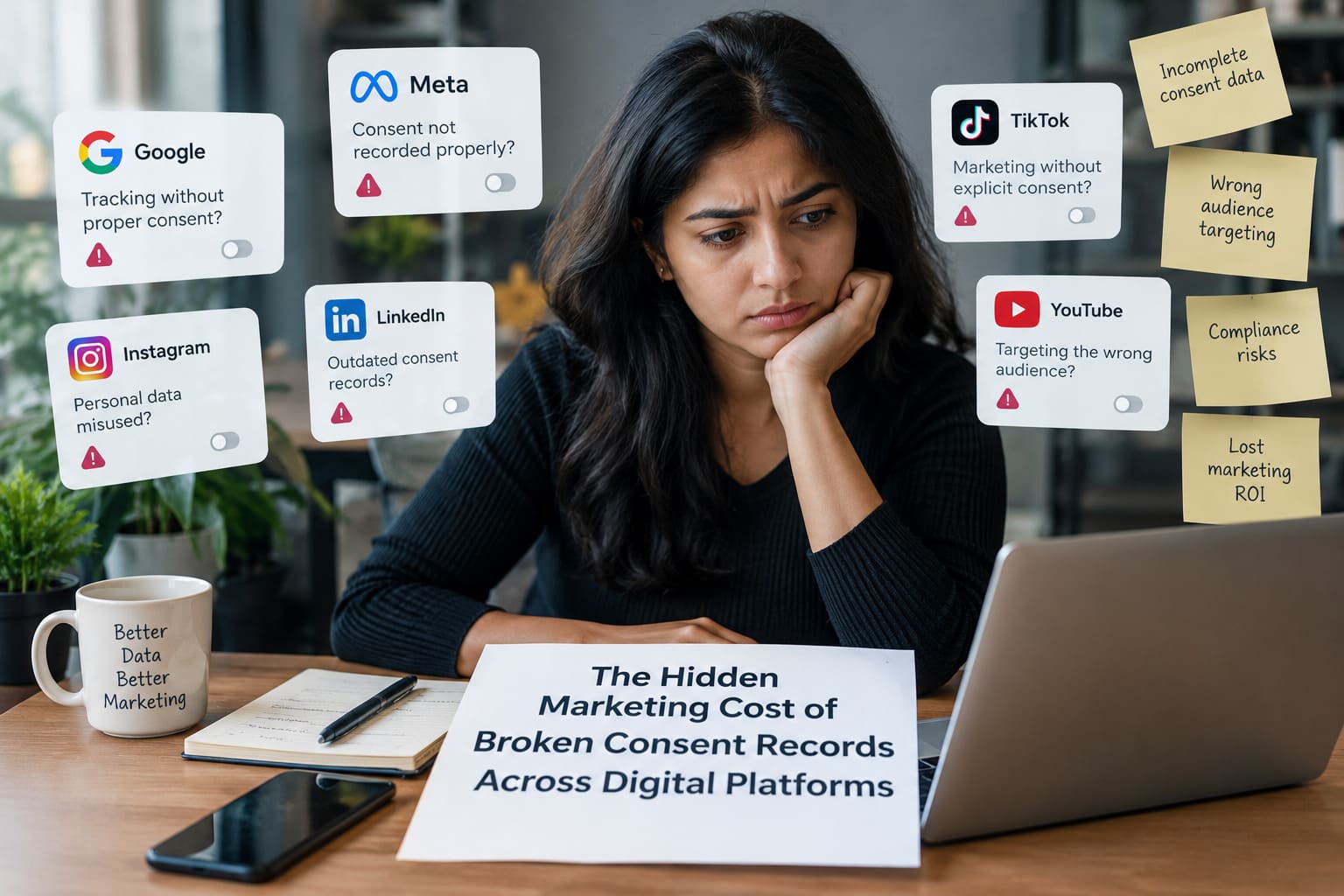
This is more than a technical inconvenience. Broken consent records can increase marketing expenses, weaken customer trust, reduce campaign effectiveness, and expose businesses to privacy compliance risks. Although these costs are not always immediately visible in marketing reports, they can gradually affect the performance of an entire marketing operation.
What Are Broken Consent Records?
Broken consent records occur when customer permission data is missing, outdated, duplicated, incorrectly synchronized, or interpreted differently across digital platforms.
Modern marketing teams often use several connected systems, such as:
- Customer relationship management platforms
- Email marketing and automation tools
- Customer data platforms (CDPs)
- Advertising and audience management systems
- Website analytics and personalization tools
- Consent management platforms
Each system may store or process customer information differently. Without reliable synchronization, a customer’s preferences can become inconsistent across the technology stack.
Consider a customer who agrees to receive product updates by email but declines personalized advertising. If the business records this preference incorrectly, its advertising platform might still include that customer in a personalized audience. The problem is not necessarily a lack of customer data. It is the failure to preserve the customer’s actual preferences throughout the marketing process.
1. Wasted Marketing Spend Across Multiple Channels
One of the most overlooked consequences of broken consent records is wasted marketing expenditure.
Businesses spend money on advertising impressions, email delivery, customer segmentation, and campaign management. When customer permissions are inaccurate, marketing teams may target people who should have been excluded from particular campaigns.
For example, an advertising team might build a retargeting audience from CRM data that has not been updated after customers changed their preferences. The company could then spend money delivering ads to people who should no longer be included in that audience.
The financial impact can extend beyond advertising costs. Marketing teams may also spend time investigating poor engagement, adjusting audience segments, and correcting campaign settings.
Over time, these avoidable expenses can make campaign performance appear weaker than it actually is.
What marketers can do: Establish a reliable process for updating consent changes across connected platforms. Review audience exclusions before launching campaigns, and regularly compare consent records with the audiences used by advertising and automation tools.
2. Lower Campaign Performance and Misleading Analytics
Marketing performance depends on accurate audience information. When consent records are inconsistent, campaign reports may not reflect the actual quality of a company’s marketing strategy.
Imagine a business measuring the performance of a personalized email campaign. Some recipients may have outdated communication preferences, while others may have been incorrectly included in the target segment. The resulting engagement data may lead marketers to draw the wrong conclusions about customer interest.
Broken consent records can also create problems when teams compare performance across channels. An email platform, analytics tool, and advertising system may each operate with different audience definitions or permission statuses.
This inconsistency can make it difficult to determine whether a campaign failed because of its messaging, targeting strategy, audience quality, or inaccurate data.
Marketing teams may then invest additional resources in changing campaign creative or adjusting targeting when the underlying issue is actually data quality.
To improve measurement, marketers should validate consent information before building audiences and document the rules used to exclude or include customers in each campaign.
3. Reduced Customer Trust and Brand Credibility
Customers expect businesses to respect their communication preferences. When someone opts out of promotional messages but continues receiving them through another channel, the experience can feel intrusive.
Even if the issue originates from a synchronization error, customers are unlikely to distinguish between a technical failure and a deliberate decision by the company. They experience the brand as one organization, not as a collection of disconnected software platforms.
Repeated unwanted communication can encourage customers to unsubscribe from more channels, ignore future messages, or stop engaging with the business altogether.
The long-term cost is difficult to calculate precisely. It may appear through declining engagement, weaker customer relationships, reduced repeat purchases, or negative brand perceptions.
Respecting consent is therefore not just a privacy responsibility. It is also part of delivering a consistent customer experience.
Businesses can strengthen trust by making preference updates easy, honoring opt-outs promptly, and ensuring that customer choices are reflected across relevant marketing systems.
4. Higher Operational Costs for Marketing Teams
When consent information is unreliable, marketing teams often compensate with manual work.
A marketing operations specialist may need to compare customer records, investigate conflicting statuses, correct audience lists, and contact technology teams to identify synchronization problems. These tasks consume time that could otherwise be spent improving campaigns or developing customer insights.
The workload can become more complicated when different departments manage separate systems. The email team may maintain one suppression list, the advertising team another, and the CRM team a third version of customer preferences.
Without clear ownership, employees may repeatedly fix the same problem without addressing its underlying cause.
Businesses can reduce this operational burden by assigning responsibility for consent data, documenting system integrations, and creating a consistent process for handling preference changes.
Automated validation checks can also help identify missing or conflicting records before they affect active campaigns.
5. Increased Privacy and Compliance Exposure
Consent requirements vary according to jurisdiction, the type of data involved, the processing activity, and the circumstances in which information was collected. Depending on the applicable rules, businesses may need to demonstrate that they have a valid basis for processing personal data and that they respect relevant customer choices.
Broken consent records can make this more difficult.
For instance, a business might struggle to demonstrate when a customer provided permission, what that permission covered, or whether a later withdrawal was processed correctly.
Inaccurate records do not automatically mean that a company has violated the law. However, they can create compliance gaps that require investigation and remediation.
Organizations should establish appropriate records of consent, maintain reliable timestamps and preference histories where applicable, and ensure that their data practices align with relevant privacy requirements.
Useful starting points include the European Data Protection Board, the Information Commissioner’s Office, and the Digital Personal Data Protection Act, 2023.
Marketing teams should work with their privacy, legal, and information security colleagues when reviewing consent processes. Technology controls are valuable, but they should support a clearly defined privacy policy rather than replace it.
6. Lost Opportunities for Responsible Personalization
Personalization works best when businesses understand both customer interests and customer preferences.
When consent data is unreliable, marketing teams may become hesitant to use customer information because they cannot confidently determine which activities are permitted. Alternatively, they may rely on broad audience segments instead of using appropriately authorized data for relevant experiences.
Both situations can limit the value of a company’s marketing technology investments.
For example, a customer might agree to receive educational content but decline promotional messages through a particular channel. An accurate consent record can help the business distinguish between these preferences and configure communications accordingly.
A broken record may prevent the business from using information appropriately, or it may cause the business to use information in a way that does not match the customer’s choices.
The solution is not to collect more data indiscriminately. It is to improve the accuracy, accessibility, and practical use of the permissions already recorded.
Why Consent Problems Become More Difficult as Marketing Technology Grows
A small business might manage customer preferences through a single email platform. A larger organization may use dozens of systems that exchange customer information across websites, mobile applications, advertising networks, CRM software, and analytics platforms.
Every integration creates another opportunity for information to become outdated or lose important context.
For example, one system might store a general marketing opt-in, while another distinguishes between email, SMS, and personalized advertising. If the integration transfers only a basic yes-or-no status, the receiving platform may not have enough information to apply the customer’s preferences correctly.
Other common causes include:
- Delayed synchronization: Preference changes take too long to reach connected platforms.
- Inconsistent identifiers: Systems cannot reliably match the same customer across records.
- Different data definitions: Platforms interpret consent statuses differently.
- Missing history: Teams cannot easily establish when a preference changed.
- Unclear accountability: No team owns the complete consent lifecycle.
These issues become harder to manage when organizations add new marketing tools without reviewing how consent information moves between them.
Practical Ways to Prevent Broken Consent Records
Businesses do not necessarily need to replace their entire marketing technology stack to improve consent management. A structured approach can help them identify weaknesses and prioritize improvements.
1. Map the Customer Data Journey
Document where customer information is collected, where consent is recorded, and which systems use that information. Include websites, forms, CRM platforms, automation tools, advertising systems, and other relevant integrations.
This exercise helps reveal where customer preferences may be lost or changed.
2. Define a Reliable Consent Source
Identify the authoritative system or process for maintaining consent information. Other platforms should receive clearly defined updates rather than independently creating conflicting versions of customer preferences.
A central source does not eliminate every integration problem, so synchronization and validation still need to be tested.
3. Standardize Consent Categories
Use consistent definitions for permissions, withdrawals, communication channels, and purposes of processing. Ensure that connected systems can preserve the distinctions required by the organization’s privacy policy and applicable laws.
4. Test Preference Changes Across Platforms
Do not assume an integration works simply because customer records are transferring successfully.
Test scenarios such as a customer withdrawing email consent, changing communication preferences, or declining a specific type of personalization. Confirm that each relevant system responds correctly before relying on the integration in live campaigns.
5. Monitor Data Quality and Synchronization
Track issues such as conflicting consent statuses, failed updates, missing records, and delays in processing preference changes. Set up alerts for failures that could affect active campaigns or privacy obligations.
6. Establish Clear Ownership
Marketing operations, data teams, technology teams, and privacy professionals should understand their respective responsibilities. Define who investigates errors, who approves changes, and how urgent consent issues are escalated.
7. Review Campaign Audiences Before Activation
Include consent validation in campaign launch procedures. Check audience eligibility, suppression rules, channel preferences, and applicable processing restrictions before sending messages or activating advertising audiences.
How to Measure the Business Cost of Consent Failures
Consent management can be treated as an operational performance issue as well as a privacy requirement.
Marketing teams can monitor several indicators to understand whether their processes are improving:
| Metric | What It Helps Measure |
|---|---|
| Consent synchronization delay | How quickly preference changes reach connected systems |
| Conflicting consent records | The number of records with inconsistent permission statuses |
| Campaign exclusion errors | Cases where ineligible contacts enter a campaign audience |
| Manual correction hours | Time spent fixing consent-related data problems |
| Integration failure rate | How often consent updates fail to transfer correctly |
| Consent-related complaints | Customer reports involving unwanted or inappropriate communication |
To estimate the financial impact, organizations can calculate the staff time spent correcting records, the avoidable campaign expenditure associated with targeting errors, and the cost of investigating and remediating incidents.
These figures should be based on actual internal data rather than assumed industry averages. Businesses should also avoid treating every consent-related cost as directly attributable to a single system failure.
The purpose of measurement is to identify preventable problems, establish a baseline, and determine whether improvements are producing meaningful operational benefits.
Conclusion
Broken consent records can create hidden costs that extend well beyond privacy administration. They can waste advertising budgets, distort campaign reporting, increase manual workloads, weaken customer trust, and make compliance obligations more difficult to manage.
As marketing technology ecosystems become more connected, maintaining accurate customer preferences requires more than collecting consent at the point of entry. Businesses must preserve those preferences as information moves between platforms and ensure that campaign processes reflect the latest valid customer choices.
A practical starting point is to map the customer data journey, identify conflicting records, test preference synchronization, and establish clear ownership of consent management.
Ultimately, effective marketing is not simply about reaching more people. It is about reaching the right people through appropriate channels, using data responsibly, and respecting the choices customers make.