








Marketing technology is changing faster than most marketing teams can keep up with. A few years ago, having a CRM, marketing automation platform, analytics dashboard, and social media tools was considered a sophisticated MarTech setup. In 2026, that is no longer enough.
Artificial intelligence is becoming part of everyday marketing operations. Customer data is becoming more valuable, AI agents are beginning to handle tasks independently, and customers increasingly expect brands to respond with relevant information in real time.
At the same time, marketers are dealing with a more complicated digital environment. Customers move between search engines, social platforms, messaging apps, websites, marketplaces, and physical stores before making a decision.
The result is a major shift in how marketing technology is selected and used.
The winning strategy in 2026 isn’t simply adding more MarTech tools. It is creating a connected technology ecosystem that helps teams understand customers, act on data, automate repetitive work, and still maintain a human connection.
Let’s explore the biggest MarTech trends in 2026 and what they mean for modern marketing teams.
What Is MarTech?
MarTech, short for marketing technology, refers to the software and technology marketers use to plan, execute, measure, and improve marketing activities.
A modern MarTech stack can include:
- Customer relationship management (CRM) platforms
- Marketing automation software
- Customer data platforms (CDPs)
- Artificial intelligence tools
- Analytics and business intelligence platforms
- Content management systems
- Advertising technology
- Social media management tools
- Email marketing platforms
- Customer experience platforms
- Personalization engines
The important change in 2026 is that these technologies are becoming increasingly connected.
Instead of using individual tools for isolated tasks, businesses are moving toward integrated systems where customer data, AI, content, automation, and measurement work together.
1. Agentic AI Is Changing Marketing Automation
Generative AI has already changed content creation and marketing workflows. In 2026, the next development is agentic AI.
Unlike traditional automation, which follows predefined rules, AI agents can interpret information, make decisions within defined boundaries, and complete multi-step tasks.
For example, an AI-powered marketing agent could:
- Identify a high-intent customer.
- Analyze previous interactions.
- Select an appropriate message.
- Personalize the content.
- Trigger an email or another communication.
- Monitor the response.
- Recommend the next action.
This doesn’t mean marketers disappear from the process. Instead, their role moves toward strategy, supervision, creativity, and decision-making.
Gartner predicts that 60% of brands will use agentic AI for streamlined one-to-one interactions by 2028, highlighting how quickly autonomous engagement is moving into mainstream marketing discussions.
Why it matters
Agentic AI can help marketing teams reduce repetitive work while responding to customers faster.
The key is governance. Businesses need clear rules around what AI can access, what decisions it can make, and when human approval is required.
2. AI-Powered Personalization Is Becoming More Practical
Personalization is not new, but the technology behind it is becoming significantly smarter.
Traditional personalization might show a customer their first name in an email. Modern personalization can consider:
- Previous purchases
- Website behavior
- Content interactions
- Customer lifecycle stage
- Product interests
- Engagement history
- Real-time intent signals
- Preferred communication channels
AI can analyze these signals and help determine what content, offer, or message is most relevant.
The goal isn’t simply to make marketing feel personalized. The goal is to make it useful.
For example, instead of sending the same promotional email to every customer, an AI-enabled system might recognize that one customer is researching a product while another is already comparing pricing options.
Both customers may receive different experiences based on their needs.
3. Unified Customer Data Is Becoming a Competitive Advantage
One of the biggest problems facing marketing teams isn’t a lack of data. It’s disconnected data.
Customer information often sits across multiple systems:
- CRM
- Website analytics
- Email platform
- Advertising platforms
- Customer support software
- E-commerce systems
- Social media
- Offline transactions
When these systems don’t communicate properly, marketers struggle to create a complete picture of the customer.
This is why unified customer data is becoming a major MarTech priority in 2026.
Salesforce’s 2026 India research found that 81% of marketers surveyed had adopted AI, while fragmented and poor-quality data remained significant barriers to effective AI-driven engagement.
The lesson for marketers
AI is only as useful as the information supporting it.
Before investing in another AI tool, businesses should ask:
Is our customer data accurate, accessible, connected, and governed?
If the answer is no, improving the data foundation may deliver more value than adding another platform.
4. First-Party Data Is Becoming More Important
Privacy expectations are changing the way businesses collect and use customer information.
This makes first-party data increasingly valuable.
First-party data is information a business collects directly through interactions with its customers and audiences. Examples include:
- Website behavior
- Purchases
- Email engagement
- Account information
- Customer preferences
- Product interactions
- Loyalty activity
In 2026, marketers are focusing more on how to collect this information responsibly and turn it into useful experiences.
Experian’s 2026 digital trends research reports that 70% of B2B marketers plan to increase their use of first-party data.
The important point is that first-party data shouldn’t simply become another database.
It should help businesses understand customers while respecting consent, privacy, and expectations.
5. AI Is Transforming Search and Customer Discovery
Search behavior is changing.
Customers are no longer relying exclusively on traditional search engines to discover information. AI-powered experiences are becoming another layer between customers and brands.
This means marketers need to think beyond traditional keyword rankings.
Content should be:
- Helpful
- Clear
- Factually reliable
- Well structured
- Relevant to user intent
- Easy for both people and AI systems to understand
This is contributing to the growth of strategies around AI search optimization and answer-focused content.
For marketers, the question is gradually shifting from:
“How do we rank for this keyword?”
to:
“How do we become a useful and trusted source when customers ask questions?”
That change could have a major impact on content strategy throughout 2026 and beyond.
6. Omnichannel Marketing Is Becoming More Connected
Customers don’t think in channels.
They might discover a product on social media, research it through search, ask a question through messaging, visit the website, and eventually purchase through an app or physical store.
Marketing technology needs to support this journey.
In India, Meta and the Retailers Association of India reported that social media influences a substantial share of retail purchase decisions, while short-form video, creators, messaging, and AI-powered campaign optimization are reshaping discovery and shopping.
This is why omnichannel MarTech is becoming increasingly important.
The objective isn’t simply to appear everywhere.
It’s to create a consistent customer experience across channels.
7. Marketing Analytics Is Moving Toward Real-Time Decisions
Marketing dashboards traditionally tell teams what happened.
Modern analytics increasingly aims to help them decide what to do next.
AI-powered analytics can help identify:
- Campaign performance changes
- Customer behavior patterns
- Conversion opportunities
- Audience segments
- Content performance
- Customer churn signals
- Attribution patterns
This creates a shift from retrospective reporting to proactive decision-making.
For example, instead of discovering at the end of a campaign that a particular audience performed poorly, marketers can potentially identify the problem while the campaign is still running and adjust their strategy.
That makes measurement part of execution rather than something that happens afterward.
8. Customer Experience Technology Is Taking Center Stage
Marketing doesn’t end when someone clicks an advertisement.
Customers judge brands based on the entire experience.
That includes:
- Website experience
- Product discovery
- Checkout
- Communication
- Customer support
- Personalization
- Post-purchase engagement
MarTech and customer experience technology are therefore becoming more closely connected.
Businesses are increasingly looking for platforms that can connect customer data, content, automation, and engagement instead of managing each component independently.
The broader trend is toward experience orchestration rather than isolated campaign execution.
9. Privacy and AI Governance Are Becoming Core MarTech Requirements
AI can make marketing more powerful, but it also introduces new risks.
Companies need to think about:
- Data privacy
- Customer consent
- AI transparency
- Data security
- Access controls
- Bias
- Incorrect AI-generated information
- Brand safety
- Human oversight
This is particularly important when AI systems can access customer data or take actions automatically.
Gartner’s 2026 marketing research emphasizes the importance of AI-ready data, content and context governance as organizations adapt to AI-driven marketing.
The best MarTech strategy isn’t simply “automate everything.”
It is:
Automate what makes sense, govern what matters, and keep humans responsible for important decisions.
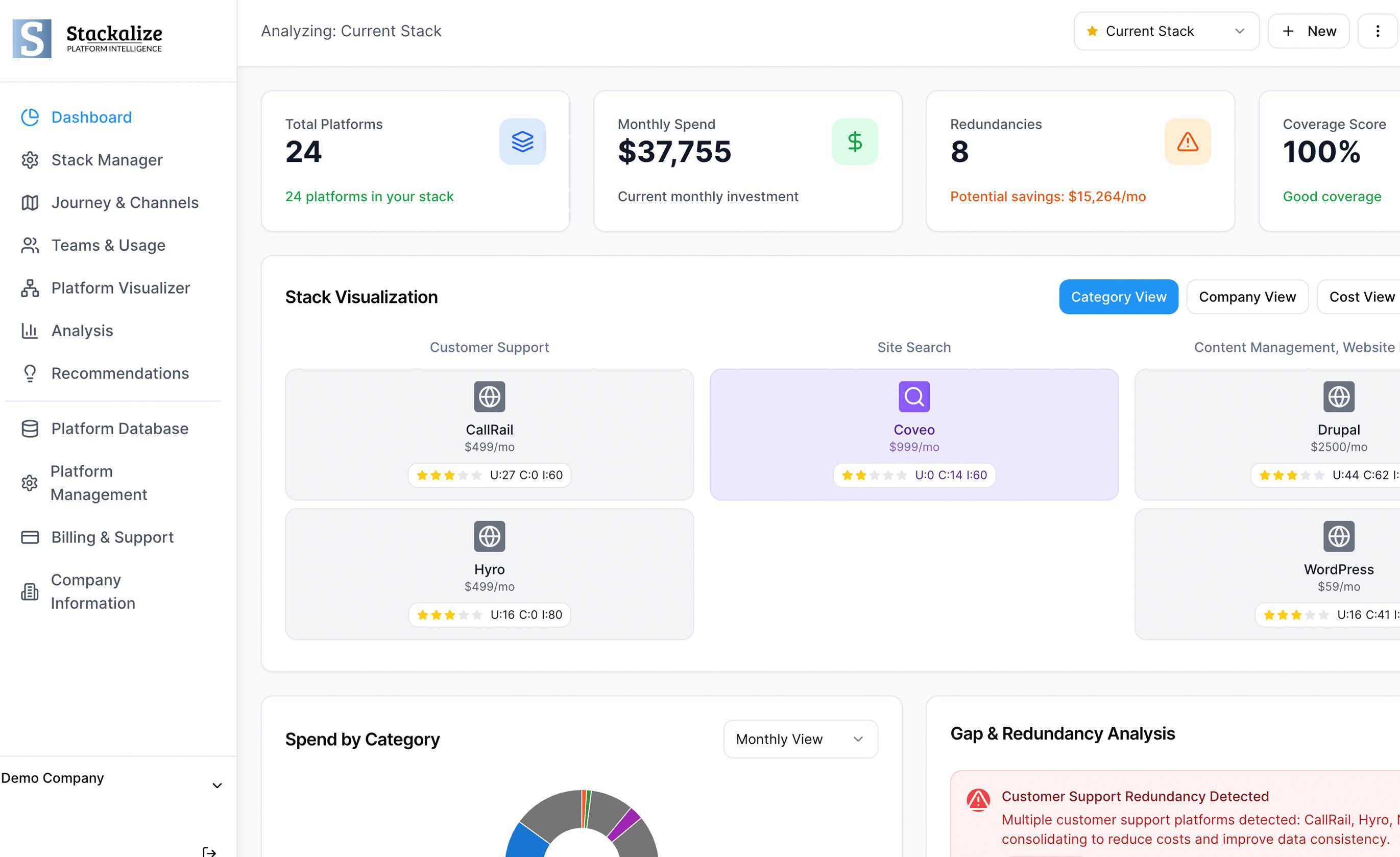
10. MarTech Stacks Are Becoming More Integrated
Marketing teams have accumulated a huge number of tools.
But more tools don’t automatically produce better marketing.
In fact, disconnected platforms can create:
- Duplicate customer records
- Data silos
- Higher costs
- Reporting problems
- Workflow inefficiencies
- Poor customer experiences
In 2026, businesses are increasingly focused on integration and simplification.
The goal is to create a MarTech stack where important systems can share information and support common business objectives.
This means marketers should evaluate technology based on more than features.
They should also consider:
- Integration capabilities
- Data portability
- Security
- Scalability
- Ease of use
- AI capabilities
- Governance
- Total cost of ownership
11. Content Technology Is Becoming AI-Assisted but Human-Led
AI can help marketers create content faster.
It can support:
- Topic research
- Content briefs
- Personalization
- Repurposing
- Content optimization
- Translation
- Ideation
- Performance analysis
But faster content isn’t necessarily better content.
As AI-generated content becomes more common, originality, expertise, credibility, and human perspective become even more important.
Marketing teams should use AI to accelerate production without allowing it to replace strategic thinking.
A useful approach is:
AI for scale + humans for judgment.
That balance can help brands produce more content while maintaining their voice and credibility.
12. Commerce Media Is Expanding Beyond Retail
Commerce media is also evolving.
Instead of being limited to traditional retail environments, businesses across industries are exploring ways to connect audience data, advertising, and measurable commercial outcomes.
This creates opportunities for brands to connect marketing activity more directly with revenue.
Experian’s 2026 research highlights the expansion of commerce media into areas beyond traditional retail.
For marketers, this means measurement is becoming increasingly important.
The question is no longer only:
“How many people saw our campaign?”
It is increasingly:
“Did the campaign influence a meaningful business outcome?”
How MarTech Is Changing the Role of Marketers
Technology isn’t simply changing marketing tools. It’s changing marketing jobs.
Marketers are spending less time on some repetitive activities and more time on:
- Strategy
- Customer understanding
- Experimentation
- Brand development
- AI supervision
- Data interpretation
- Creative direction
- Cross-functional collaboration
McKinsey describes this evolution as marketing becoming a continuous growth engine that connects insights, content, commerce, and performance rather than operating as a collection of disconnected campaigns.
The strongest marketers in 2026 won’t necessarily be the people who know the most tools.
They will be the people who understand how technology, data, customers, and business goals fit together.
How Businesses Can Prepare for the MarTech Future
Companies don’t need to replace their entire MarTech stack overnight.
A better approach is to start with the fundamentals.
1. Audit your existing tools
Identify platforms that overlap, aren’t being used, or don’t integrate well.
2. Improve data quality
Clean duplicate records, standardize customer information, and establish clear ownership of important data.
3. Identify practical AI use cases
Start with areas where AI can solve a measurable problem rather than adopting AI simply because it is trending.
4. Connect important systems
Prioritize integrations between CRM, analytics, automation, content, advertising, and customer experience platforms.
5. Establish AI governance
Define who can use AI, what data can be accessed, which decisions require approval, and how outputs should be reviewed.
6. Measure business outcomes
Track metrics that connect marketing activity with pipeline, revenue, retention, customer value, and other meaningful outcomes.
7. Keep the customer at the center
Technology should make the customer experience better—not simply make the technology stack more complicated.
What the Future of MarTech Looks Like
The future of MarTech isn’t about collecting the largest possible number of software tools.
It’s about creating a smarter ecosystem.
AI will increasingly assist with decisions and execution. Customer data will become more connected. Marketing automation will become more intelligent. Search and discovery will continue to evolve. Privacy and governance will become fundamental requirements.
At the same time, human creativity will remain important.
Technology can analyze millions of signals, generate variations, automate workflows, and identify patterns. But understanding a customer’s emotions, building trust, developing a distinctive brand, and making strategic choices still require human judgment.
The most successful marketing teams will therefore combine AI efficiency with human creativity.
Final Thoughts
MarTech Trends 2026 point toward a marketing environment that is more intelligent, connected, personalized, and automated.
But technology alone won’t create better marketing.
The real advantage comes from using the right technology for the right customer problem.
Businesses that build strong data foundations, integrate their MarTech stacks, adopt AI responsibly, improve customer experiences, and continue investing in human creativity will be better positioned for the next phase of digital marketing.
In 2026, the question isn’t whether marketing technology will transform marketing.
Frequently Asked Questions
1. What are the biggest MarTech trends in 2026?
The biggest MarTech trends in 2026 include agentic AI, AI-powered personalization, unified customer data, first-party data, AI-driven search, omnichannel marketing, real-time analytics, and stronger privacy and AI governance.
2. How is AI changing marketing technology?
AI is helping marketers automate repetitive tasks, analyze customer behavior, personalize campaigns, create content, identify opportunities, and make faster data-driven decisions. AI agents are also enabling more advanced multi-step marketing workflows.
3. Why is customer data important for MarTech in 2026?
Connected and accurate customer data helps businesses understand customer needs, improve personalization, coordinate campaigns across channels, and use AI more effectively. Strong data quality also helps reduce fragmented customer experiences.
4. How can businesses prepare for the future of MarTech?
Businesses can prepare by auditing their existing technology stack, improving data quality, connecting important platforms, adopting practical AI use cases, establishing clear AI governance, and measuring marketing performance against meaningful business outcomes.