







Marketing has evolved significantly over the past decade. Businesses today have access to thousands of digital tools designed to improve customer engagement, automate repetitive tasks, analyze campaign performance, and generate qualified leads. While having numerous options is beneficial, selecting the right marketing tools can quickly become overwhelming.
Many organizations invest in software without first identifying their business goals or understanding how the tools will fit into their existing workflows. As a result, they end up paying for multiple platforms that provide overlapping features, increase operational complexity, and fail to deliver measurable returns.
Choosing the right marketing tools is not about purchasing the most popular platform or adopting every new technology available. Instead, it involves selecting solutions that align with your business objectives, integrate effectively with your existing systems, and help your marketing team work more efficiently.
This guide explains how businesses can evaluate marketing technology, understand different categories of marketing tools, and build a technology stack that supports long-term growth.
Why Marketing Tools Matter
Modern marketing depends on data, automation, and personalization. Businesses interact with customers across websites, email, social media, search engines, mobile applications, and digital advertising platforms. Managing these interactions manually is nearly impossible.
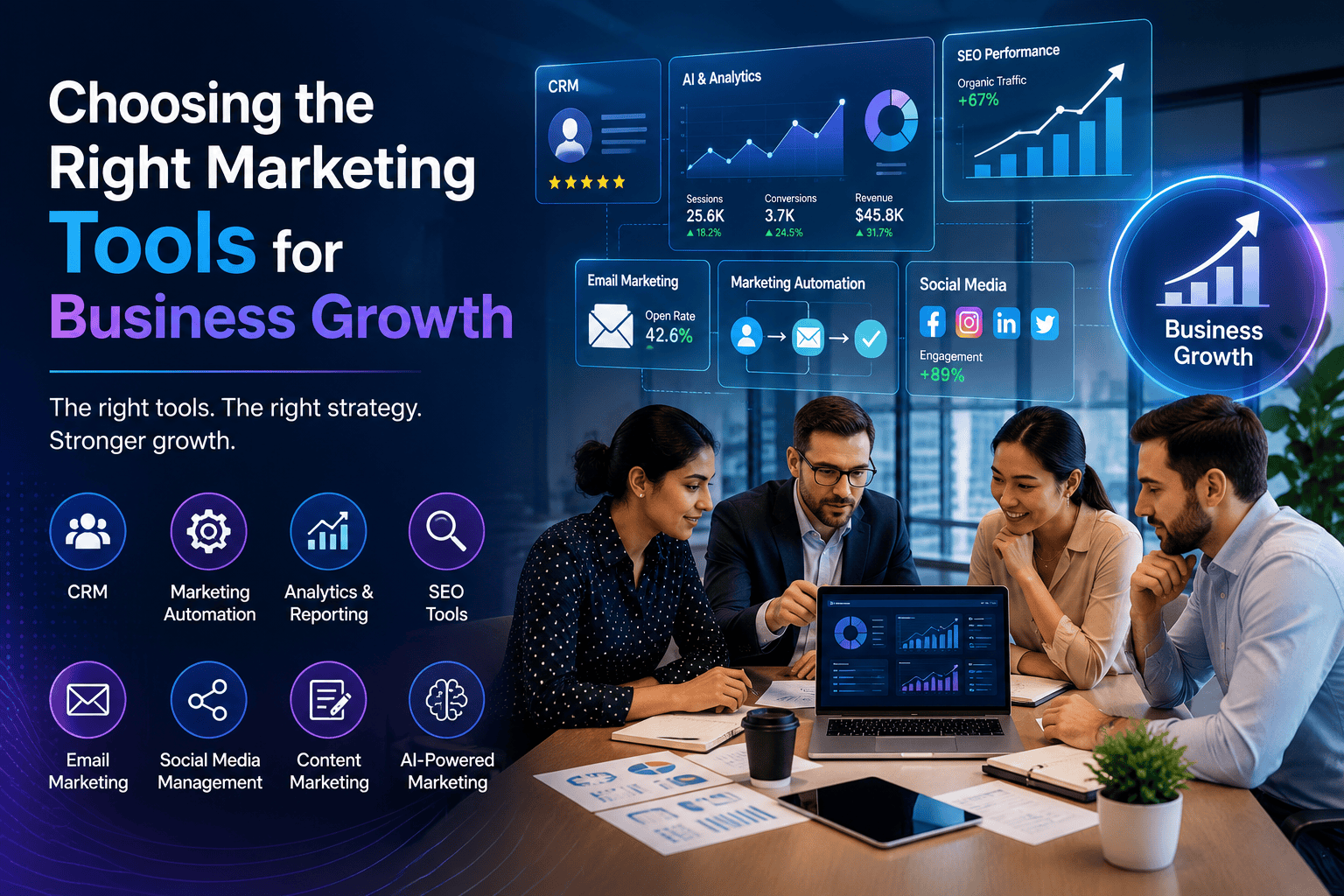
Marketing tools help organizations:
- Automate repetitive marketing activities
- Improve customer engagement
- Generate qualified leads
- Measure campaign performance
- Personalize customer experiences
- Increase operational efficiency
- Improve collaboration between sales and marketing teams
- Make data-driven decisions
Instead of spending time on manual processes, marketing teams can focus on strategy, creativity, and customer relationships.
Start with Your Business Goals
Before investing in any marketing software, businesses should clearly define what they want to achieve.
Common marketing objectives include:
- Increasing website traffic
- Improving lead generation
- Growing email subscribers
- Enhancing customer retention
- Increasing online sales
- Improving campaign ROI
- Automating repetitive workflows
- Strengthening customer relationships
Once these goals are established, selecting appropriate marketing technology becomes much easier.
Essential Types of Marketing Tools
Customer Relationship Management (CRM)
CRM platforms organize customer information in one centralized location. They help businesses manage leads, monitor customer interactions, track sales opportunities, and improve communication across departments.
A well-implemented CRM enables marketing and sales teams to work together using accurate customer data, improving both efficiency and customer satisfaction.
Marketing Automation Platforms
Marketing automation software reduces manual work by automating repetitive marketing tasks.
Typical automation features include:
- Email campaigns
- Lead nurturing
- Customer segmentation
- Workflow automation
- Personalized messaging
- Campaign scheduling
Automation improves consistency while allowing marketers to engage customers at the right time with relevant content.
Analytics and Reporting Tools
Without reliable analytics, businesses cannot determine whether their marketing strategies are successful.
Analytics tools help marketers understand:
- Website traffic
- User behavior
- Conversion rates
- Marketing ROI
- Customer acquisition channels
- Campaign performance
- Audience demographics
Data-driven insights enable businesses to continuously improve marketing performance.
SEO Tools
Search engine optimization remains one of the most cost-effective long-term marketing strategies.
SEO tools assist with:
- Keyword research
- Technical website audits
- Content optimization
- Competitor analysis
- Backlink monitoring
- Rank tracking
Strong SEO increases organic visibility and attracts qualified visitors without relying solely on paid advertising.
Content Marketing Tools
Creating valuable content consistently requires planning and organization.
Content marketing platforms support:
- Editorial calendars
- Content collaboration
- Publishing workflows
- Performance tracking
- Content optimization
These tools help businesses maintain consistent communication with their audience.
Email Marketing Software
Email marketing continues to deliver one of the highest returns on investment among digital marketing channels.
Modern email platforms offer:
- Automated campaigns
- Personalized emails
- Customer segmentation
- A/B testing
- Performance reporting
- Subscriber management
Relevant email communication strengthens customer relationships and encourages repeat business.
Social Media Management Platforms
Managing multiple social channels manually consumes valuable time.
Social media tools simplify:
- Content scheduling
- Engagement monitoring
- Analytics
- Team collaboration
- Campaign management
- Brand monitoring
These capabilities help maintain a consistent online presence.
AI-Powered Marketing Solutions
Artificial Intelligence is transforming marketing by helping businesses process large amounts of customer data and automate complex decision-making.
AI marketing tools support:
- Predictive analytics
- Customer segmentation
- Content recommendations
- Personalized marketing
- Chatbots
- Lead scoring
- Campaign optimization
Rather than replacing marketers, AI enhances productivity by allowing teams to focus on strategic activities.
Key Factors to Consider Before Choosing Marketing Tools
Ease of Use
Software should be intuitive and easy for teams to adopt. Complex systems often result in low adoption rates and reduced productivity.
Integration Capabilities
Marketing platforms should integrate seamlessly with existing systems such as CRM, analytics platforms, advertising tools, and content management systems.
Connected systems reduce manual work and improve data accuracy.
Scalability
Business needs evolve over time.
Choose marketing technology that can support future growth without requiring a complete replacement as your organization expands.
Data Security
Marketing platforms handle valuable customer information.
Ensure software providers maintain strong security practices, regulatory compliance, and reliable data protection measures.
Reporting Features
Effective marketing decisions require accurate reporting.
Look for platforms offering customizable dashboards, campaign reports, attribution analysis, and real-time insights.
Customer Support
Reliable technical support reduces downtime and helps teams resolve issues quickly.
Training resources, documentation, and onboarding assistance are equally important.
Common Mistakes Businesses Should Avoid
Many organizations fail to maximize their marketing technology investments because they make avoidable mistakes.
Some common examples include:
- Purchasing tools without a strategy
- Using too many disconnected platforms
- Ignoring employee training
- Focusing only on price
- Overlooking integration capabilities
- Failing to measure ROI
- Neglecting data quality
- Choosing features that are never used
Avoiding these mistakes improves long-term marketing performance.
Building a Modern Marketing Technology Stack
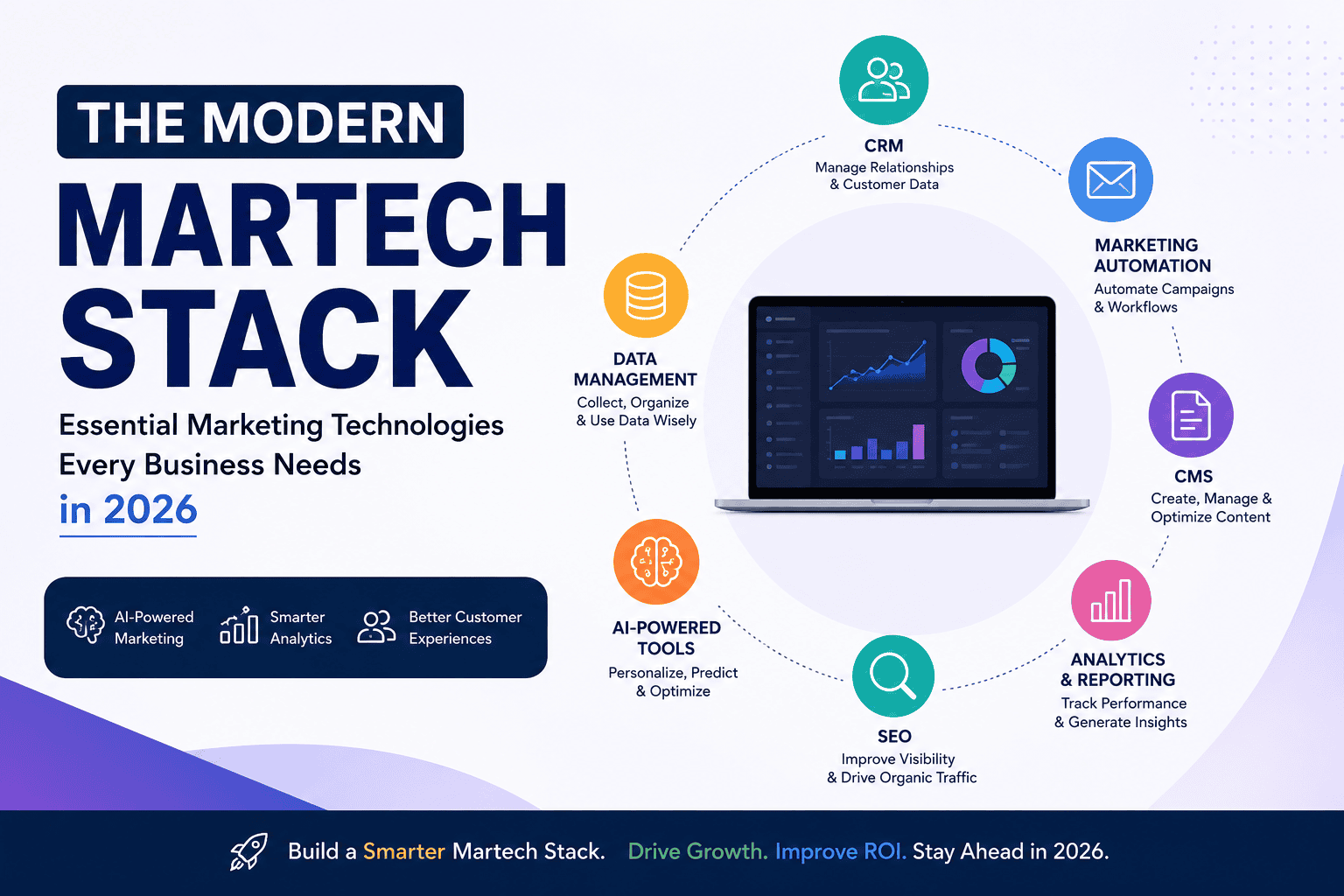
An effective marketing technology stack may include:
- CRM platform
- Marketing automation software
- Analytics solution
- SEO tools
- Email marketing platform
- Social media management platform
- Content management system
- AI-powered marketing tools
The exact combination depends on business size, industry, customer needs, and marketing objectives.
Benefits of Choosing the Right Marketing Tools
Organizations that invest in appropriate marketing technology often experience:
- Better customer experiences
- Higher campaign performance
- Improved lead quality
- Increased operational efficiency
- Stronger collaboration
- Better decision-making
- Higher marketing ROI
- Sustainable business growth
Rather than replacing marketing expertise, technology enables teams to work smarter and deliver more personalized customer experiences.
Conclusion
Selecting the right marketing tools is one of the most important decisions a business can make in today’s digital landscape. The ideal technology stack is not determined by popularity or the number of features a platform offers. Instead, it should align with your business goals, integrate smoothly with existing systems, support future growth, and provide meaningful insights that improve marketing performance.
Businesses that carefully evaluate their marketing technology investments can streamline operations, strengthen customer relationships, improve campaign effectiveness, and achieve sustainable growth. As digital marketing continues to evolve, choosing flexible, scalable, and data-driven solutions will help organizations remain competitive and adapt to changing customer expectations.
Instead of chasing every new marketing trend, focus on building a technology ecosystem that empowers your team, supports informed decision-making, and delivers measurable business value.
Frequently Asked Questions (FAQs)
1. What are marketing tools?
Marketing tools are software solutions that help businesses manage marketing activities such as CRM, SEO, email marketing, automation, analytics, content creation, and social media management.
2. Why are marketing tools important for business growth?
They improve efficiency, automate repetitive tasks, provide customer insights, enhance engagement, and help businesses make data-driven decisions.
3. How do I choose the right marketing tool?
Start by identifying your business goals, evaluating your budget, checking integration capabilities, ensuring scalability, and selecting platforms that meet your long-term needs.
4. Can small businesses benefit from marketing tools?
Yes. Many affordable marketing platforms help small businesses improve productivity, generate leads, and compete effectively in digital markets.
5. Are AI-powered marketing tools worth investing in?
AI tools can improve personalization, automate workflows, optimize campaigns, and provide predictive insights, making them valuable for businesses seeking long-term growth.