








In today’s competitive business environment, building lasting customer relationships is no longer optional – it’s essential for sustainable growth. Customers expect personalized experiences, timely communication, and seamless interactions across every touchpoint. Businesses that consistently meet these expectations are more likely to retain customers, increase loyalty, and generate long-term revenue.
This is where Customer Relationship Management (CRM) plays a vital role. A CRM system is more than a database for storing customer information; it is a strategic platform that helps organizations understand customer behavior, improve communication, streamline sales processes, and deliver exceptional customer experiences.
However, simply implementing CRM software is not enough. Success depends on how effectively your business uses it. By following proven CRM best practices, organizations can transform customer data into meaningful relationships and measurable business results.
In this guide, we’ll explore the most effective CRM best practices that help businesses strengthen customer relationships while improving sales, marketing, and customer service performance.
What Is CRM?
Customer Relationship Management (CRM) is a business strategy supported by technology that enables organizations to manage interactions with current and potential customers throughout the customer lifecycle.
A CRM platform centralizes customer information such as:
- Contact details
- Purchase history
- Sales activities
- Email interactions
- Support requests
- Customer preferences
- Marketing engagement
This unified view allows teams to provide consistent, personalized experiences while improving collaboration across departments.
Why CRM Matters for Customer Relationships
Customers today interact with businesses through multiple channels, including websites, social media, email, mobile apps, and customer support. Without a centralized system, maintaining consistency becomes difficult.
An effective CRM helps businesses:
- Deliver personalized communication
- Build customer trust
- Improve response times
- Increase customer satisfaction
- Enhance customer loyalty
- Support data-driven decision-making
- Improve collaboration between sales, marketing, and support teams
Ultimately, CRM helps businesses shift from transactional interactions to long-term relationships.
CRM Best Practices Every Business Should Follow
1. Define Clear CRM Goals
Before implementing or optimizing your CRM, establish measurable objectives.
Examples include:
- Increase customer retention
- Improve lead conversion
- Shorten sales cycles
- Enhance customer satisfaction
- Increase repeat purchases
- Improve marketing ROI
Clear goals help ensure your CRM strategy aligns with business priorities.
2. Maintain Accurate Customer Data
Your CRM is only as valuable as the quality of the data it contains.
Best practices include:
- Remove duplicate records
- Update customer information regularly
- Standardize data entry formats
- Validate contact information
- Archive inactive records
Clean data enables better segmentation, reporting, and personalization.
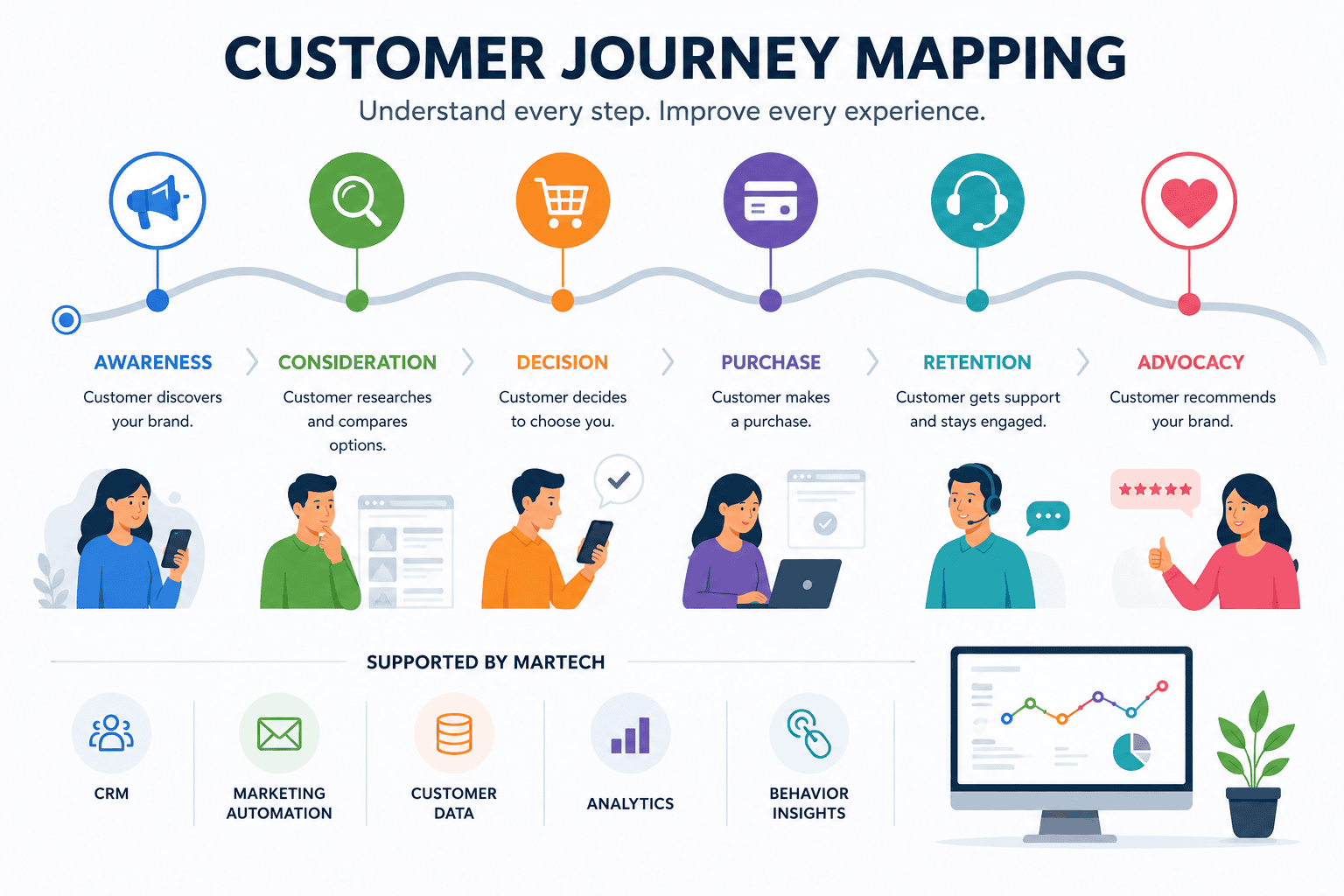
3. Understand Your Customer Journey
Every customer interacts with your business differently.
Map each stage of the journey:
- Awareness
- Consideration
- Purchase
- Onboarding
- Engagement
- Retention
- Advocacy
Tracking these stages helps deliver the right message at the right time.
4. Segment Your Customers
Not all customers have the same needs.
Create customer segments based on:
- Industry
- Location
- Purchase history
- Customer lifetime value
- Product interest
- Engagement level
- Company size
Segmentation enables more relevant communication and better campaign performance.
5. Personalize Customer Communication
Personalization may include:
Modern customers expect businesses to understand their preferences.
- Product recommendations
- Personalized emails
- Customized offers
- Birthday or anniversary messages
- Relevant educational content
Personalized experiences strengthen trust and increase engagement.
6. Automate Routine Tasks
CRM automation saves time while improving consistency.
Automate processes such as:
- Welcome emails
- Lead assignment
- Follow-up reminders
- Sales notifications
- Customer onboarding
- Renewal reminders
- Feedback requests
Automation allows teams to focus on relationship building rather than repetitive tasks.
7. Integrate CRM with Your Martech Stack
A CRM becomes significantly more valuable when connected with other marketing technologies.
Common integrations include:
- Marketing automation platforms
- Email marketing tools
- Customer support software
- Analytics platforms
- Social media management tools
- E-commerce platforms
Integration creates a unified customer experience across channels.
8. Encourage Team Collaboration
Customer information should not remain isolated within one department.
Ensure:
- Sales teams update opportunities
- Marketing teams record campaign engagement
- Support teams log service interactions
A shared CRM provides complete customer visibility.
9. Monitor Customer Engagement
Track customer activity regularly.
Important metrics include:
- Email opens
- Website visits
- Product usage
- Purchase frequency
- Support requests
- Event participation
These insights help identify opportunities for proactive engagement.
10. Measure CRM Performance
Monitor key performance indicators such as:
- Customer Retention Rate
- Customer Lifetime Value (CLV)
- Lead Conversion Rate
- Sales Pipeline Growth
- Customer Satisfaction (CSAT)
- Net Promoter Score (NPS)
- Revenue per Customer
Regular analysis helps optimize your CRM strategy.
Common CRM Mistakes to Avoid
Many businesses fail to maximize CRM value because they:
- Treat CRM as only a contact database.
- Ignore data quality.
- Fail to train employees.
- Overcomplicate workflows.
- Neglect customer segmentation.
- Avoid automation opportunities.
- Rarely review CRM performance.
- Operate with disconnected systems.
Avoiding these mistakes improves both operational efficiency and customer relationships.
How Martech Enhances CRM
CRM works best as part of a broader marketing technology ecosystem.
Martech solutions extend CRM capabilities by enabling:
- Marketing automation
- AI-driven personalization
- Customer analytics
- Predictive lead scoring
- Behavioral segmentation
- Omnichannel communication
- Performance reporting
Together, CRM and Martech create a more connected, data-driven customer experience.
Emerging CRM Trends
Businesses are increasingly adopting advanced CRM capabilities, including:
- AI-powered customer insights
- Predictive analytics
- Conversational AI
- Customer Data Platform (CDP) integration
- Real-time personalization
- Privacy-first customer data management
- Voice of Customer (VoC) analytics
Organizations that embrace these innovations are better positioned to build stronger customer relationships in the years ahead.
Benefits of Following CRM Best Practices
Implementing CRM best practices helps businesses:
- Build stronger customer trust
- Increase customer retention
- Improve lead conversion
- Deliver personalized experiences
- Enhance collaboration across teams
- Improve operational efficiency
- Increase marketing ROI
- Support sustainable business growth
These benefits extend beyond customer satisfaction and contribute directly to long-term profitability.
Conclusion
CRM is more than a technology platform – it is the foundation of effective customer relationship management. Businesses that maintain accurate customer data, personalize interactions, automate repetitive tasks, and integrate CRM with their broader Martech ecosystem are better equipped to deliver meaningful customer experiences.
As customer expectations continue to evolve, organizations that adopt CRM best practices will be able to strengthen loyalty, improve retention, and drive sustainable business growth. Investing in CRM is not simply about managing contacts; it is about creating lasting relationships that fuel long-term success.
Frequently Asked Questions
1. What are the best CRM practices for better customer relationships?
The best CRM practices include keeping customer data accurate, personalizing communication, tracking interactions, following up consistently, and using customer insights to improve engagement.
2. How can CRM software improve customer relationships?
CRM software helps businesses organize customer information, understand customer needs, manage interactions, automate follow-ups, and provide more consistent and personalized experiences.
3. Why is accurate customer data important in CRM?
Accurate customer data helps teams make informed decisions, deliver relevant communication, avoid duplicate records, and maintain a clear view of each customer’s interactions and preferences.
4. How often should businesses review their CRM strategy?
Businesses should review their CRM strategy regularly to identify data-quality issues, improve workflows, evaluate customer engagement, and ensure the CRM continues to support changing business and customer needs.