








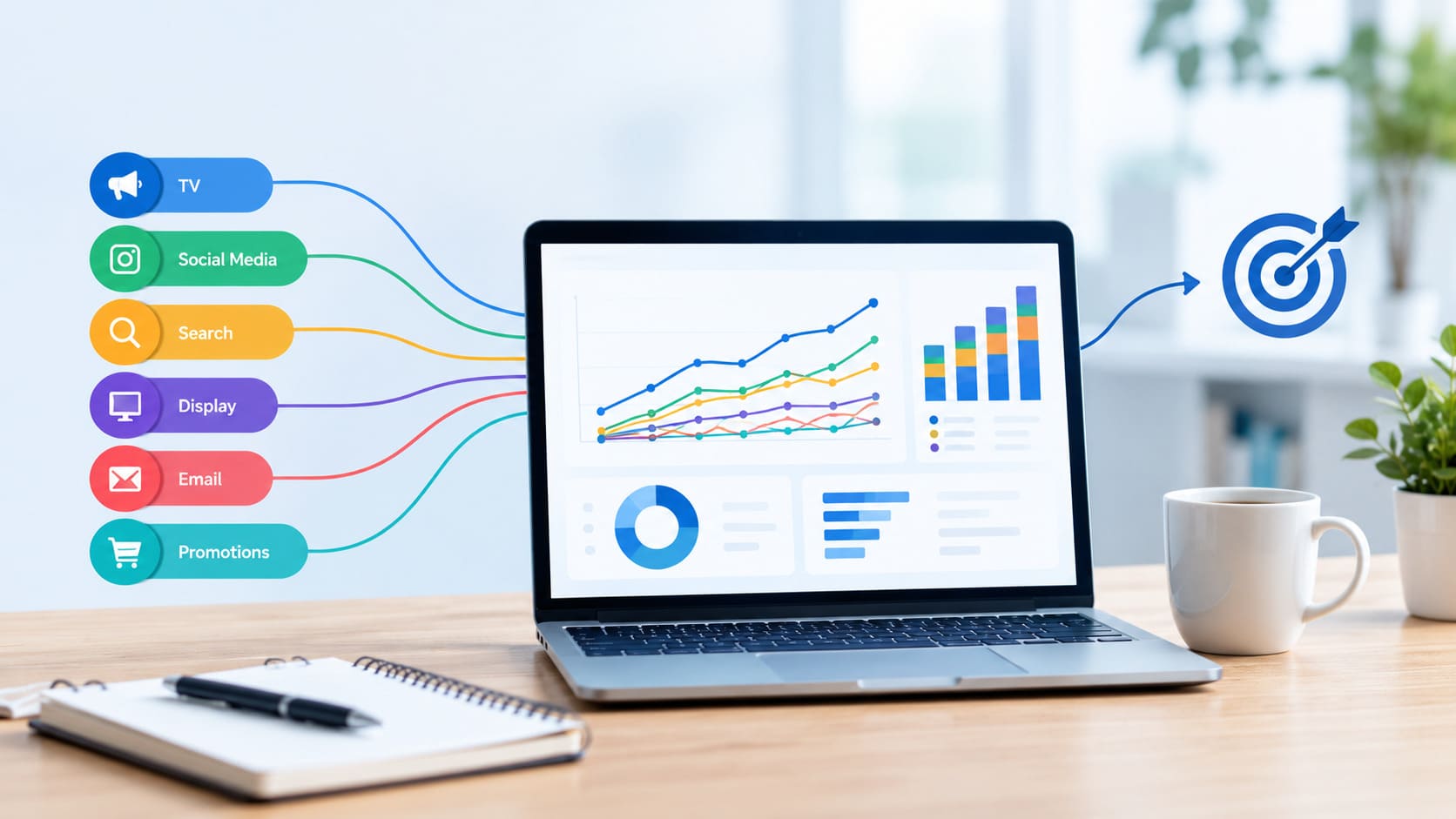
Every business wants to know whether its marketing investments are delivering meaningful results. Companies spend money on social media advertising, search campaigns, email marketing, television commercials, and other promotional activities. However, understanding which efforts actually influence sales can be more complicated than it seems.
A campaign may generate thousands of clicks but produce very few purchases. Another channel may receive less attention while quietly contributing to a significant share of revenue. Without a clear way to evaluate these differences, marketers risk investing in activities that look successful on the surface but do not deliver the expected business outcomes.
This is where Marketing Mix Modeling (MMM) becomes useful. It helps businesses analyze historical data to understand how different marketing channels and external factors influence performance. Instead of relying only on clicks or last-touch attribution, companies can develop a broader view of what drives their results.
What Is Marketing Mix Modeling?
Marketing Mix Modeling is a statistical method used to estimate how different marketing activities contribute to business outcomes, such as sales, revenue, or customer demand.
It examines historical information about marketing spending, campaign activity, sales performance, and other relevant variables. These variables may include seasonal changes, pricing decisions, economic conditions, holidays, and competitor activity.
For example, a retailer might notice that sales increase during a holiday season. Marketing Mix Modeling can help estimate how much of that increase is associated with advertising and how much may be explained by seasonal demand or other influences.
The goal is not simply to identify which channel received the most attention. It is to understand which activities appear to contribute to business performance and how marketing resources might be allocated more effectively.
Why Traditional Marketing Measurement Is Not Always Enough
Many marketing teams use platform dashboards to measure campaign performance. These tools provide useful information, including impressions, clicks, conversions, and advertising costs. However, each platform generally measures activity within its own environment.
This creates a challenge when customers interact with several channels before making a purchase.
Imagine someone who sees a brand’s social media advertisement, searches for the product on Google, reads an email, and eventually buys the product after visiting the website directly. Different platforms may claim credit for parts of this journey, making it difficult to determine the overall contribution of each channel.
Marketing Mix Modeling approaches the problem from a broader perspective. It analyzes aggregated historical data rather than depending entirely on individual customer-level tracking. This makes it useful for understanding performance across multiple channels, including some offline activities.
MMM does not eliminate the need for other measurement methods. Instead, it can complement attribution reporting, conversion tracking, and controlled experiments to create a more complete picture.
How Marketing Mix Modeling Works
Marketing Mix Modeling usually follows a structured process that turns historical business data into actionable insights.
1. Collect Relevant Marketing and Sales Data
The process begins with gathering reliable information. Businesses may collect advertising expenditure, impressions, campaign dates, sales figures, product prices, promotional activity, and historical demand.
Data quality matters because incomplete or inconsistent records can weaken the model’s results. Marketing teams should align reporting periods, verify figures, and ensure that the data represents the business activity being measured.
2. Identify Important Business Influences
Sales rarely depend on advertising alone. Seasonal demand, discounts, product availability, economic changes, and competitor promotions can also affect customer behavior.
A useful model considers these factors wherever reliable data is available. This helps reduce the risk of attributing every sales increase or decline to marketing activity.
3. Analyze the Relationship Between Marketing and Outcomes
Statistical techniques are used to estimate the relationship between marketing activity and business performance.
The model may account for advertising carryover, sometimes called the adstock effect. This reflects the idea that an advertisement can influence customer decisions beyond the day it appears.
It may also consider diminishing returns. For instance, doubling an advertising budget does not necessarily double sales. Once a campaign reaches much of its relevant audience, additional spending may produce smaller gains.
4. Estimate Channel Contributions
After analyzing the data, the model estimates how much each marketing channel may have contributed to the measured outcome.
A business might discover that paid search captures existing demand effectively, while video advertising helps generate awareness over a longer period. These findings can help marketers understand the different roles channels play in the customer journey.
The estimates should be interpreted carefully. A statistical relationship alone does not prove that a marketing activity caused a particular result.
5. Use the Findings to Improve Budget Decisions
The final step is turning the results into practical decisions. Marketing teams can compare potential budget allocations, estimate possible outcomes, and identify opportunities to improve efficiency.
These recommendations should be tested against real-world results whenever possible. Businesses should also update their models as customer behavior, competition, and marketing strategies change.
Key Benefits of Marketing Mix Modeling
Better Marketing Budget Allocation
MMM helps businesses evaluate how spending across different channels relates to overall performance. Rather than distributing budgets based only on clicks or impressions, marketers can consider estimated business contributions and potential returns.
A Broader View of Campaign Performance
Some marketing activities influence customers without generating an immediate click or conversion. MMM can help assess channels such as television, outdoor advertising, and brand campaigns when suitable data is available.
Improved Long-Term Planning
Historical patterns can reveal how seasonality, advertising pressure, pricing, and promotions relate to sales. These insights can support planning for upcoming campaigns, product launches, and seasonal demand.
More Informed Performance Discussions
Marketing teams often need to explain their spending decisions to business leaders. MMM can provide a consistent analytical framework for discussing channel contributions, return on investment, and possible budget changes.
Greater Privacy-Friendly Measurement
Because traditional MMM generally works with aggregated data rather than individual-level browsing histories, it can support measurement when access to personal tracking data is limited. However, its usefulness still depends on data quality, model design, and the business questions being asked.
Marketing Mix Modeling in a Real-World Scenario
Consider an online retailer that invests in paid search, social media advertising, email marketing, and video campaigns.
At first, the company evaluates success mainly through platform-reported conversions. Paid search appears to perform exceptionally well, so the team considers moving more of the budget into that channel.
Before making the change, the company uses Marketing Mix Modeling to examine historical sales, marketing expenditure, discounts, seasonal trends, and other available business data.
The analysis suggests that paid search plays an important role in converting customers who are already interested in buying. Meanwhile, video advertising may help build demand earlier in the customer journey. Seasonal promotions also explain part of the sales increase that initially appeared to come from advertising alone.
With this broader understanding, the company can evaluate its budget more carefully. Rather than cutting video campaigns immediately, it can test different spending levels and compare the results.
This example illustrates the value of MMM: it helps marketers consider the wider business context before making decisions based on a single dashboard.
Marketing Mix Modeling vs. Marketing Attribution
Marketing Mix Modeling and marketing attribution both help businesses understand marketing performance, but they answer different questions.
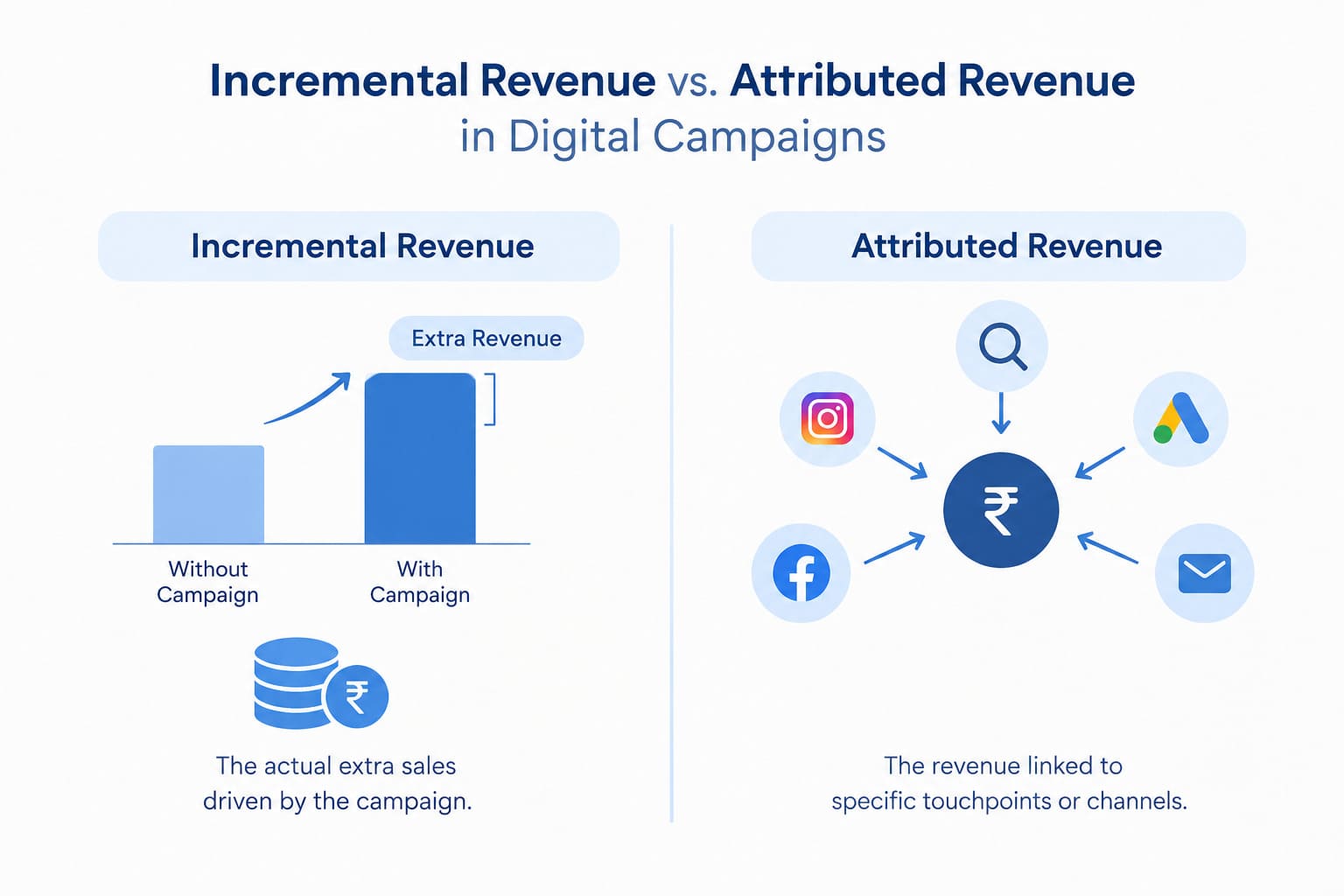
Marketing attribution typically assigns credit to customer interactions or touchpoints associated with a conversion. Depending on the method, it may use first-touch, last-touch, or multi-touch attribution.
Marketing Mix Modeling generally analyzes aggregated historical data to estimate the relationship between marketing activity and overall business outcomes.
MMM can be particularly useful for evaluating broad channel effects, offline advertising, and external influences. Attribution can offer more detailed insight into tracked digital customer journeys.
Neither approach is universally superior. The best measurement strategy depends on the business model, data availability, privacy requirements, and decisions marketers need to make. Combining MMM with attribution and incrementality experiments can provide stronger evidence than relying on any single method.
Common Challenges Businesses Should Understand
Despite its benefits, Marketing Mix Modeling is not a perfect measurement system.
Data quality: Missing campaign records, inconsistent reporting periods, and inaccurate sales figures can reduce reliability.
Limited historical variation: If a company always spends heavily on one channel and never changes its investment, it may be difficult to distinguish that channel’s contribution from other influences.
Changing market conditions: Consumer preferences, competitors, and advertising platforms evolve. A model based on older data may not accurately reflect current behavior.
Complex interpretation: Model results can be difficult to understand without appropriate analytical expertise. Estimates should be explained in clear business terms, including their uncertainty and limitations.
Correlation versus causation: A model can identify relationships in historical data, but those relationships do not automatically prove that advertising caused the observed outcome. Experiments and other validation methods can help strengthen confidence in the findings.
Recognizing these limitations helps businesses use MMM as a decision-support tool rather than treating its estimates as unquestionable facts.
Best Practices for Getting More Value From Marketing Mix Modeling
Businesses can improve the usefulness of MMM by following a few practical principles.
- Start with a clear objective: Decide whether the priority is improving return on marketing investment, planning budgets, understanding channel contributions, or forecasting sales.
- Maintain consistent data: Establish reliable reporting processes for marketing expenditure, sales, promotions, and other relevant variables.
- Include meaningful external factors: Account for seasonality, pricing, distribution changes, and other influences when suitable data is available.
- Validate the findings: Compare model estimates with controlled experiments, historical patterns, and other credible measurement approaches.
- Update the model regularly: Revisit assumptions and estimates when market conditions or marketing strategies change.
- Communicate results clearly: Explain what the analysis suggests, how uncertain the estimates are, and which decisions the findings can reasonably support.
These practices make the analysis easier to interpret and help teams connect measurement with actual business decisions.
The Future of Marketing Mix Modeling
Marketing Mix Modeling continues to evolve as businesses look for more reliable ways to measure marketing effectiveness. Modern approaches increasingly use automated data preparation, faster model development, scenario planning, and tools that make results easier to explore.
Open-source frameworks and commercial measurement platforms can also make MMM more accessible to organizations that previously lacked the resources to build complex statistical models from scratch.
However, technology alone cannot guarantee accurate results. Sound statistical methods, reliable data, relevant business knowledge, and ongoing validation remain essential.
As marketing channels become more interconnected and privacy expectations continue to influence measurement practices, MMM can play an important role in helping businesses evaluate performance at a broader level.
Conclusion
Marketing Mix Modeling gives businesses a way to look beyond surface-level campaign metrics and examine the factors associated with sales and revenue. By considering advertising expenditure, seasonal demand, pricing, promotions, and other influences, it helps marketers develop a more balanced understanding of campaign performance.
Its greatest value lies in supporting better decisions, not producing a single perfect number. When combined with attribution, experimentation, and reliable business data, MMM can help marketing teams evaluate their investments more thoughtfully and plan future campaigns with greater confidence.
For organizations aiming to make marketing measurement more meaningful, Marketing Mix Modeling offers a practical framework for connecting campaign activity with wider business outcomes.
Frequently Asked Questions
1. What is Marketing Mix Modeling?
Marketing Mix Modeling is a statistical approach that helps businesses measure how marketing activities influence sales and revenue.
2. How does Marketing Mix Modeling work?
It analyzes historical marketing spending, sales data, seasonal trends, and other factors to estimate the contribution of different channels.
3. What are the benefits of Marketing Mix Modeling?
It helps marketers improve budget allocation, understand channel performance, plan campaigns, and make data-driven decisions.
4. How is MMM different from marketing attribution?
MMM analyzes aggregated data to estimate broader marketing effects, while attribution assigns credit to customer interactions along the conversion journey.
5. Can Marketing Mix Modeling improve marketing ROI?
Yes. It can identify opportunities to use marketing budgets more effectively, although results depend on data quality and implementation.